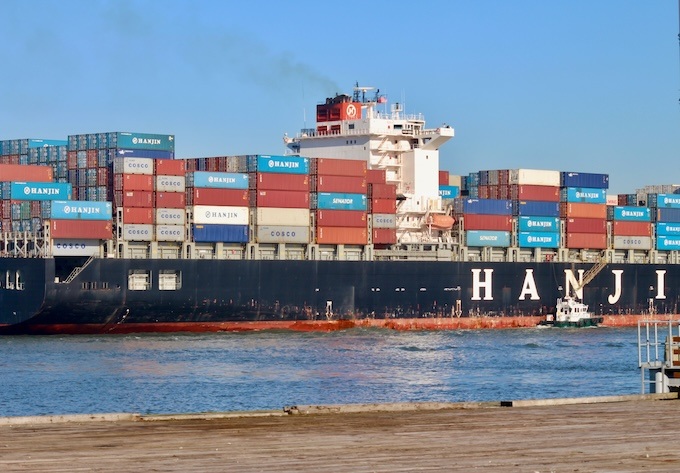
Trans-oceanic container ship, Columbia River, Rainier, Oregon. Photo: Jeffrey St. Clair.
The falling U.S. share of the world economy (40 percent in 1960 versus 25 percent in 2026) is a driving force of economic nationalism stateside. Its rhetoric under President Trump is America First, with abundant use of sanctions, tariffs and war (directly [Iran] and by proxy [Israel and Ukraine]). On the note of warfare, the president has used military operations abroad as did Presidents Clinton, Obama and Biden since the fall of the former Soviet Union on December 26, 1991, heralding a big change in the world order.
Another landmark change in the global order is China’s share of the world economy (3.5-4 percent in 1960 versus 19-20 percent in 2026). Currently, China is a manufacturing world power. The nation is also blessed with a bevy of natural resources such as rare earth minerals like erbium and yttrium. Advanced electronics and artificial intelligence, prominent industries stateside in 2026, rely upon these two heavy elements.
Accordingly, given the history of U.S. militarism and racism against Asians, the contradictions of economic nationalism, the America First rhetoric are plentiful. President Trump refers to America’s interest as “ours” and “we” when he speaks of other nations cheating the U.S. This is a bid to unite the class interests of elites (billionaires and corporations, key donors to Democrats and Republicans) with workers. Thus, the economic rise of China is a big target of distortion.
China’s prominent trading partners help to form the grouping of BRICS (Brazil, Russia, India, China and South Africa) nations. There is a BRICS summit in New Delhi, India, set for September 12-13.
Speaking of military operations, U.S. Treasury Secretary Scott Bessent announced increased economic warfare against Iran plus any countries doing business with that Persian nation; the Shanghai Cooperation Organization met in Kyrgyzstan. Nations’ heads of state attending this gathering ranged from China, Russia, India, Iran and Pakistan to Belarus, Kazakhstan, Kyrgyzstan, Tajikistan and Uzbekistan. The SCO also addressed measures to counter Uncle Sam’s deeds worldwide, including the U.S. war against Iran and Israel’s genocide of Palestinians.
In the SCO’s Bishkek declaration, the members also pledged to “support and strengthen an open, transparent, fair, inclusive, and non-discriminatory multilateral trading system based on generally accepted international principles and rules that promotes global economic development, ensures fair market access, and ensures special and differential treatment for developing countries.” Uncle Sam is looking at challenges to it alone, calling the shots of a world order that gets its marching orders from Washington, DC. Meanwhile, the U.S. is pursuing attempts to dominate other nations to boost the bottom line of America’s elites.
Think of Uncle Sam’s taking of Venezuelan oil reserves, the details of which are emerging glacially. Then there’s the talk from Washington of the U.S. using tactical nuclear weapons to subdue Iran. The president has been threatening to take Greenland. He has also launched a trade war against Canada, a major U.S. trading partner, claiming the neighbor to the north has been unfairly treating America.
Recall the president’s premise for his America First approach to jobs and economic gains? U.S. global trade partners had been ripping off America. He was going to solve that problem, draining the swamp of Washington insider corruption, and so on. Wait. What?
For starters, U.S. industry made the call to move abroad. To be clear, the deindustrialization of the Midwest and Northeast was a bipartisan priority that the political establishment facilitated, based on decisions made in corporate boardrooms. Democrats and Republicans supported corporate America moving production abroad to pursue higher returns on investment and weaker environmental policies.
Placing the drive for profits before the needs of the human population is the normal operation of the capitalist system. Ruling class interests use two-party politics to craft laws and policies that benefit elites, billionaires and corporations.
The contradictions of economic nationalism and the world order are growing. An affordability crisis of working and poor people stateside as their tax dollars flow away from them and into the congressional-military-industrial complex, is the tip of a proverbial iceberg. The worsening climate crisis that profits billionaires and corporations in the short term, as the political duopoly facilitates this ecocide, is a wake-up call for movement politics.