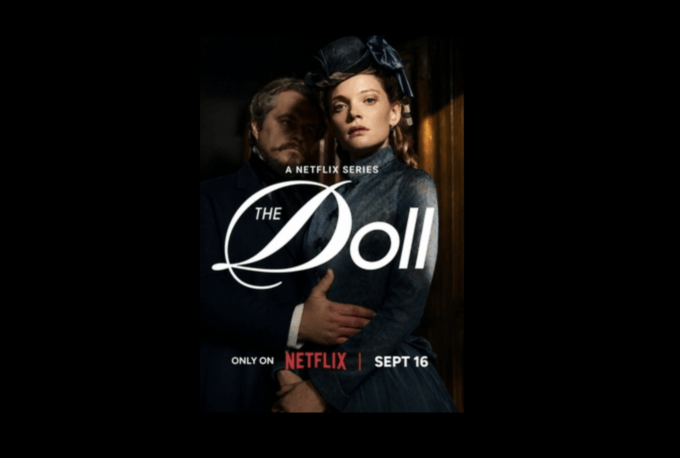
Source: Netflix poster – Fair Use
“The history of all hitherto existing society is the history of class struggles. Freeman and slave, patrician and plebeian, lord and serf, guild-master and journeyman, in a word, oppressor and oppressed.”
–Karl Marx
No, it’s not Ibsen’s feminist three-act play A Doll’s House and it’s not Harriet Arnow’s working class novel The Doll Maker. It’s the new Netflix series, The Doll (Lalka in Polish), inspired by the novel of the same name by Boleslaw Prus, a troublemaker born in Poland in 1847. A foe of the tsar and imperial Russia, Prus was arrested and imprisoned for his revolutionary activities. He wrote The Doll, a most revolutionary novel, in the late 1880s. Poet and social critic Czeslaw Milosz, the author of The Captive Mind, has called it the greatest of all Polish novels. Wikipedia describes it as a work that “exposes the social inequalities, class divisions and contradictions of 19th century Warsaw.” The Netflix series takes up these same themes and brings them to the screen triumphantly.
The Dollalso offers oodles of eye candy for viewers who are enthralled with costume melodramas. But anyone and everyone with a brain will watch it for the narrative it offers about the clash between the emerging bourgeoisie and the declining aristocracy. True, the aristocracy and the bourgeoisie are no longer at one another’s throats the way they once were before capitalism and capitalists seized control of power and wealth in Europe. In that sense it’s not timely. Still, there’s a kind of universality and contemporaneity at work in this drama. By looking at the past, The Doll hints at the present and suggests the future.
As Marx observed in The Communist Manifesto: “The history of all hitherto existing society is the history of class struggles. Freeman and slave, patrician and plebeian, lord and serf, guild-master and journeyman, in a word, oppressor and oppressed.” He might have added that the future of all societies will be the story of the clash between oppressor and oppressed. In The Doll the aristocrats are a dying breed. The members of the bourgeoisie are ascending, though they meet opposition.“Power concedes nothing without a demand,” Frederick Douglass wrote. Or without a struggle one might add.
The creators of the The Doll— Pawel Demirski, Jagoda Dutkiewicz and Pawel Maslona —probably didn’t crib their scenario from The Communist Manifesto, but it sure looks, sounds and feels that way. Let’s be clear there’s no copyright infringement. Ideas can’t be copyrighted. Besides, Marx and Engels didn’t bother registering their work with a copyright office, and Demirski, Dutkiewicz and Maslona offer an original take on an old theme explored by Balzac, Zola and Stendhal.
The Doll offers workers and their cause as well as emancipated women in rebellion against the Polish patriarchy. But the real action is between Stanislaw Wokulski (Tomasz Schuchardt), who represents the bourgeoisie, and Izabela Lecka (Sandra Drzymalska) who represents the aristocracy. Drzymalska is amazing whenever she’s in front of the camera. Schuchardt less so. The character he plays is rather stiff. Bela is a wild woman who refuses to be tamed.
“Stan” and “Bela,” as they’re known to friends and family members, are at odds with one another throughout the series and with enough suspense about their futures to make for binge watching. Other couples swirl around them. There’s a horrific rape scene perpetuated by a member of the decadent aristocracy. The working woman who has been raped has her righteous revenge. Plus there’s the crime of arson that demands to be solved, the felon caught and punished, and law and order victorious. The wise chief of police tells a subordinate, “The case will solve itself.” It does indeed.
Stan, the archetypal bourgeois man, has everything that money can buy, everything except a wife. Beautiful Bela has everything he craves and obsesses about; looks, a title, an aristocratic family and valuable properties. If he had his way, he would, in the words of Marx, drown “the most heavenly ecstasies of religious fervor, of chivalrous enthusiasm, of philistine sentimentalism, in the icy water of egotistical calculation.”
Bela’s mercenary, alcoholic money-strapped father wants to find a husband for his daughter, and, while he doesn’t like the bourgeoisie, he’ll accept Stan and his wealth in exchange for his daughter’s hand. Bela is daddy’s property to be sold to the highest bidder.
She plays fast and loose with Stan. She hates him and she loves him, rejects him and accepts him, uses him and abuses him. He pays his agents to spy on her and to report back to him. He objectifies her and violates her privacy. She sees through him and the dangerous game he plays. At a dramatic moment she tells him, “You want a little doll to play with.” She nails it! And at another dramatic moment he says, “the aristocracy has no future.” That’s also true.
The Doll might appear to have been easily made. It moves ahead rapidly and with no real gaffs. But I’m sure it didn’t unroll without challenges. There’s a large cast, revolving scenes, costumes that keep changing, make-up to be applied, cameras to roll and more.
Another new Netflix series, The Leopard, is set in nineteenth century Italy. Garibaldi and his soldiers march on the aristocracy and threaten to unify scattered feudal kingdoms and create the country we know as Italy. The Leopard offers a nice premise, but it doesn’t fulfill its promise. Stick with The Doll unless you crave the grandeur of Italian villas and stuffy aristocrats. Stan and Bela are made for one another and for the ages.