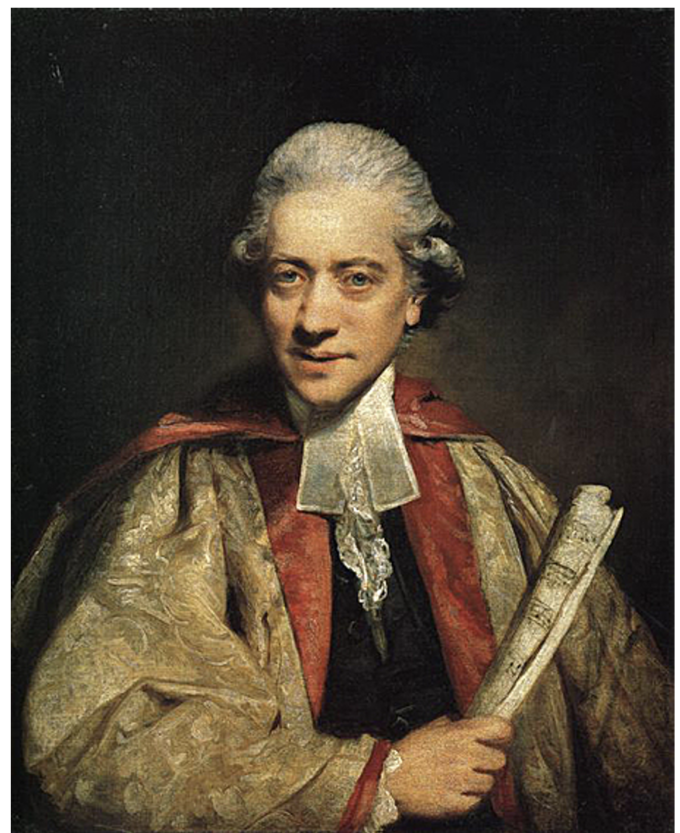
Joshua Reynolds, Dr. Charles Burney, 1781 (National Portrait Gallery, London)
Who among us hasn’t forgotten a wallet or passport or laptop or packed lunch or gift in the taxi or subway on the way to the airport or on the plane after landing at a distant destination?
In his draft journal (now in the British Library) for what would be published a year later in 1771 as The Present State of Music in France and Italy, the music historian Charles Burney, whom his friend Samuel Johnson called the preeminent travel writer of his day, admits that his European research trip began with a self-inflicted delay:
“Tuesday June 5th, 1770. Arrived at Dover in order to embark for France but was detained there by a foolish accident which happened on the road, for having left my sword, that necessary passport for a gentleman on the continent, I thought it of consequence enough to remain at Dover till I recovered it which was not till Wednesday night.”
Psychologists tell us that “prospective memory”—like remembering to remember to pack a toothbrush—is particularly susceptible to disruption by stress.
A 2021 article by Anna Farmaki published in the International Journal of Tourism Research asserts that:
“Even though academic attention has been paid to the tourism-memory nexus, the concept of forgetfulness in tourism has been largely overlooked and remains unexplored.”
A history of the sword in musical manners and practice has yet to be written.
Forgetting your sword in 1770 was no small matter, not so much because of the hardware’s usefulness in fending off highwaymen (a persistent problem on the Grand Tour and for English travelers even on the road from London to Dover) but for what the weapon symbolized, the status it represented even if never drawn.
How could one be a gentleman—or play at being one—never mind make his way across the continent to consort with aristocrats and diplomats, musical and scientific celebrities, if he couldn’t even keep his sword at his side or in his luggage?
Lord Chesterfield’s popular and influential Letters to His Son, written across the mid-18th century but published posthumously in 1774, malign a young nobleman who constantly misplaces his sword. Chesterfield warns his own heir not to do the same.
The classic Rudiments of Genteel Behavior by the transplanted French dancing master François Nivelon paid meticulous attention to the fashionable treatment of the sword: “the Hat should be plac’d easy under the left Arm, and that Wrist must be free and strait, and the Hand support itself above the Sword-hilt; the Sword exactly plac’d as shewn in this Figure, is the only proper and genteel Situation for it.”
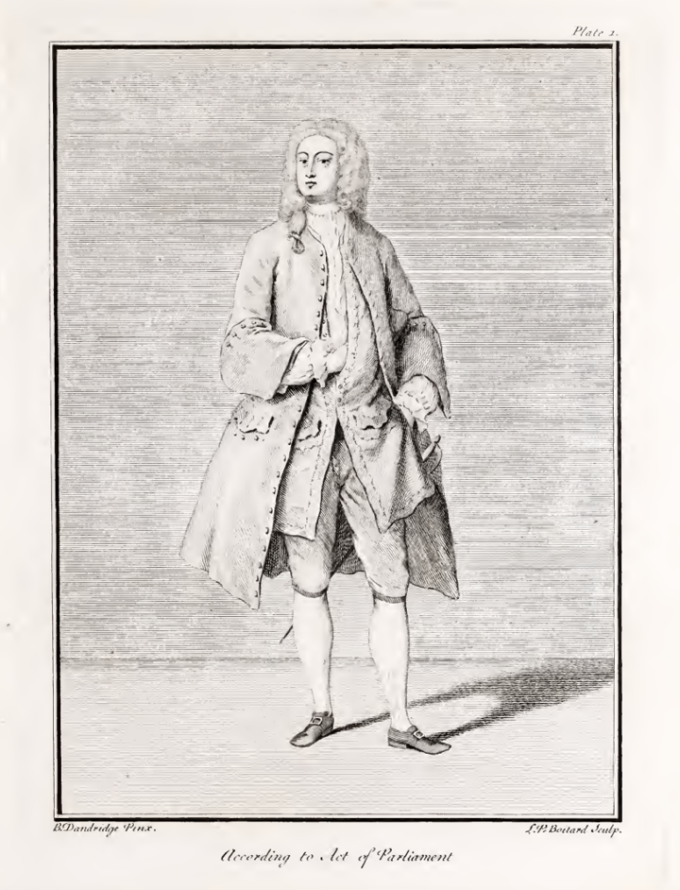
François Nivelon, The Rudiments of Genteel Behavior (London, 1737).
A musician’s sword was not only for show.
After returning to his native Hamburg after a curtailed sojourn in Holland, Johann Mattheson, that great man of musical letters of the first half of the eighteenth century, claims to have been stalked and maligned by a local organist. The feud culminated in a “duel in an open field” on the morning of July 9th, 1704. Mattheson’s enviable education in music, mathematics, modern and ancient languages included tuition in dancing and fencing. In that dawn clash, Mattheson wounded his adversary in the right arm. Both men’s seconds agreed that he was not fit to go on. Mattheson won a non-lethal victory.
Another one followed later that year when George Frideric Handel and Mattheson drew their swords against one another in front of the Hamburg Opera. During the just-concluded performance of Mattheson’s Cleopatra, Handel had refused to yield the director’s harpsichord to the work’s composer when the latter returned to the orchestra after having died on stage as Mark Antony. Once again Mattheson proved the superior swordsman, Handel’s life spared—according to his memoir—by a thick score tucked inside his jacket. (Mattheson’s account says it was a brass button that prevented his blade from piercing Handel’s heart.)
A few months later, 200 miles to the south, the twenty-year-old Johann Sebastian Bach reached to draw his sword in the Eisenach town square after being accosted by a student whose bassoon playing he had insulted during a collegium musicum rehearsal earlier that day. Before Bach could unsheathe his weapon, the heckler pulled him down to the ground and the pair wrestled around until separated. The Eisenach church council was not amused by their young organist’s temper.
A month after Burney set out on his continental tour, the fourteen-year-old Wolfgang Amadeus Mozart was made a Knight of the Order of the Golden Spur by Pope Clement XIV. The honor brought with it the right to wear a sword, though he had already been pictured as a six-year prodigy in an oil portrait of 1762 (possibly by Pietro Antonio Lorenzoni) with the hilt of his child-sized sidearm peeking through the brocaded finery of his suit. Presumably both Burney and the young Mozart, by then a teenager, were wearing their swords when they met in Bologna some weeks later at the end of August 1770.
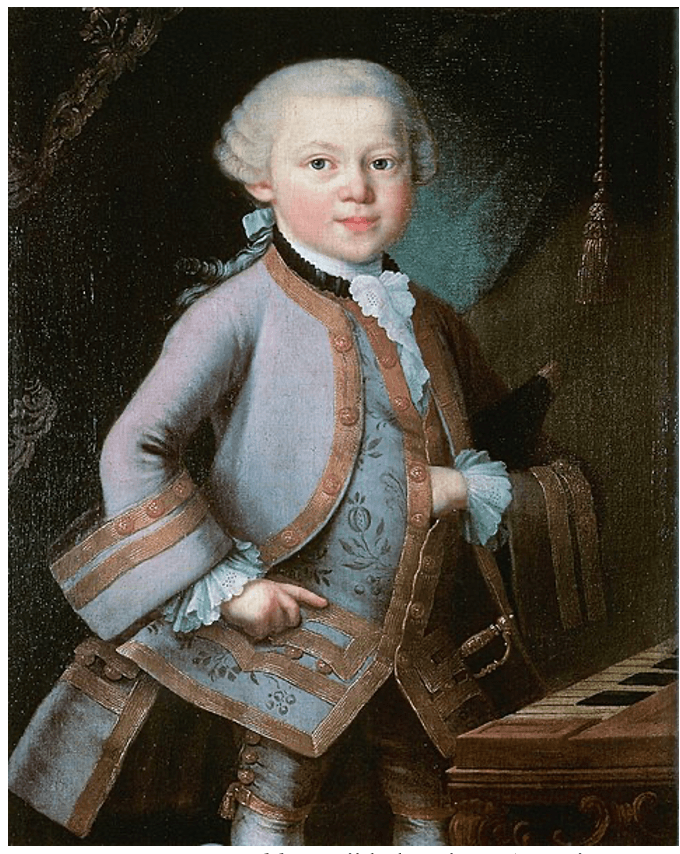
Mozart as a six-year old, possibly by Pietro Antonio Lorenzoni, 1763 (Mozarteum, Salzburg).
What does it mean ergonomically, ethically, aesthetically, emotionally, psychologically, socially to wear a sword in performance—not to mention before and after? Who has attempted a historically informed reenactment of weaponized 18th-century performance? Dom Bedos de Celles’ L’art du facteur d’orgue (the art of organ building), the first of its four volumes published in 1766, shows an organist on the bench wearing his sword. This is presumably how the famed organists of Paris, including the last of the illustrious Couperin family, were accoutered when Burney met them soon after having retrieved his own sword on the other side of the Channel.
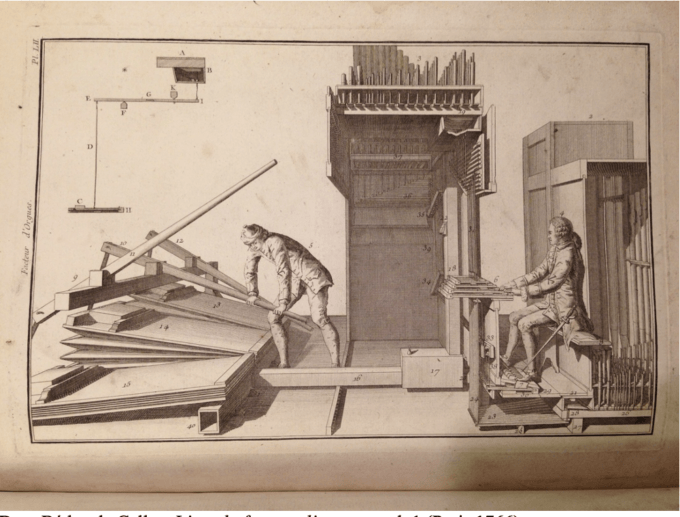
Dom Bédos de Celles, L’art du facteur d’orgues, vol. 1 (Paris 1766).
Aside from these historical and performance-practical considerations, a history of the sword in music could visit other organ lofts.
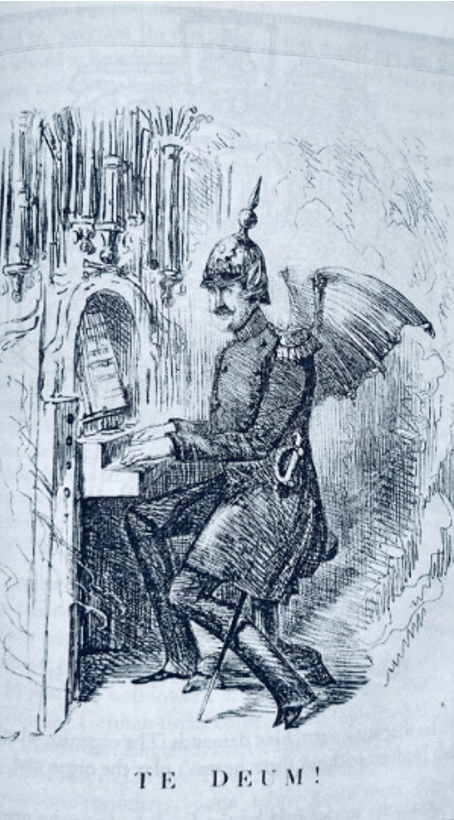
The Prussian King plays the organ instead of entering the Crimean War (Punch, 1854)
Crucial, too, is a return to the stage—moving in the opposite direction of Mattheson before his duel with Handel. First on the itinerary would have be Don Giovanni’s slaying of the Commendatore.
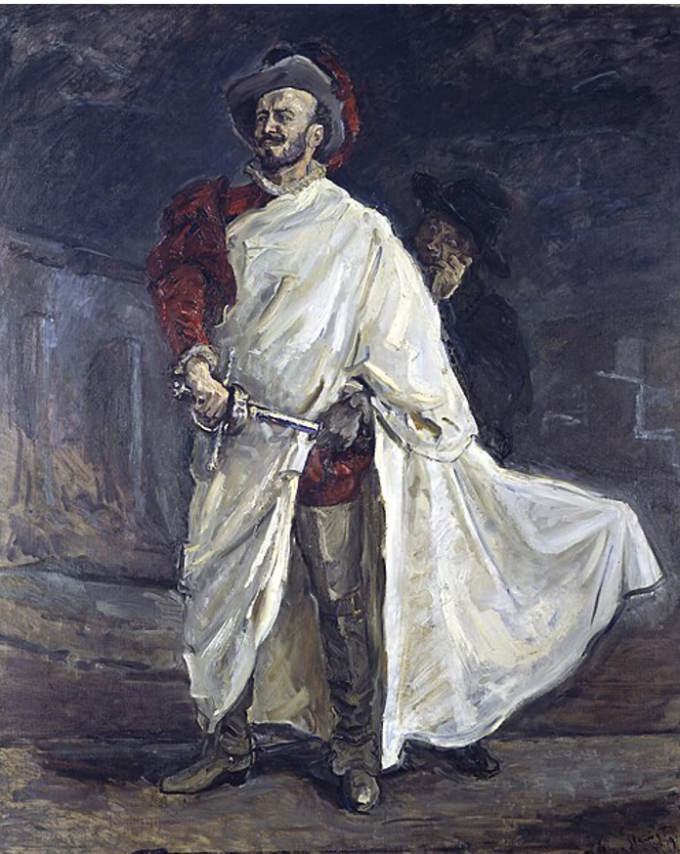
Max Slevogt, The singer Francisco D’Andrade as Don Giovanni, 1912 (Alte National Galerie, Berlin).
Also to be assaying would be the Wagnerian sword of Siegmund, reforged by his son Siegfried and called Nothung (slide)—a name that could be translated as “Necessary Sword.”
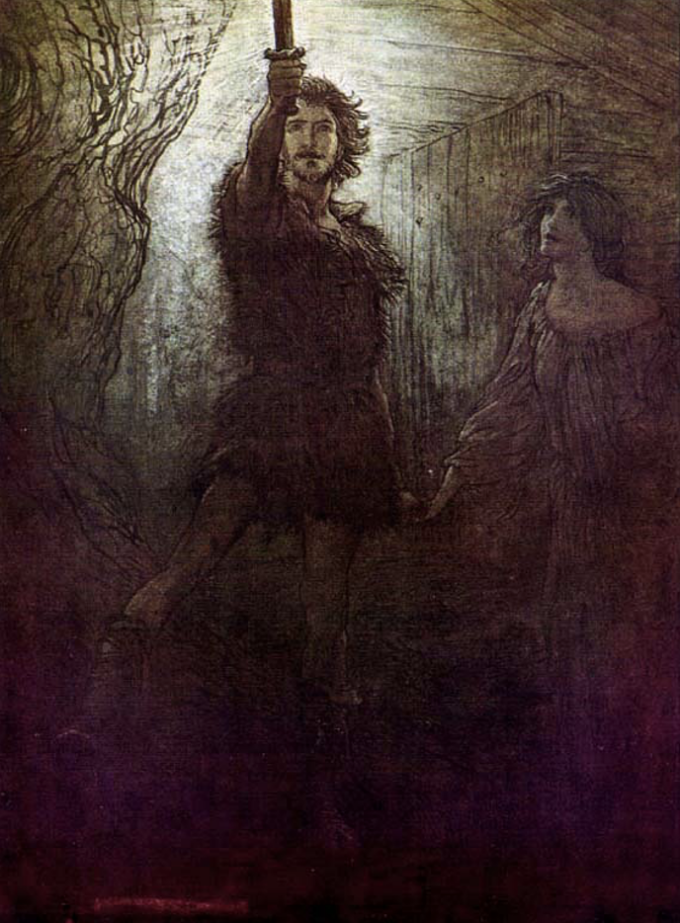
Arthur Rackham, Illustration to Richard Wagner’s Die Walküre (London, 1910).
“Necessary” is how Burney described his sword too, though its necessities were very different from those obtaining in Der Ring des Nibelungen.
There might also be a chapter on jazz musicians and their “axes,” as well as a survey of incidents like that in which Dizzy Gillespie pulled a knife on his bandleader boss Cab Calloway backstage at the State Theatre in Hartford, Connecticut in 1941.
In his diary, Burney described his forgetting of the sword as a “foolish accident,” but he might more forthrightly have used the words “embarrassing faux pas.” Given this gentlemanly passport’s mannered importance and scabbarded potency, it is little wonder that Burney excised the incident from his published travels. In the famous portrait of him painted in 1781 by his friend, Sir Joshua Reynolds, Burney wears his Oxford doctoral robes and brandishes a rolled-up score, not a sword.