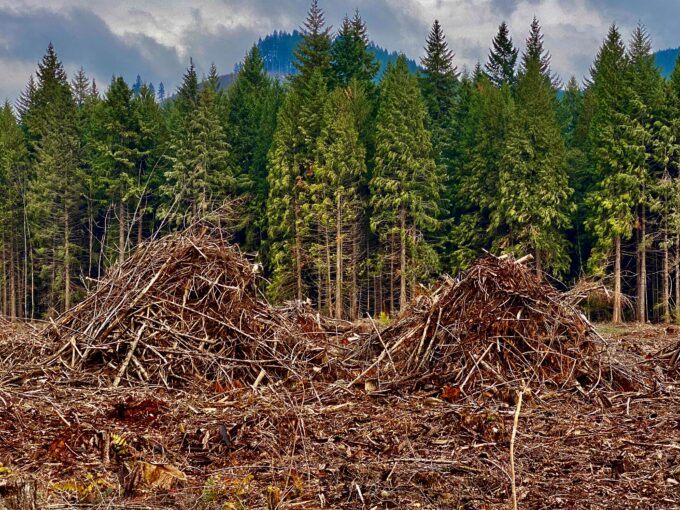
Logging on the Gifford Pinchot National Forest. Photo: Jeffrey St. Clair.
Most of the West’s perennial wildfire plague is due to human stupidity. But it’s not just the careless people who start the fires, it’s also all the people that voted for politicians who ignored the climate crisis or called it a hoax. The primary risk factor for increased wildfire vulnerability is hotter, drier forests. Were it not for major election interference by Jeb Bush, and a nakedly partisan Supreme Court, we would have had Al Gore as President, and America might have led the world away from a suicidal leap off the cliff of climate disaster. But at least we were saved from having a “wooden personality” in the White House.
Instead, 26 years later, chasing America’s bumbling descent into psychotic irrationality, much of the world has also thrown in the towel on preserving an inhabitable climate. We have a President who is so malevolently abusive to the environment he is grabbing the planet by the pussy, spending billions bribing companies to sabotage clean energy.
But as long as we have all paid dearly for front row seats to this UFCSC (Ultimate Fighting Climate Stupidity Championships) cage match, let’s take a look at another contender, the US Forest Service. For decades the agency has peddled a fairy tale that Western forests are morbidly dense and unhealthy because they have put out too many fires over the last 90 years, and that’s why we have so many, massive forest fires. Solution? 1.“Fuels reduction treatments” and 2. “Prescribed burns.” The euphemisms are deliberately crafted to make you think our forests are sick, and the Forest Service “doctor” will make house calls to do forest CPR. And for good measure, this medicine will also protect your home in the forest.
This is wildfire management malpractice.
Yes, the agency has a lot of “in-house” research to support their claim. But the agency lives, eats, and breathes conflict of interest. The agency operates under the umbrella of the US Dept. of Agriculture, which treats forests as a commodity resource. It’s joined at the hip to the logging industry. It promotes lumber and wood products with videos like this that encourage burning wood for heat, the most polluting way to heat a home, and more carbon intensive than using coal. The agency receives funding selling trees to the timber industry. This obvious conflict of interest is institutionalized.
In contrast to agency research, over 40 studies from different countries and independent researchers tell almost the opposite story. In the largest study ever done, the authors concluded forest “thinning,” accelerates and intensifies wildfires. They wrote, “Dense, mature forests tend to burn less…because they have higher canopy cover and more shade, which creates a cooler, more moist microclimate.” The higher density of trees of all sizes can act as a windbreak, buffering gust-driven flames and limiting flying embers. “Thinning and other activities that remove trees, especially mature trees, reverse those effects, creating hotter, drier, and windier conditions.” Consistent with that research, photographs of the current Cottonwood Fire, the most destructive in Utah history and largest in the nation, suggest the fire is burning right through areas that had been thinned.
Continuing the medical theme, thinning our forests to prevent wildfires makes no more sense than thinning your brain to prevent Alzheimer’s. It’s just making things worse.
We know of Forest Service employees who have been fired for challenging the agency’s forest thinning orthodoxy. Communications with researchers (including those with PhDs in ecology) in federal agencies and other institutions characterize the differences in conclusions drawn by independent research compared to Forest Service-connected research this way:
1. The burning and thinning mindset has been institutionalized, and it is difficult to change. It takes a long time to convince people that the strategy is not working. Employees are reluctant to consider what they have been doing is failing or making it worse.
2. There is a long-term budget commitment to “active forest management” so land managers want to take advantage of those available funds. Follow the money.
3. Land management agencies (primarily the Forest Service and BLM) want to be perceived as being proactive because the public expects them to do something to put out or prevent fire, to keep their homes safe. Land managers don’t want to be blamed if there is a poor outcome (especially when houses, cabins or other structures burn) which feeds the public’s expectation that something can and should be done.
This is also climate malpractice.
Pre-emptive deforestation is also an obvious climate disaster. Every tree cut down loses its carbon absorption, and every tree burned releases all that carbon into the atmosphere immediately when we can least afford it. We are contemptuous at deforestation of the Amazon knowing the “lungs of the earth” are being mutilated and its climate buffering is being lost. But when we do the same to American forests, many cheer it on because it’s branded “fuels reduction.”
This is public health malpractice
Smoke from wood burning, whether from a fireplace, wildfire, pizza oven, or prescribed burn, is the most toxic type of pollution the average person ever inhales. New research gives another black eye to the presumptive therapeutics of “prescribed burns.” On a national scale, 10,000 people die annually from wildfire smoke, but slightly more than that die from prescribed burn smoke. Per hectare burned, the overall health burden and daily health care costs were found to be nearly five times higher for prescribed burns compared to wildfires. This contradicts claims that human health is being protected by prescribed burns.
The apocalyptic megadrought strangling the life out of the American West, turning our forests into bonfires and smothering us in toxic smoke is not random bad luck, it is the direct and predicted result of decades of human caused greenhouses gases, climate policy failures, and pervasive political propaganda. And the Forest Service is only making it worse, blasting us with a firehose of stupidity with their “fuel reduction” solution, ironically adding “fuel to the fire.”