Illustration by Paola Bilancieri.
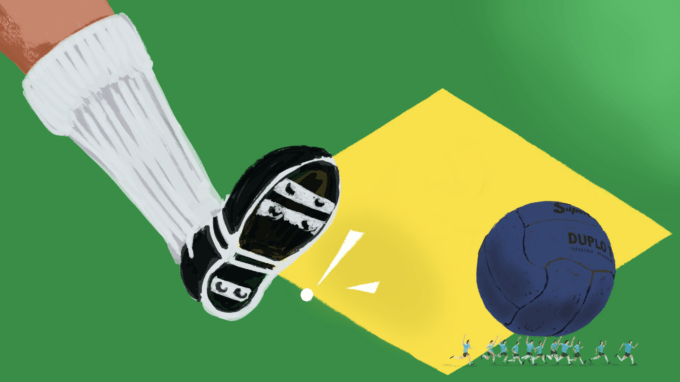
In 1950, the fourth FIFA World Cup was held in Brazil from June 24 to July 16. Brazil became the finalist of its group by defeating Mexico 4–0, crushing Sweden 7–1, and beating Spain 6–1. What happened then could be a lesson for this year’s soccer World Cup, where small country teams are performing with excellence.
Unlike Brazil, Uruguay’s national team, by contrast, showed a different performance. They tied a difficult match 2–2 against Spain after trailing 2–1. Then Uruguay defeated Sweden 3–2, scoring the winning goal just minutes before the end of the match.
The match between a brilliantly performing Brazil and an unconvincing Uruguay would decide the world title. Uruguay, one point behind Brazil, had to win to become world champion. Their rival needed only a draw to lift the coveted trophy.
There was enormous interest in the match despite the consensus among sports journalists and the public that Brazil would be the champion. After all, the Brazilian team had won its previous matches with ease, while Uruguay had only managed a draw with Spain and a hard‑fought win against Sweden. A comparison of previous performances left little doubt about the final result.
On July 16, 1950, Rio de Janeiro was buzzing. An improvised carnival was ready to celebrate Brazil’s triumph over Uruguay. Brazilians completely filled the recently inaugurated Maracanã Stadium. Although the official count was a world‑record 173,850 spectators, unofficial estimates put the number closer to 210,000.
Only a few Uruguayans were present at the match.
The newspaper O Mundo published a special edition with a photograph of the Brazilian team under the caption: “These are the world champions.” Jules Rimet, the former president and creator of the FIFA World Cup, had prepared a speech in Portuguese to congratulate the winners, who were expected to be the Brazilians. The Brazilian Football Confederation had printed 22 gold medals with the names of its players. A song titled “Brazil the Victors” had been composed days before the final match.
Before the match, the mayor of Rio de Janeiro, Ângelo Mendes de Moraes, addressed the crowd with words aimed at the Brazilian players: “You, players, who in less than a couple of hours will be acclaimed as champions by millions of compatriots, have no rivals in the entire hemisphere.”
With the Brazilian players and the public anticipating victory, Juan López, Uruguay’s coach, told his players that the best way to face the powerful Brazilian team was to play defensively and try not to let them score too many goals. Outside the locker room, Uruguay’s captain, Obdulio Varela, nicknamed “The Black Chief,” told his teammates: “Juan is a good man, but he’s completely wrong.” He added: “Friends, those who watch don’t play. Let the show begin.” And with those memorable words, the players walked onto the field.
The first half ended 0–0. Two minutes into the second half, Brazil scored the first goal. The Brazilians were delirious, and the Maracanã shook violently as thousands of spectators jumped and shouted at the top of their lungs. Brazil was a party.
After the goal, Varela took the ball from the net and slowly—very slowly—walked toward George Reader, the British referee. Speaking to him in Spanish, he questioned the validity of the goal. He spoke at length, forcing the referee to call for an interpreter. The game was halted while the conversation took place. The Brazilian spectators were furious. A Brazilian player spat on him, but Varela remained unmoved.
Varela would later say that his actions were a carefully planned strategy meant to cool down the crowd. Once his mission was accomplished, he turned to his teammates: “Come on, amigos, now is the time to win.” The Uruguayan players, suddenly energized by Varela’s words, now felt they could face the Brazilian Goliath.
Twenty‑one minutes into the second half Uruguay tied the score. Running quickly down the right side, Alcides Ghiggia sent a low cross to Juan Schiaffino, who managed to score. The Maracanã, which until then had been a celebration, suddenly fell silent, a silence “that terrified our players,” Brazilian manager Flavio Costa later said.
A draw would have crowned the Brazilians, but another surprise awaited them. The Uruguayan Ghiggia exchanged passes with Julio Pérez. Ghiggia kept running and fired a deadly shot to score the second goal just 11 minutes before the end of the game. The inconceivable had happened. Brazil had lost the match, and Uruguay became world champion.
The loss of the World Cup had a devastating effect on Brazilians. There were dozens of suicides, and many spectators suffered nervous breakdowns. Rio de Janeiro, which had been all samba before the match, became as silent as an abandoned country church.
Years later, Varela recalled: “There was so much sadness among the fans that I decided to go have a drink with them. I thought the Brazilians were going to kill me when they realized who I was. But I also thought that if I had to die that night, that was my fate. Fortunately, I couldn’t have been more wrong. The Brazilians congratulated me, and we had a few drinks together.”
The next day, Varela refused to be photographed and declined to participate in the celebrations, saying: “My heart is with the people who are suffering.” Upon their return, the Uruguayans were greeted by a country in ecstasy. Everyone was jubilant except one person: Obdulio Varela, the man who had saddened the Brazilians.