
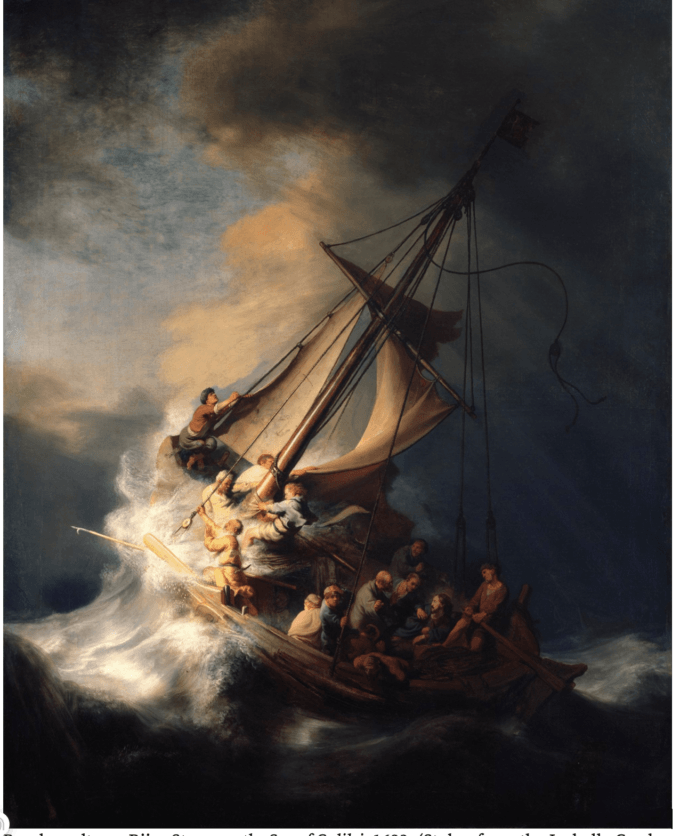
Rembrandt van Rijn, Storm on the Sea of Galilei, 1633. (Stolen from the Isabella Gardner Museum, Boston in 1990)
The Democratic Party has been long asleep on board its sinking ship. Suddenly the crew has been roused by what many pundits have dubbed a blue tsunami, an event more catastrophic than that other political disaster metaphor, the landslide. But what of the supposed winners? Tidal waves are indiscriminate about whom they destroy.
Chuck Schumer should be running for ground a lot higher than that of his home on Park Slope, Brooklyn. An initial tsunami is followed by subsequent surges in a so-called wave train. The angry water could sweep the would-be Senate majority leader and life-preserver-donning cronies far out to sea.
As usual, I turn to J. S. Bach’s music to help me make sense of the modern world, never mind that this fervent Lutheran held a worldview diametrically opposed to my own. I do not apologize for using Bach’s art for my own purposes, even if the composer would surely have objected that I had distorted his own conception of his work. I also believe that his music can help focus political thought and action. Bach has something to say to the Democratic Party.
In 1723, he left the employment of an enlightened prince to work for the proto-democratic City Council of Leipzig, a commercial and university center of Saxony in Germany. Bach preferred the prince, but his boys needed a college education. The family moved to the big city.
In Bach’s first year as Leipzig’s Director of Music, he produced perhaps his most striking wave music—the cantata BWV 81, “Jesus schläft, was soll ich hoffen” (Jesus sleeps, what can I hope for), for the fourth Sunday after Epiphany. The Gospel for that Sunday, from which Bach’s cantata freely draws, is Matthew, Chapter 8. The Disciples are in a boat on the Sea of Galilee and are overtaken by a storm. Jesus is on board but sleeping.
The cantata begins with an alto aria, a foreboding lullaby, reverent toward the sleeping Jesus but fearful at what might befall the Disciples—and by extension all Christians—when the Savior is not awake.
An ensuing tenor recitative selfishly complains further of the Lord’s lack of attentiveness, before the storm is unleashed in a bravura tenor aria: “The foaming waves from Belial’s streams / redouble their fury.”
Belial is one of the four Crown Princes of Hell, but here he is not whipping up infernal flames but deadly waters. The opening string line of Bach’s aria surges upward then froths down above a pounding pedal point, before the tenor dives into the foam, ripping off the torrents of scales and arpeggios, as if his voice is surfing the flood. Unexpectedly, the storm suddenly lashes against the sandbags of belief and gives way to a poised, though hardly resolute, recitation enjoining Christians to “stand indeed like a rock, / when the winds of trouble blow about him, / though the stormy flood / seeks to weaken the strength of faith.” But such resolve cannot stem the flood, and the music jumps its banks again with exhilarating terror.
Awakened by the Disciples, Jesus delivers a scolding arioso in the minor mode castigating them for their lack of faith: in the face of disaster belief is the only lifeline.
Jesus then rises to subdue the storm himself: “Schweig, aufgetürmtes Meer” (Quiet, heaving sea). Unison strings begin on the off beat, as if Bach is catching the wave as it builds upward, lofting two oboes d’amore above its crest, like daredevil seagulls skimming the foam. Here Bach deploys a common harmonic progression of his time, one heard most famously in Pachelbel’s Canon and also shared with Handel’s “Thou didst blow,” from the oratorio Israel in Egypt, where the Pharaoh’s army disappears below the surface of the Red Sea tsunami. Whereas Handel used this sequence in that aria to depict the serene aftermath of the wave, in Bach’s storm the well-worn pattern is darkened by its minor key and churns with power and fury. Jesus shouts into the roiling waters, the strings seething onward without respite: “Quiet heaving sea! Be silent, storm and wind!”
In contrast to what I presume to be Bach’s intended message, I hear Jesus himself being caught up in the power of the raging waters. The paradox is that the power is his own, for he literally commands the elements. Yet Jesus seems ready to be carried away by the thrill of his storm. After all, for the piece to extend to its proper dimension, Jesus’s orders must first fall on the wind’s deaf ears and be unheard by the wrathful waters. In order to dramatize the storm, Jesus must issue a slew of futile commands: his aria lasts longer than Jesus’s omnipotence should require.
In all its skillful fury, this piece doubtless excited Bach’s listeners, but in paradoxically reveling in its own destructive majesty, the aria raises the old question about music itself: giving in to the aria’s sensual power commits the sin that ultimately brings with it natural disaster. In this piece meant partly to scare listeners with their own guilt, it is the seductive thrill of the music itself that unleashes the tsunami.
A second recitative then professes faith in Jesus, belief vanquishing the storm. Tranquility returns.
A closing chorale, forthright but barbed with occasional unsettling dissonance, promises safety even if anxieties can never be fully allayed.
Beneath your protection
I am free from storms
and all enemies.
Let Satan sniff around,
let the enemy be exasperated
Jesus stands by me.
Though there is thunder and lightning,
though sin and hell terrify,
Jesus will protect me.
The thrill of riding the victory wave distracts from deeper fears. Modern listeners can fill in the identities of Satan and the yearned-for political savior as they like. But what this music proclaims, even against its own theological ballast, is that the status quo will sink the ship. All hands on dec and a new hand on the tiller: a new course must be set.


