
Photo by Mike Hindle
Before we talk bailouts, let’s take a look at the latest numbers:
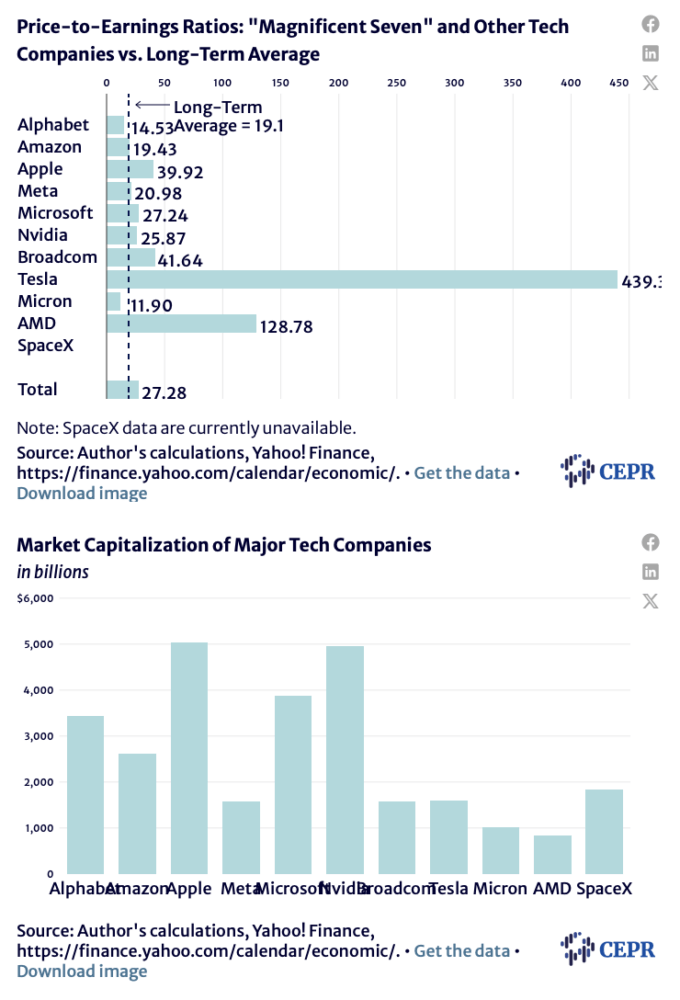
The timing of a bursting bubble is impossible to predict. China’s bubble already collapsed, leading to a plunge in its AI-tech index of 40 percent. This crash occurred even as Chinese AI was grabbing an ever larger share of the World AI market.
Whatever the specific cause of the crash, it seems investors questioned whether the companies would earn the sort of profits that would justify the stocks’ market value. Incredibly, according to Reuters, the total market cap in the country’s AI-tech index was just $1.2 trillion before the crash. That compares to a valuation of more than $5 trillion for Nvidia alone, and well over $25 trillion for AI-related companies in total.
Anyhow, while we can’t know the timing, more analysts and investors are coming around to expecting that a crash is coming. And stocks have a long way to fall. The current value of the stock market is around $80 trillion. While the AI-related companies are sure to take the biggest hit, the rest of the market is not likely to escape unscathed. In the crash following the 1990s Internet bubble, the NASDAQ lost almost 80 percent of its value, but the S&P 500 lost 50 percent. Even stocks like GM and McDonald’s took big hits. If the market were to fall to its historic average PE ratio, the loss would be around $40 trillion.
Who Gets Hit?
If the AI boom goes bust, the economy is sure to take a big hit in the short term. The flood of investment in building data centers will slow to a trickle. The consumption that has been driven by soaring stock values will dry up. And the circular financing that has helped propel the AI boom will unravel. When this convoluted chain of finance becomes untangled, we will find out who is holding the bag. To take Warren Buffett’s great line: When the tide goes out, we find out who was swimming naked.
Anyhow, that story is likely not to be pretty, but we need to learn some lessons from the 2008 crash. Fortunately, the Congressional Progressive Caucus is on thecase, with a list of dos and don’ts.
At the top of their list is no bailouts for AI companies, the tech companies, and their financiers. This was the major sin of the response to the collapse of the housing bubble. As millions of people were losing their homes and their jobs, the government and the Fed rushed to rescue the banks and the insurers who had profited by promoting the bubble. They warned us that these bailouts were necessary to prevent a Second Great Depression.
While the Second Great Depression line was repeated endlessly, including by supposedly neutral reporters in the media, it was crap. We know how to get out of a depression: spend money. World War II ultimately got us out of the first Great Depression, not because it was a war (wars don’t have a magical impact on the economy), but because there was agreement that we had to spend whatever was necessary to defeat Nazi Germany. If we had spent the same amount of money ten years earlier, building up the country’s housing, health care system, and schools, we could have gotten out of the Great Depression in 1931 instead of 1941.
This point needs to be front and center when we hear the AI boys telling us that we have to save their rears for our own good. They had no intention of sharing their AI bonanzas with us (see how much money they are spending to defeat California’s wealth tax), and there is no reason the rest of the country should come up with the money to keep their companies going.
There is a reason we have bankruptcy law. The companies that got themselves in too deeply — in debt and lease commitments — and can’t pay their bills can go into bankruptcy. The shareholders get wiped out, but the companies, insofar as they have useful lines of business, keep operating.
There could be cases where some of the companies facing bankruptcy are insurers, where they lent the money that was supposed to provide annuities to their customers. There are guarantee funds at the state level, many of which are grossly inadequate. In this story, the insurers need to go bankrupt, and their top executives should look for new jobs, but the federal government should be prepared to step in to ensure that most of these annuities are paid in full.
Of course, some banks may go under in the crash story, but this is why we have deposit insurance. The bank can be restructured, with the shareholders wiped out, the top management removed, and customers can get access to their money as though nothing had happened. The Federal Deposit Insurance Corporation (FDIC) has done such restructuring numerous times and should be prepared to do it on a large scale following a collapse of the AI bubble.
Many individuals may take a big hit with their 401(k)s. This is unfortunate, but we can’t dictate how people should invest their money. Some people do things like buy crypto or gamble on Polymarket. They have a right to take risks with their money. Investors should have understood that holding stock portfolios that were heavily exposed to AI was risky. They were prepared to pocket the big gains from these stocks over the last five years. If the prices plunge, the rest of us should not be obligated to bail people out.
What should be front and center is an aggressive agenda to get the economy back on its feet, which means replacing the economic demand that was generated by the AI bubble. That is close to $1 trillion a year in investment spending (roughly 3 percent of GDP), although much of this is on imported goods. It is likely that much more domestic demand will be lost due to reduced consumption spending.
The wealth effect on consumption from stock holdings is usually estimated as 3 cents on the dollar. This means that if we lose $30-40 trillion in stock wealth from a crash, annual consumption will fall by $900 billion to $1.2 trillion. This falloff in consumption, coupled with the lost investment, will create a huge gap in demand.
Fortunately, We Know How to Spend Money
The key to boosting the economy in this story is simple: spend lots of money. That will mean running large deficits, but a serious downturn is exactly when the country can and should run large deficits. We can count on the deficit hawks to yell and scream, as they always do when someone proposes spending money on progressive items, but reality-based folks should ignore them.
This is a case where the key insight from Modern Monetary Theory folks comes clearly into play. Since we print our own currency, the limit on deficit spending is really inflation, which in turn comes down to the availability of real resources, labor, and specific types of capital and natural resources. If we have unemployed workers and many areas of excess capacity, the government can spend freely without worrying about inflation.1
There is no shortage of areas where we can find good uses for more spending. Education, health care, and childcare are three great places to start. Maybe we can move towards free college, Medicare for All, and vastly expanded support for childcare.
And we can try to catch up with the rest of the world on the green transition. In China, roughly two-thirds of the new cars sold are EVs. And these cars cost much less to buy and far less to run than gas-powered cars. We don’t have to ask people to sacrifice to save the planet; the Trump gang is demanding people sacrifice to destroy the planet.
The same story applies to wind and solar power. It is now far cheaper to produce clean energy than electricity from fossil fuels. China already has more wind and solar generation capacity than we have total generation capacity. We all know of Donald Trump’s hatred for wind and solar, but maybe Congress could get around it by saying that all the new facilities will be for national defense and have drone-launching capabilities. He’ll never know the difference.
And we can start to redress the imbalances between labor and capital to ensure that workers have more purchasing power, starting with a big hike in the minimum wage. Also, if we’re going to see the massive productivity payoff promised by the AI promoters, then we should shorten the workweek to 36 or even 32 hours. That will go far towards reducing unemployment.
This list should be our starter set. An economic downturn caused by the collapse of the AI bubble opens a world of possibilities. We can accomplish many great things, just as Franklin Roosevelt did with the New Deal. We just have to make sure that bailing out the AI bros is not one of the items on the list.
This first appeared on Dean Baker’s AI Bubble Monitor blog.