
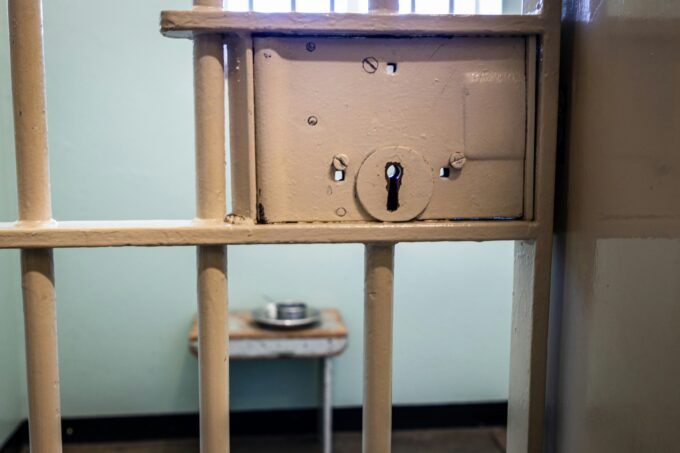
Image by Grant Durr.
In the dorms, there’s a water fountain, but it’s always warm because many mouths are slurping the cold water greedily. Sweat beads off the dorm’s sticky walls. Men pass out on their racks when the heat overcomes them. At Lawtey CI, they brought a stretcher to carry men out. It’s 90 degrees outside, plus the Florida humidity, and it’s routinely over 100. Floridians are used to the sweltering heat.
This is different.
The dorms I lived in were open-bay, housing 80 to 120 men in a single room. A hundred-plus men, without AC. Our own body heat was part of the equation.
Confinement is worse. Confinement is where you feel as if you’re your own puddle of sweat on the floor, with a metal sink attached to the toilet, where we’d sip water like we’re fish trying to breathe out of the water.
I served eight and a half years in the Florida Department of Corrections, from 2010 to 2018, at Lake Butler RMC, Suwannee CI Annex, Taylor CI Main Unit and Annex, Lawtey CI, and Baker CI. CI stands for correctional institution, which is what Florida calls most of its prisons. Florida State Prison is the only major institution with “prison” in its name. I’ve been home for eight years now. In September, a federal judge in Texas ruled that holding prisoners in extreme heat without air conditioning is unconstitutional, and in Florida, a lawsuit over the heat in one prison, whoops, “Correctional Institution,” is headed to trial in Miami.
On September 22, U.S. District Judge Robert Pitman ordered Texas to air-condition every one of its prisons by the end of 2029. He found that at least nine people died from the heat in Texas prisons between 2023 and 2025, and he wrote that even without deaths or injuries, the extreme heat “creates degrading, inhumane conditions and causes severe suffering.”
His order covers about 90,000 people, nearly two-thirds of the state’s prisoners. Texas has required its county jails to stay at 85 degrees or below since 1994, but it never required that of its prisons. The case started with Bernie Tiede, the man Jack Black played in the movie “Bernie,” who suffered a stroke in the summer of 2023 in a cell that court documents say regularly exceeded 110 degrees. Texas has appealed to the conservative Fifth Circuit and asked Pitman to put his order on hold. In an October 8 filing, the state said enforcing it before the appeal is decided would throw “chaos and confusion” into its plans to install air conditioning. The agency says it will cool every prison, but it hasn’t set a date.
Florida’s in a different federal circuit. The Eleventh Circuit hears federal appeals from Florida, Georgia, and Alabama, and it has already decided a prison heat case.
Men on Florida’s death row at Union Correctional Institution sued over the heat in their cells. In 2004, the court ruled against them, upholding a finding that the temperatures there were “almost always consistent with reasonable levels of comfort and slight discomfort”, the kind anyone would expect in a Florida home without air conditioning. The court wrote that “a prisoner’s mere discomfort, without more,” isn’t enough to violate the Eighth Amendment. That case is Chandler v. Crosby. As of 2024, the Eleventh Circuit still hadn’t found excessive heat in a prison to be cruel and unusual punishment.
In 2022, the Florida Department of Corrections said only 157 of its 639 dorms had air conditioning.
The case that could change that is Wilson v. Dixon. In October 2024, the Florida Justice Institute sued on behalf of the men at Dade Correctional Institution, a concrete prison in Homestead, less than six miles from Everglades National Park, where none of the dorms are air-conditioned. The lawsuit says the heat likely contributed to four deaths. In September 2025, U.S. District Judge Kathleen Williams let the men sue as a class, on behalf of every man held there now or in the future. This May, Florida asked her to undo that, and she hasn’t ruled. The class covers about 1,400 men, and Dante Trevisani, litigation director at the Florida Justice Institute, told me that “as of now, we plan to be ready to go to trial starting November 2nd,” though he said he can’t predict whether the judge will push it back.
Stefano Schiavon, a UC Berkeley professor of architecture and civil and environmental engineering, used 31 sensors installed throughout Dade CI to measure the heat there in the summer of 2025. “At every location, it was hotter inside the prison than it was outside,” he said. In some wings, the heat index was above 88 degrees 97 percent of the time. The median was 98, with peaks around 120.
I never did any time at Dade CI, but I lived in that heat for multiple summers, and it was brutal inside those dorms, where we sweated through the night.
When the men sued, Florida asked the judge to throw the case out. The Constitution, the state’s lawyers wrote, “does not mandate comfortable prisons.” The state also pointed to the posters it had put up about heat-related illness as evidence it was responding reasonably.
The Miami Herald reported that Florida’s DOC doesn’t keep track of heat deaths. Every death gets recorded as a homicide, a suicide, an accident, or natural.
The men’s lawyers have a medical doctor and a forensic pathologist who looked at the deaths in the lawsuit and the heat those men were exposed to. Their opinion, Trevisani said, is that “the heat was a contributing factor to their deaths,” a cause the DOC doesn’t record.
In 2012, the year I worked in the infirmary at Lake Butler, Florida called 298 of its 324 prison deaths natural. That’s 92 percent. At Lake Butler RMC, it was 172 of 176. The department’s own page said its counts cover “the previous 5 fiscal years,” so the oldest ones fell to the wayside every summer. I wrote about them in October. How many of these deaths were due to the heat? We’ll never know.
It’s a double-edged sword, the heat and the cold.
Suwannee CI Annex in Florida, where I was housed during the summer of 2012, is what we call a climate-control camp, which inside the prison walls means air conditioning. When Florida says it, it means something else. “Various climate control measures are used to reduce heat, including industrial fans,” the department says about the dorms it doesn’t cool. At the correctional institutions I did time in, those fans were there to pull stale air out of the dorm and not to cool it down in the least.
On the department’s own list of facilities with air conditioning, the Suwannee Annex was one of only 10 prisons that weren’t marked “partially” air-conditioned. Where I was in confinement, the AC there became a torture device. The officers would turn the temperature of the wing down so low, and sometimes strip you of your clothes and bedding, leaving you alone to do as many jumping jacks and exercise as you could, only for a moment, to curl yourself upon your lap on the toilet praying for a wink of sleep, which was nearly impossible. When the lights turn on at 4:00 a.m., if you have a bed to make (unless you’re on property strip, when they’ve taken everything), you make it, and then your teeth chatter for hours. All I had on were white boxer shorts that barely stayed on, because they gave me a pair that didn’t fit.
My Department of Corrections record shows I went into confinement at the Annex on July 25. Outside, it was a Florida July. Inside, I was shivering.
Florida’s federal courts have looked at that too. In December 2011, at Santa Rosa Correctional Institution, an officer turned off the heat during the day in a dorm where a man was being held without his property, in a cell with a window that wouldn’t completely close. He sued. In 2017, the court ruled that turning off the heat, combined with the man’s lack of property, wasn’t “an extreme deprivation.”
That same department ran the air conditioning on my confinement wing cold enough to keep a man in his boxers awake in July.
In Texas, Judge Pitman called it “deliberate indifference” that the prison director failed to commit to a plan to install air conditioning on a timeline the agency itself had said more than once was possible. In Florida, the state has asked Williams to decide the case without a trial, arguing that the evidence doesn’t show the conditions at Dade CI are unconstitutional. Trevisani called the Texas ruling “persuasive, we think,” even though it came from another circuit. If the men win, he said, the remedy they’ll argue for would be “something that lowers the heat index to some kind of safe level,” and only at Dade, since the case doesn’t reach any other prison.
The Florida Department of Corrections calls itself “the nation’s third-largest prison system” in its own annual report, and its lawyers wrote “prisons” in front of Williams, so even Florida forgets what it calls its correctional institutions.
Comfort was never the issue inside Florida’s prisons—”Correctional Institutions”—but control sure is.


