
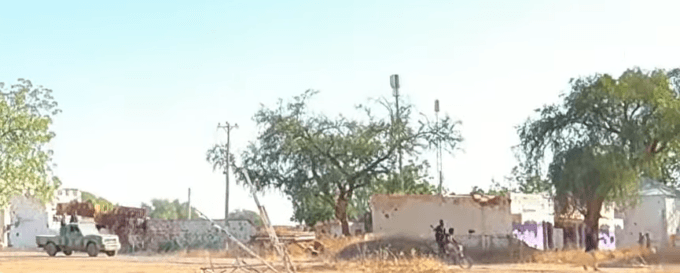
RSF forces in El Fasher, Sudan. Image: Screen capture from video shot by Alwedatalah.
On November 23, the majority of the 193 States Parties to the Organisation for the Prohibition of Chemical Weapons will gather in The Hague for their annual Conference. It is an opportunity to reflect on developments in 2026 and look to the challenges that lie ahead.
Yet one of the most serious challenges to the global prohibition on chemical weapons is not being addressed as a specific issue on the Conference’s agenda: Sudan, and the mounting evidence that chemical weapons have been used in the horrific conflict that has blighted the country and its people for more than three years.
In September 2024, workers at the Al-Jili oil refinery north of Khartoum heard an aircraft overhead, followed by something falling that was not a conventional explosive bomb. There was no blast, no fire and no shrapnel. Instead, there was a strange yellow-white cloud, a smell one witness likened to rotten eggs and another to a mixture of chlorine and toilet cleaner. Within minutes, around twenty men were struggling to breathe. Two lost consciousness before help arrived.
That account, drawn from two refinery workers interviewed separately as part of a preliminary investigation published in September, might once have stood as an isolated and unverifiable claim from a country most of the world has stopped watching closely. It no longer stands alone.
Over the past year, it has been corroborated by an open-source investigation by France 24’s Observers unit, which geolocated and authenticated photographs and video from the same incident and traced a chlorine container found near the impact site to a shipment imported by a company linked to the Sudanese Armed Forces. It was echoed in April 2025, when the US State Department formally determined that Sudan’s government had used chemical weapons and imposed sanctions on that basis.
Most significantly, the joint investigation published on September 5 by The New York Times and The Washington Post, drawing on a leaked internal dossier of roughly 150 documents, photographs, videos and intercepted messages from Sudanese officers, has added an entirely new dimension to the allegations.
That material describes a chlorine bomb programme developed from 2024 onwards, involving some 290 munitions manufactured and more than a hundred reportedly used. It also includes accounts of a desert test that one officer described as “100 per cent” successful, and messages in which the army’s commander, General Abdel Fattah al-Burhan, is said to have ordered subordinates to erase all trace of the effort.
Taken together, these investigations, official findings and newly disclosed military records provide several distinct and mutually reinforcing strands of evidence. Their significance lies not simply in the number of reports, but in the extent to which material from different sources points towards the same alleged programme and pattern of use.
I spent years advising the OPCW on precisely this kind of evidence, much of it in relation to Syria, where the pattern was depressingly similar: barrel-shaped munitions dropped from aircraft, no conventional blast, a distinctive smell, and workers or residents left gasping for breath.
The Fact-Finding Mission in Syria did not assign blame, because that was not its mandate. The UN-OPCW Joint Investigative Mechanism that followed did have that mandate, and it attributed specific attacks to the Syrian government by weighing precisely the kind of evidence now emerging from Sudan: witness testimony, delivery methods and which side actually possessed the aircraft needed to carry out the attacks.
In Sudan, as in Syria, only one party to the conflict operates fixed-wing or rotary aircraft. The Rapid Support Forces do not. That asymmetry matters because it significantly narrows the field of those who could plausibly have carried out an aerial chemical attack. It is an important evidential consideration, although it cannot on its own establish responsibility for a particular incident.
None of this proves, to the standard required by a court of law, that a specific chemical weapon was used on a specific date by specific individuals. The preliminary investigation is candid about its own limitations. No one has been able to reach the alleged impact sites. There has been no environmental or biomedical sampling, no laboratory analysis and no forensic examination of the recovered munitions.
Among the most immediate priorities is the forensic recovery of a mobile telephone reportedly containing original photographs and video of the refinery incident. The device is damaged, but may still contain recoverable evidence. It should be secured and examined by specialists without further delay. Other witnesses and medical personnel who could provide important evidence also need to be reached while their recollections remain fresh.
This is precisely the situation the Chemical Weapons Convention was designed to address. The Convention does not simply prohibit the use of chemical weapons; it also establishes procedures through which allegations of use can be investigated and verified. Sudan is one of its 193 States Parties and is bound by its obligations under the treaty.
Sudan has so far refused to allow OPCW inspectors access to the country, while making claims that the United States has sent inspectors into Sudan. The circumstances surrounding access and the use of the Convention’s verification mechanisms therefore require urgent clarification. A state’s refusal to cooperate with a properly pursued investigation cannot be allowed to become a permanent obstacle to establishing the facts.
If states can simply decline entry and wait for international attention to move on to the next crisis, the Convention’s credibility is placed at risk. Every other government watching Sudan’s war will draw the appropriate lesson.
There is also a narrower, practical argument for urgency, separate from the moral one. Evidence of this kind does not remain available indefinitely. Digital material can be lost, devices can fail and witnesses can become harder to locate. The case for a fuller inquiry is strongest now and will only weaken with time. Waiting for political circumstances to become more convenient is not a neutral choice. It favours those with an interest in ensuring that the evidence becomes harder to establish.
What should happen next is not complicated to state, even if it is difficult to achieve. The UN Security Council, or a sufficiently large bloc of States Parties acting through the OPCW’s own mechanisms, should press for a mandated technical investigation with an explicit remit to establish the facts and, where the evidence supports it, attribute responsibility, along the lines of the Joint Investigative Mechanism in Syria.
That investigation should work in close coordination with the Independent International Fact-Finding Mission for Sudan, established by the UN Human Rights Council in 2023, which already has standing and expertise in examining the wider conduct of this war. Priority should be given to the forensic recovery of the digital material identified by witnesses, securing hospital and refinery records before they are lost or altered, and interviewing additional witnesses and medical staff who have already been identified but not yet reached.
Sudan’s war has produced horrors on a scale that makes a single incident at an oil refinery seem, on the face of it, like a minor footnote. It is not. Chemical weapons occupy a distinct category in international law precisely because of the indiscriminate suffering they cause, and because their prohibition, unlike so much of the law of armed conflict, has held for most of the past century.
That prohibition survives only because states have been willing, however imperfectly, to investigate credible allegations rather than allow them to lapse into rumour. Sudan is now the test of whether that willingness still exists.
The evidence before the international community, assembled from witnesses, journalists, photographic and video material, and leaked documents from within Sudan’s own military, is unusually substantial given the conditions under which it has been gathered. It deserves a response commensurate with its seriousness.
The Chemical Weapons Convention was created because the international community recognised that the prohibition of chemical warfare could not depend simply on the goodwill of individual governments. It required institutions, verification procedures and a willingness by States Parties to act when that prohibition was challenged.
Sudan now presents precisely that challenge. The question facing governments in The Hague is not whether they should prejudge the outcome of an investigation. It is whether they are prepared to ensure that an independent investigation can take place at all.
If the international community cannot find the political will to respond to evidence of this gravity, the consequences will extend far beyond Sudan. They will affect the credibility of one of the most important achievements of international arms control. International law is as effective as States wish to uphold its commitments.


