
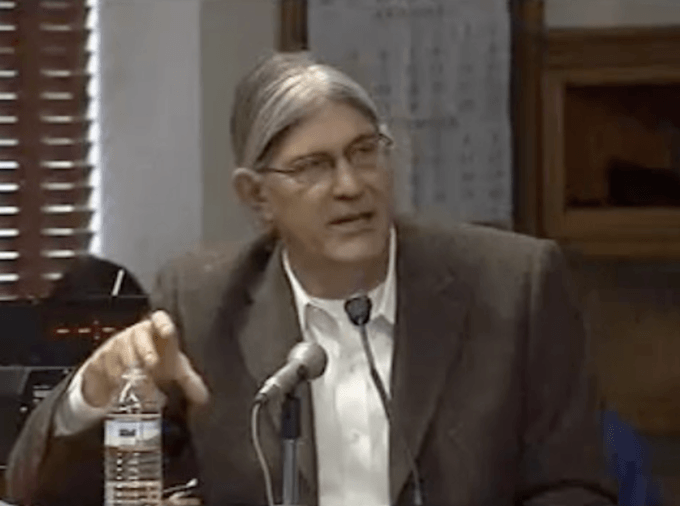
Photograph Source: Albaum – This file was derived from: CVNTrialVideoSample.png – Public Domain
The New York Times obituary headline for Ward Churchill states what was most noteworthy about the controversial academic. It makes explicit reference to his statements on 9/11 that led to a university investigation for “academic misconduct” and later to his firing from a tenured faculty position at the University of Colorado Boulder. That text pairs with the black-and-white photograph of Churchill, resting his head in his palm, black hair parted down the middle, and eyes gazing directly into the lens while a desk lamp casts a halo over his head. Taken together, the headline and the photo frame a central question: was this man a sinner or a saint? Was he a martyr for academic freedom, or what we might call in today’s hyper-online parlance an “edgelord,” intentionally shocking the public by comparing the people who died in the Twin Towers during the 9/11 attacks to Nazi war criminals, calling them “little Eichmanns”? Either way, “the paper of record” only grants thousand-word retrospectives to those whose fame or infamy rises to a certain level of importance to justify the ink spilled.
Yet the obituary airbrushes the longest-standing controversy dogging Churchill’s legacy. Since at least the early 1980s, many Indigenous people have called into question Churchill’s self-proclaimed Native identity, which was as much a part of his persona as his professed “radical” politics. Today, critics label him a “Pretendian”—a colloquial term used to describe non-Indigenous people falsely claiming Indigenous identity, ancestry, or heritage. Scholars like Daryl Leroux term this “self-Indigenization,” which Dakota scholar Kim TallBear defines as a modern form of colonial theft. After taking land and stripping resources, settlers extract Indigenous stories, steal dead ancestors, and assume institutional positions and moral authority by claiming to be Indigenous people themselves. While this issue burned quietly in Indigenous circles for decades before reaching mainstream headlines, media outlets—especially in the alternative press—lionized Churchill as a symbol of free speech. In doing so, they erased the critics who should have mattered most: the very Indigenous activists, academics, and tribal nations Churchill claimed as his base as a scholar and co-director of the Colorado American Indian Movement.
What follows are preliminary notes based on years of research into AIM and Ward Churchill. As an undergraduate during the height of the controversy, Churchill remained an abstract figure absent from my American Indian Studies syllabi. Only in graduate school did I read his co-authored books, The COINTELPRO Papers and Agents of Repression, valuing their extensive research on FBI surveillance files. (Revisiting those books, their cited sources, and conclusions years later led me to different interpretations of AIM history, though that is an essay for another day.) Throughout my education, only one professor encouraged me to read Churchill; most Indigenous academics discouraged it, citing his open hostility toward Indigenous critics and his well-known record of manufacturing a fake Indigenous identity. While I initially watched the fallout of his investigation and firing from the periphery, my research on AIM and FBI surveillance eventually intersected with his work, forcing me to confront his scholarship even more thoroughly. When AIM elders shared accounts that directly contradicted Churchill’s published histories, I turned my focus to the storyteller himself. Examining his claims with the same scrutiny he applied to his Indigenous critics yielded far more questions than answers.
Rather than an exhaustive history of Churchill’s extensive record of self-Indigenization as an artist, writer, professor, and activist, I offer three key sources for consideration:
Early AIM Callouts
For those interested in the earlier history of Ward Churchill, his involvement with AIM, and the anti-communist origins of his 1983 book Marxism and Native Americans, you can listen to my interview on the TYMSYY podcast (hosted by Sardana Nikolaeva and Masha Kardashevskaya). In this episode, I detail early instances where members of the American Indian Movement challenged his claims to Indigeneity and his disruptive and divisive behavior in the movement.
Jodi Rave’s 1993 Reporting
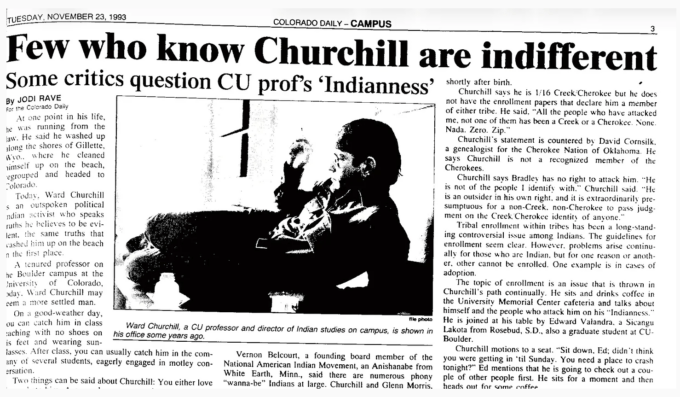
A decade before Churchill gained national notoriety, Jodi Rave—a Mandan, Hidatsa, and Mniconjou Lakota journalism student in his class—interviewed him for the Colorado Daily. Her November 1993 article, “Few Who Know Churchill Are Indifferent,” paired the subheading, “Some critics question CU prof’s ‘Indianness’,” with a lead photo of Churchill sprawled across a desk with a lit cigarette. He often lectured before students with his signature sunglasses and, weather permitting, without shoes.
Rave seemed nonplussed by his radical 1960s aesthetic and vibes, focusing more on hard facts. “The essence of Churchill centers around his involvement in Indian politics,” she writes. “He is often a target for criticism among Indians, [who are] the base of his platform,” she continues. By this time, Churchill had published numerous books and articles on Indigenous history and politics and appeared as an invited speaker on campuses across the country. That stature made him appear as an “expert” in his field. So when he dismissed critics of his self-proclaimed “1/16 Creek/Cherokee” ancestry as “identity police,” he must have been able to back up his claims. Yet no tribal nation ever enrolled him, recognized him as a descendant, or contained a single living relative he could point to.
Pointing out that tribal belonging requires enrollment or proven lineal descent, Rave writes: “[F]or what qualifies an Indian to be an Indian, the most accepted bottom line is you must be a member of a federally recognized tribe, or you must be able to prove Indian lineal descent.” Many American Indian people who don’t write books or have tenured faculty positions know and navigate this sometimes challenging and messy reality of tribal life. Sovereign nations determine their own membership through enrollment offices—not tenure committees, university administrators, publishers, or online commentators.
Although Rave never gave her opinion on Churchill’s identity, she suffered relentless personal attacks from him and his supporters for simply raising the question, but she also received wide support from Indigenous communities for her courage to report the truth. And her reporting is testament to the decades of Native people speaking truth to a power constantly trying to erase, distort, or undermine tribal sovereignty.
As Churchill well knew, sovereignty is the buzzword of American Indian Studies and the American Indian Movement. And what do sovereign nations do? They determine their membership. That’s why every tribal nation has an enrollment office, designed specifically to be the authority about tribal belonging. That authority rests with living and breathing Indigenous nations.
Institutional Accountability
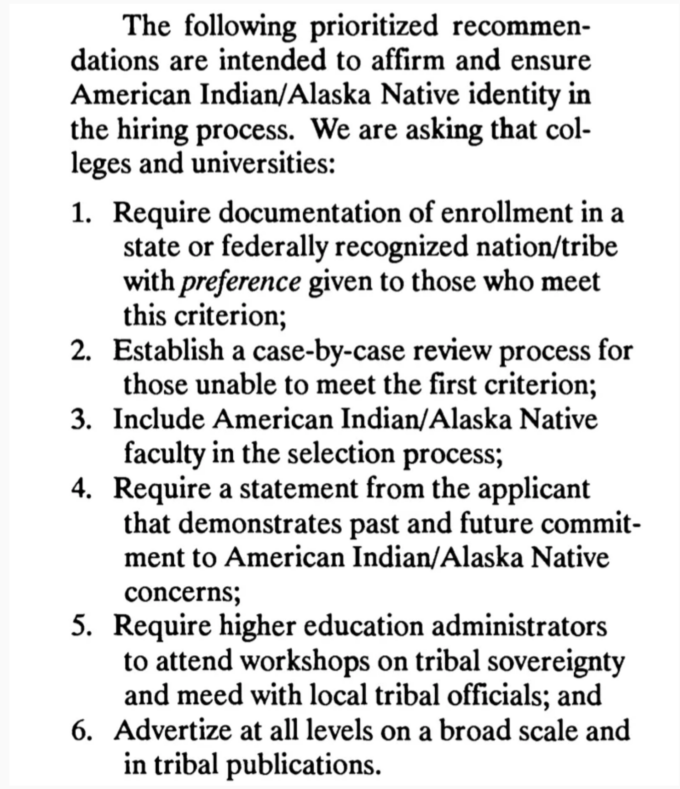
Association of American Indian and Alaskan Native Professors’ recommendation for university hiring practices for Native faculty published in Wicazo Sa Review (1993).
The same year Rave published her reporting, the Association of American Indian and Alaskan Native Professors, drawing from a database of over 350 verified Native scholars across more than 100 campuses, took aim at the university systems that enabled people like Churchill. Publishing a white paper in Wicazo Sa Review, the association targeted university hiring practices that perpetuated identity fraud. They argued that universities have no business certifying Indigeneity and proposed a modest baseline: requiring proof of enrollment in a recognized nation or tribe.
Though frequently forgotten, employment discrimination was at the heart of the Red Power movement. While academic freedom is protected under the First Amendment, federal Indian preference employment laws recognize the unique political status of tribal citizens holding dual citizenship, first enshrined into law in 1934 with the Indian Reorganization Act. Despite being codified in law, federal employment discrimination persisted for decades, leading to top administrative positions in places like the Bureau of Indian Affairs being dominated by white workers.
In 1970, Indigenous activists coordinated sit-ins at Bureau of Indian Affairs offices across the country to force the federal government to hire more American Indians in the federal service. AIM co-founder Clyde Bellecourt remarked that AIM “became a national movement overnight” because of the success and popularity of these protests among Native people.
Although Indian preference has yet to be applied nationally to universities, it does provide a potential protection against discriminatory hiring practices. The year following Rave’s reporting on Churchill, a group of American Indian leaders demanded that the University of Colorado Boulder lead an investigation into anti-Indian hiring practices related to Churchill’s faculty position, its promotion of his false claims to Indigenous identity through institutional faculty profiles, professional CVs, conference proceedings, grant funding, and university publications. The university ignored the request.
Who Are the Victims?
Self-Indigenization is not a victimless offense. Churchill frequently disparaged and distorted the legal right of tribal nations to say who their citizens are. He deployed the metaphor of a “toy poodle” to mock the blood quantum requirements some tribes used for membership and often exaggerated or sometimes falsified the evidence for his assertions. The truth is that Indigenous people face real challenges over enrollment. There are many examples of people being denied enrollment for being unable to meeting blood quantum requirements while still belonging to Indigenous community and having living Indigenous relatives. Their stories are real and sometimes painful, while their descent and connection to community is still oftentimes recognized. But this was not Churchill’s story, nor were they his challenges.
Pretendianism happens because mainstream institutions like the media, universities, and publishers reward people for claiming Native identity without actually checking if those claims are true or heeding tribal authority on such matters, enabling the problem instead of stopping it.
The charges brought by Indigenous people against Churchill were not just against him as an individual, but against an institution that alibied his Indigenous claims—whether intentionally or not—through their official channels over the protests of tribal nations. And while Churchill’s admirers and defenders boil down the larger controversy surrounding the infringement upon his rights to academic freedom and free speech, the oldest controversy of this continent—that is, the plundering of Indigenous lives and lands for the benefit of others—remains the primary and overriding contradiction of Churchill’s legacy.
Both controversies continue to simmer. As U.S. universities continue their targeting and purge of pro-Palestine academics, contravening commitments to academic freedom and free speech, they also continue hiring, promoting, and defending Pretendians like Churchill. There is an unhelpful and reductive saying of “walking and chewing bubble gum at the same time”—that is, we can defend academic freedom and tribal sovereignty. This is true. But Churchill is not such a case. The primary contradiction is that Pretendianism is a tool of Indigenous genocide and erasure. Just as zionists attempt to “self-Indigenize,” the pre-requisite to do so requires eliminating the actual Native: the Palestinian. And as many students and scholars found out, speaking against a U.S. sponsored genocide has consequences. Just as Indigenous scholars have found out, speaking out against our own genocide has consequences—for which we are often ignored.


