Photo by John Edgar
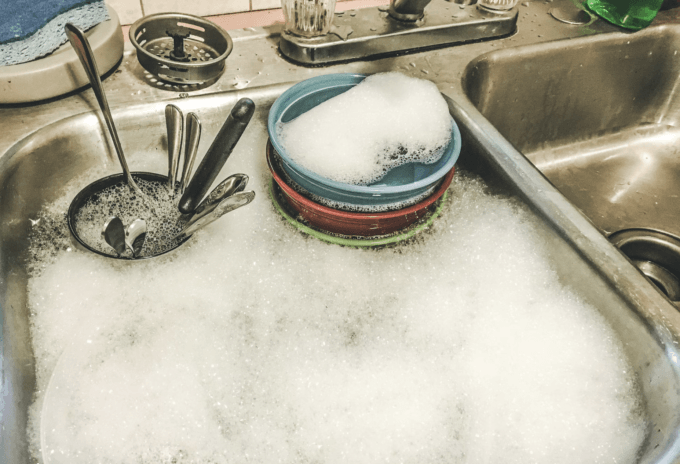
Caring labor, or household work, creates our world. Whether we call it caring labor or household work, the activity is a subsidy to private industry. It gains from failing to compensate providers’ money and time spent. A key measurement of the economy, Gross Domestic Product, fails to include this unpaid activity.
To be clear, GDP measures growth of the economy, the dollar value of goods and services bought and sold in the marketplace. GDP doesn’t measure the quality of life. Love is not a part of the GDP, nor are the related characteristics of empathy and solidarity.
GDP is all about the growth of buying and selling, or marketplace exchange. Okay, let us look at the numbers for unpaid household work, which for reasons of history and patriarchy, takes a gender form. Females provide unpaid household work, generally, though males also are such providers.
One thing is clear. Unpaid household work is labor intensive. Human-to-human relationships require abundant patience and perseverance, not for the faint of heart.
Despite and because of this requirement, unpaid household work is widespread. Capitalism depends upon the growth of a labor force, educated, fed and prepared for the rigors of earning wages under the direction of employers. Therefore, unpaid household work is central to this relationship, hidden but essential.
We turn to the federal Bureau of Economic Analysis, or a monetary sense of the dollar value of this subsidy to private industry. “BEA has calculated government estimates of the value of unpaid household work, which it refers to as household production. While these estimates are not included in Gross Domestic Product, BEA has produced them so that they are comparable both to GDP and to estimates of unpaid work in other countries.
“As of May 2026, BEA had produced estimates of the value of unpaid household work from 1965 through 2020. In its estimate for 2020, BEA valued unpaid household work at about $5.3 trillion, which was equivalent to about 25 percent of GDP in that year.” That is no typo, folks. For a single year, 2020, the BEA estimates the value of unpaid household work at $5.3 trillion.
https://files.gao.gov/reports/GAO-26-107871/index.html?_gl=1*10xpw1f*_ga*Mzg4MTkyNzM3LjE3ODk1NzAxNzQ.*_ga_V393SNS3SR*czE3ODk2NjcwNjgkbzEkZzAkdDE3ODk2NjcwNjgkajYwJGwwJGgw#TOC_3
Corporate America’s profits after taxes averaged 10.2 percent of GDP in 2020, according to the BEA. By contrast, the value of unpaid household work was two and a half times larger. The quantifying of unpaid household work for reasons of GDP measurement begs a question.
Who does this prodigious amount of caring labor? Who benefits? What would a society look like that compensated providers of household work?
Meanwhile, the infants, kids and adults who receive unpaid household work gain. They benefit from the cleaning, feeding and mentoring that providers deliver. This unpaid household worker is central to human development.
As you might imagine, there are different views of how to tackle the societal dilemma. Author and activist Selma James stresses the crucial need to advance a class formation that politically privileges the majority of humanity, focusing on unpaid household work. In her landmark 1952 essay “A Woman’s Place,” she details the roots of a fledgling female revolt against their domestic servitude that consists of daily and unpaid labor time serving the needs of children and husbands.
James called for a women’s movement that struggles to avoid exchanging one form of oppression for another, from being unpaid housewives to paid wage-laborers under employers.
James explains more fully her position in a 1972 book, The Power of Women and the Subversion of the Community, written with co-author Maria Dalla Costa. The same year James launched the International Wages for Housework Campaign, to compel governments to direct some of the surplus (profits from waged workers sustained by unpaid female labor) from capitalist employers to unwaged housewives.
That’s a taxing proposition. It would end employers’ free ride off uncompensated labor. It would be time to pay up for so-called free enterprise, sure to generate stiff opposition and require a disciplined response.
Unpaid household work enables paid or waged work outside the home. Unpaid household work precedes the capacity of workers to be wage earners. They are the infants, toddlers, kids and teens who develop into the proletariat who enter the wage-earning labor force.
Silvia Federici, an author and professor, sheds light on the invisible and invaluable labor of women under capitalism—or socially reproductive work. She, like James, expands our understanding of who performs and benefits from such reproduction and how it connects with the capital-wage nexus. Her view is historical and material.
For the purpose of private wealth accumulation, capitalism’s dynamism—constant technological change and a blind pursuit of growth—constantly upends how we live and work. The capitalist class is therefore revolutionary, as Marx and Engels write in The Communist Manifesto. Federici’s writing unpacks the changing social dynamics of, and resistance to, a system that increasingly relies on women to perform the unpaid work of caring for humans.
Recent history is instructive. There’s no need to travel to the horse-and-buggy era. Consider changes in the U.S. economy over the past half-century.
As the postwar economy ended in the 1970s and the era of neoliberalism (corporate America using the two political parties to attack New Deal and Great Society programs and labor unions generally) began, women flooded into the labor force to make up the household shortfall of income from males losing their family wage employment. That dynamic emerged from deindustrialization, the shift of blue-collar unionized manufacturing work for men abroad to Asia, mainly China. Women’s double-day of unpaid household work and waged labor outside the home rose.
The late Dolly Parton’s hit song “9-5” captures the half of it. The double day of women in the wage-labor force performing unpaid household work after leaving the workplace is the other half. It’s a money-time crunch, and a source of familial stress and strife.
As union employment fell, household debt rose. Workers got private loans instead of pay raises to maintain their living standards, according to Richard D. Wolff, author and economics professor. The roots of financialization grew, spurring a fundamental shift in how people live and work, as their slices of the economic pie shrank.
The current Iran War price hike in food and fuel worsens this crunch on the poor and working class. Policy proposals to alleviate the 2026 money-time crunch slamming households are long overdue. A basis for family-friendly policies is to prioritize a stance that all people who labor, in and out of the waged workplace, are working people who deserve compensation for their efforts, caring for humans and creating goods and services.
Not one or the other but both. All rise. Imagine that as a measurement of human development, one that is achievable the old-fashioned way of movement politics.