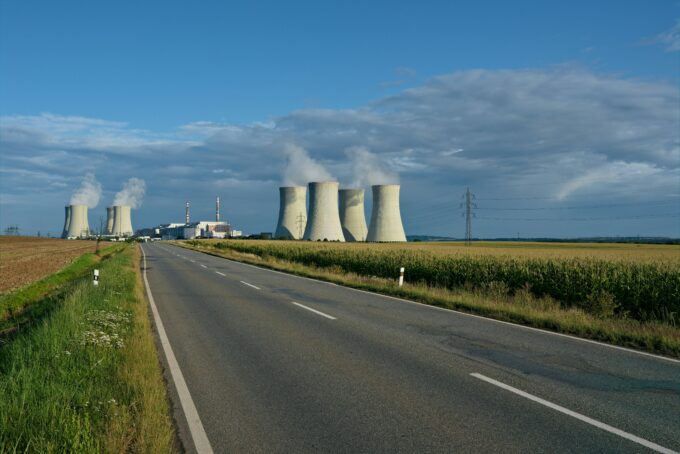
Image by Lukáš Lehotský.
Are all six New England governors out of their minds? It’s 2026, renewable energy is surging globally, nuclear power plants remain as dangerous as ever, and they want to build new nukes?
On September 30, Massachusetts’ Gov. Maura Healey will host her regional counterparts at a “pro-nuclear summit” at the University of Massachusetts-Lowell, for the public to supposedly learn about the so-called safety and benefits of “advanced” nuclear energy. Protestors will be there in droves, led in part by the Clamshell Alliance, which began exposing the perils of atomic energy half a century ago. The dangers nukes pose haven’t changed; 21st century marketing has.
At a time when the governors—and other leaders—should be the strongest voices promoting renewable energy, many instead either enacted legislation, or offered incentives, or adjusted regulatory frameworks to support nuclear development. We’re in the midst of a catastrophic climate emergency that demands we accelerate clean energy, not gamble our future on repackaged nukes.
Here’s a question: How likely would any state be taking another bite of the nuclear apple if the Trump administration hadn’t cut nearly $8 billion in Biden-era renewables funding last year? There’s a story CNN, MS NOW, and Politico would be well advised to pursue.
New nuclear plants take 10 to 15 years to come online. Small modular reactors—the industry’s latest attempt to rebrand its radioactive product—still exist only on paper. Solar, wind, storage, and efficiency can be permitted and built now, at a fraction of the cost. Every dollar, every year spent chasing nuclear is a dollar and a year not spent on the energy sources that can actually reduce emissions.
In 1977, I was one of 1,414 people arrested for protesting construction of a nuclear plant in Seabrook, New Hampshire, along once-pristine salt marshes inland from the state’s coastline. Part of the Clamshell Alliance, one of the first groups in the country organizing to halt nuclear construction, we didn’t need a degree in atomic energy to understand that nukes were hazardous, absurdly expensive, and a technology the government routinely lied about. The industry once claimed electricity from atomic reactors would be “too cheap to meter.”
Not long after Seabrook, I joined the staff of New Roots, editing a magazine chronicling the alternative energy movement, then still in its infancy. We’ve come a long way since then.
It’s been half a century since the antinuclear movement began waking the country up to atomic energy’s dangers—before Three Mile Island (1979), Chernobyl (1986), and Fukushima (2011), and the many near-misses since.
Longtime nuclear critic and Clamshell veteran Harvey Wasserman has compared the cost of the new reactors to renewables, noting that even pronuclear proponents concede they merely hope small modular reactors will cost “only” about three times as much as proven solar power, and four times or more the cost of offshore wind. Nuclear can’t compete with renewables on safety, construction time, climate impact, overall cost, or creating jobs.
Then there’s the waste no one wants to discuss out loud: every reactor over the past eight decades has produced radioactive material that will stay lethal for thousands of years, with no permanent storage solution anywhere. Nuclear infrastructure, from uranium mines to waste dumps, has a long documented history of landing hardest on poor, Black, Indigenous, and other communities of color, whose land and treaty rights get steamrolled in the process. Add nuclear plants sitting in active war zones in Ukraine and Iran, and the inconvenient truth that “civilian” nuclear programs are the on-ramp to developing weapons capability, and the case for caution isn’t nostalgia—it’s realism.
Governors: please do your homework to learn why the second Seabrook reactor was never built. When the twin-reactor project was proposed in 1972, it was projected to cost under $1 billion. By 1984, the price had ballooned past $10 billion. The utility abandoned the second reactor, and the primary builder filed for bankruptcy.
When you gather for your summit, governors, please don’t ignore the sea of protestors outside. Better yet: open a window, open the doors, and open your eyes. The energy future you’re looking for won’t be found inside your conference room. It’s been standing outside it for 50 years.