
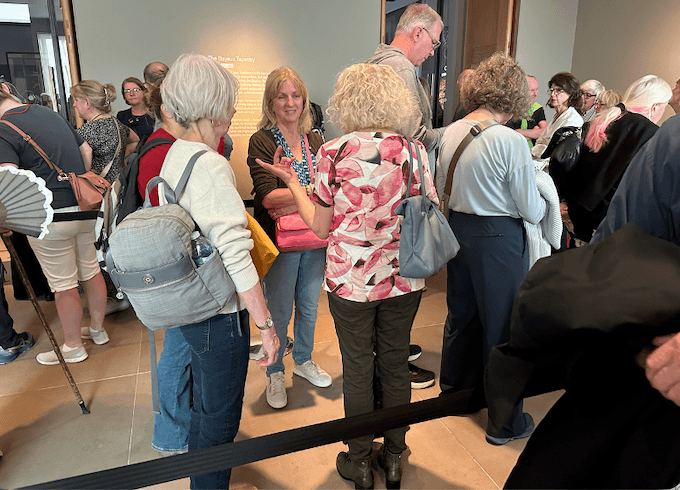
Visitors waiting in line, The Bayeux Tapestry exhibition, British Museum, Sept. 17, 2026. Photo: Stephen Eisenman.
“An Englishman, even if he is alone, forms an orderly queue of one.”
– George Mikes, How to be an Alien: A Handbook for Beginners and More Advanced Pupils, (1946).
Bayeux mania
The exhibition of the Bayeux Tapestry at the British Museum in London has generated a whirlwind of publicity and been a bonanza for the institution. Despite the high cost of transporting, installing and protecting the fragile embroidery (tapestries are woven), “Bayeux mania” is expected to generate about $14 million in profit (revenue above costs) for the venerable museum. That’s the vulgar side of things. The lofty side – the art, history and cultural legacy of the object – seems to be of less matter to exhibition curators and promoters.
Though the story of the Norman Conquest of England in 1066 told on the 70-meter-long embroidery unfurls like the panels of a comic strip, the meaning of key episodes has long been debated by experts. Even the famous scene of King Harold’s death is ambiguous. For the public, it’s worse: The figures mostly look alike, with long bodies and little, pointed heads; the relationship between the subjects in the middle of each panel and the vignettes in the borders above and below is opaque; and the identifying names and places are written in Latin.
The dramatic battle scenes are confusing and perhaps comical to many viewers. If you are used to Game of Thrones carnage, the bloodless separation of head or leg from torso on the tapestry, effectuated by two-edged Viking swords, will be deeply unsatisfying. The didactics don’t help much either. Wall texts and graphics at the BM are minimal and seem directed at children or teens, though the long queues to enter the exhibition space would tax the patience of any child.
But not the adult English public, for whom queues – standing in line – is a matter of heritage and pride. While the Bayeux Tapestry is an example of artistic virtuosity and an expression of French (or early Norman) chauvinism, the Bayeux Tapestry exhibition – by virtue of the long queues to enter — is an example of institutional power and an expression of English conformism. At the British Museum, to paraphrase Shakespeare, the queue’s the thing.
My first visit to the Bayeux Tapestry
Before it landed at the British Museum, the Bayeux Tapestry resided at the Bayeux Tapestry Museum, a specially converted seminary in Bayeux, Normandy. Before that (1948-1983), it was housed in the Hôtel du Doyen, an 18th C. private mansion in the same, small city. That’s where I saw it first, without the queues or crowds – in fact, all by myself.
In summer 1974, I cashed in the U.S. Savings Bonds I’d received as gifts for my bar-mitzvah five years before and blew the money (about $500) on a trip to Europe with my friend, Andrew Zerman. We flew with our backpacks to Reykjavik, and then on to London via Icelandic Airlines – the hippie express. I looked the part – long hair, Nehru shirt and bell-bottom trousers. But I preferred Beethoven to the Grateful Dead and herbal tea to marijuana. (That would soon change.) Andy wore chinos and swore by Stephen Sondheim. We camped for free in the basement apartment in Kensington of John Goldstone, a Zerman family friend we never met – he was busy producing Monty Python and the Holy Grail (1975) and The Rocky Horror Picture Show (1975).
Apart from visiting Carnaby Street and finding it dead, and being impressed by the Crown Jewels in the Tower of London, I have little recollection of what we did or saw. After a couple of weeks, Andy and I spilt up for a while, with a plan to meet up later in Paris and return together to the U.S. Before that, however, I wanted to go to Bayeux to see the tapestry. I’d learned about it from an old issue of National Geographic Magazine (1966).
The Channel crossing from Dover was my first cruise, though I was a veteran of the Staten Island Ferry. From Calais-Maritime station, I took the train to Rouen. After that, I stuck out my thumb to hitch the rest of the way to Bayeux. There, I stayed at an ancient-looking, half-timbered youth hostel and ate granola at breakfast with a bunch of other kids of different nationalities, all of them older, cooler, and sexier than me. That morning, I walked the short distance to the Hôtel du Doyen, paid the one- or two-franc admission and entered the still empty gallery.
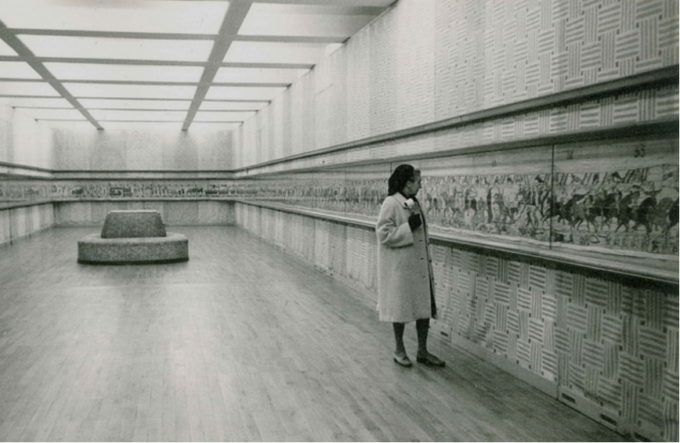
Bayeux Tapestry at the Hôtel du Doyen, Bayeux, where it remained from 1948-1983. Photo: Postcard, c. 1965.
I remember taking my time and following the dramatic narrative, section by section, frequently circling back to remind myself what happened before. Today, I can’t remember much of my reaction to what I saw except the following: that the people and events depicted were completely foreign to my experience and understanding. Eleventh-century Hastings might as well have been the planet Mars. I didn’t then know the L.P. Hartley quote: “The past is a foreign country; they do things differently there.” But I understood the sentiment.
The tapestry itself
In my undergraduate classes in medieval art at SUNY Albany in the mid 1970s, and later in graduate school, we spent little time on the Bayeux Tapestry. That’s probably because it’s a unicorn – there’s almost nothing like it, which means it’s hard to put it in art historical context. Unlike Romanesque churches and cathedrals – of which there are thousands (hundreds in Britain alone) – there are very few textiles of that age for the simple reason that they are extremely perishable. Moth larvae eat woolen threads, and beetles and silverfish will eat linen. A significant part of the artistic legacy of Britain and continental Europe wound up in the guts of bugs.
But that was a poor excuse for my teachers not spending more classroom time on the rare survival. The Bayeux Tapestry is a remarkable work of art, the medieval equivalent, as Karl Werckmeister noted, of the ancient Column of Trajan (113 CE) or Column of Marcus Aurelius (193 CE). Instead of Carrara marble however, it’s made of linen with woolen embroidery; and instead of spiraling upward, it spreads out horizontally – much more practical, when you think of it. Even though the Trajan column was originally flanked by a pair of libraries with viewing platforms, it still would have been impossible for Roman viewers to find a position from which to follow the whole narrative of the Emperor Trajan’s military campaigns against the Dacians. The Marcus Aurelius column, though more deeply carved than the Trajan and thus somewhat easier to “read,” was isolated in the Piazza Colonna, so its narrative was even harder to follow than the Trajan’s.
The Bayeux Tapestry, on the other hand, was originally draped (on special occasions) around the nave of the cathedral of Bayeux, probably just above eye level, and thus easy for anybody to see and appreciate. The comparison with Roman art isn’t fanciful: There are at least two scenes in the tapestry modeled after tableaux in the Trajan and Marcus Aurelius columns. One of them (scene 47) shows a mother leading a child from a scene of destruction. Its titulus reads: Hic Domus Incenditur “Here a house is burned.” It’s based on scene 20 from the Marcus column showing a mother leading a child away from a scene of fighting and looting, indicating that the designer of the embroidery had travelled to Rome and brought back a sketch or a memory of what he saw. The scene is poignant, with the quality that the critic Roland Barthes described in photography as “punctum” – the pregnant detail that brings up close something that is far away in place or time.
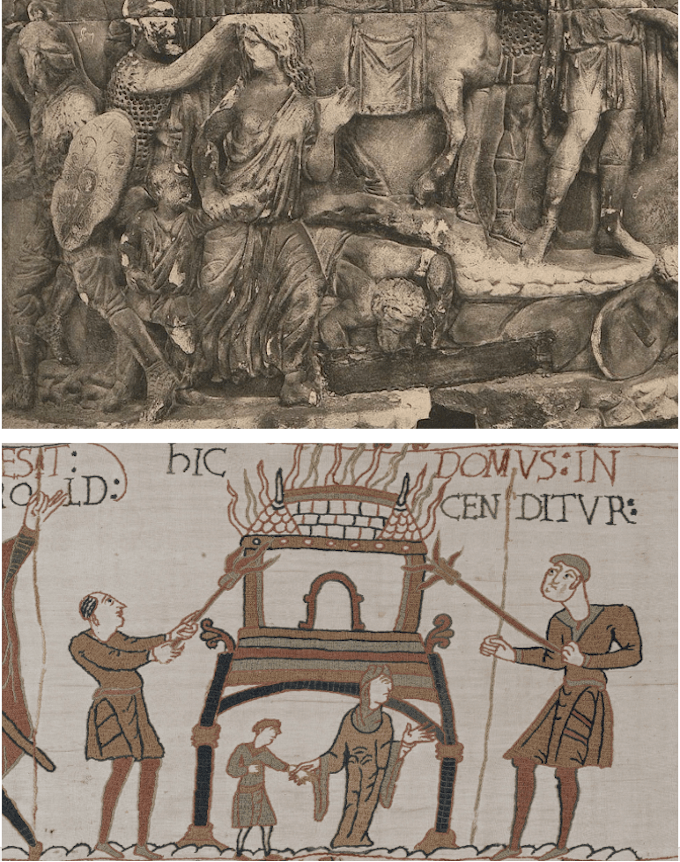
Top: scene 20, Column of Marcus Aurelius. Bottom: scene 47, Bayeux Tapestry.
About 800 years later, during the Peninsular Wars, the Spaniard Francisco Goya depicted a similar subject in an etching whose title, “I saw it” (The Disasters of War, c. 1810-15) makes explicit the direct emotional appeal implicit in the earlier representations. War photographers in Gaza, Iran and elsewhere today make similar entreaties.
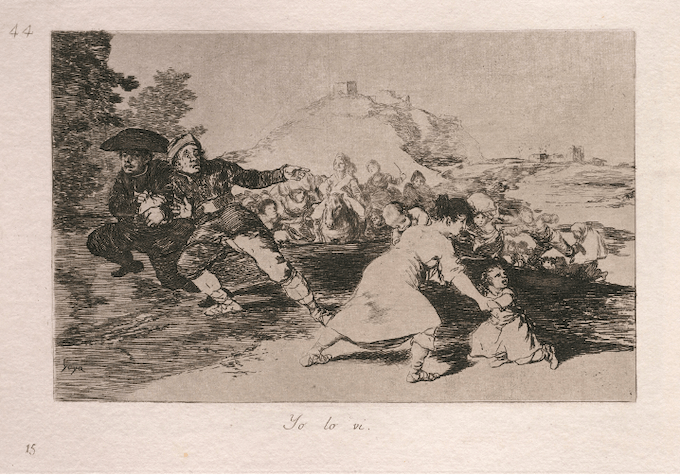
Francisco Goya, “Yo lo vi,” (“I saw it”), Disasters of War, c. 1810. Washington, National Gallery of Art.
The events on the Bayeux Tapestry unspool like an epic movie. Viewing it in the cathedral, as was the case originally, would have been the medieval equivalent of going to the cinema and seeing The Longest Day(1962) or Saving Private Ryan (1998). French viewers likely took similar pride in the outcome of the conflict.
The embroidery shows the defeat of the English at the hands of the French (the Normans) and the triumph of William (“the Conqueror”) over Harold Godwinson. The expression “history is written by the victors” couldn’t be truer than when applied to the Bayeux Tapestry. It was made about 15 years after the event and depicts the battle as a righteous restoration of the divinely ordered kingship of William. According to contemporaneous French chroniclers like William of Jumièges and William of Poitiers, King Edward the Confessor of England, lacking an obvious heir, chose his first cousin (once removed), William of Normandy to succeed him. Harold, his brother-in-law, accepted the designation with equanimity, but later, after an eventful visit to William in France, changed his mind and upon his return to England and the death of Edward, seized the crown. This is all shown on the textile, though again ambiguously.
Aggrieved by the usurpation, William quickly built and organized a flotilla of ships to carry soldiers and horses across the channel to Pevensey Bay, about 10 miles west of Hastings. This is represented by a succession of panels showing the felling of trees, the assembly of the ships, and their passage from France to England. William arrived on September 28, 1066, and the battle took place just over two weeks later, on October 14. Harold unwisely rushed to the fight immediately after defeating his own brother, Tostig Godwinson and the Viking King Harald Hardrada of Norway at Stamford Bridge in Yorkshire. He traveled with his forces by boat to London and then 60 miles on foot to the battle site near Hastings. Though the English troops were well armed and trained, the French had better tactics. Their archers and cavalry were more mobile and flexible than the vaunted English axe-men and defeated them in a single day. It probably wasn’t an arrow in the eye that killed Harold, as the tapestry suggests. That detail was embroidered much later; more likely, it was the blow to the thigh shown in the second depiction of Harold, at right. Blood loss and infection were the main killers in pre-modern wars.
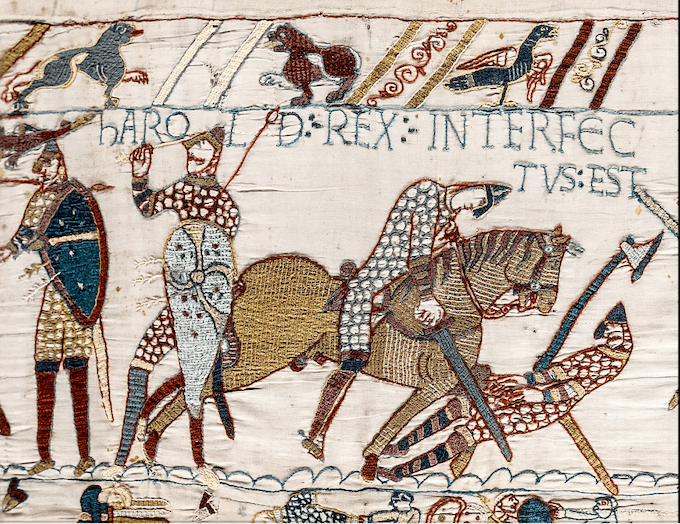
Scene 57, Bayeux Tapestry, “Here Harold was Killed,” c. 1085. Bayeux Tapestry Museum, France.
Though the battle was over fast, its impact was long lasting. Feudal England, with its weak kings and strong local nobles or earls, was conquered by an immensely rich and aggressive French Duke who embraced all the rights and prerogatives of a king. In England, he quickly consolidated his power by seizing land and property belonging to local earls and redistributing it to newly settled French nobles. He surveyed and assessed all real property in England (the “Domesday Book”) the better to tax and control it. And he proceeded to end many of the cherished customary rights of peasants to graze animals, glean, or hunt on common lands, and to legally challenge noble seizures.
In sum, the Battle of Hastings was a fight between avatars of two political systems, feudalism and an emerging centralized monarchy, and the latter won. Thomas Paine put it this way in Part II, Rights of Man(1792): “A banditti of ruffians overrun a country and lay it under contributions. Their power being thus established, the chief of the band contrived to lose the name of Robber in that of Monarch; and hence the origin of Monarchy and Kings.” English kings proceeded to consolidate wealth and power for another 600 years, only interrupted by a few, significant irruptions from below, for example the Great Peasant Revolt of 1381, Kett’s Rebellion of 1549, and the English Revolution a century later.
Those later revolts, and the political struggles in the 19th and 20th centuries for labor unions, voting rights, gay rights, decent housing, and a healthy environment were often fought with one eye cast back to 1066. That was when England was invaded and subjected to the “Norman yoke.” The goal of these latter day liberation struggles was to remove and destroy forever modern shackles, whatever form they took. However, the idea of the Norman yoke sometimes has another, far more retrogressive resonance. It suggests there was once a pure, Anglo-Saxon race that was sullied by foreign invaders. It proposes the existence of a unique Englishness that must be protected from foreign contamination.
Battle of the queue, 2026
My wife Harriet and I arrived at the BM about a half-hour before the 2 p.m. entry time on our tickets. The security queue was surprisingly short, however the queue in the Great Court to get into the exhibition itself was longer. The people waiting were mostly white, older (60-80+) and middle class, typical for most British museum exhibitions but especially weekdays during the school term. The exhibition is sold-out for the rest of 2026. A second and final tranche of tickets for next year will be released in early October. Tickets are about 40 bucks – not cheap.
After a few minutes of standing in this queue, a tall thin, young man with a round face and regulation British Museum polo shirt, approached the line and asked everyone the time stamped on their tickets. Those whose time was before 2 pm, were directed to move in front of us; those after, behind us, like at a crowded airport check-in. We cheerfully complied. Then, after a few minutes, I realized that British Museum members – they gripped their member cards like talismans — were drifting away from the main queue to form a second, shorter one to the right. Being proud (if recent) BM members, we moved there too. The tall young man (TYM) then conferred with colleagues by phone and returned to us to say (politely) there was no special queue for members, and we should all return to our former places.
By now bored with my phone, I walked back to ask TYM about the logistics of the operation:
Me: “So, I read that museum officials expect about a million visitors over the ten months of the exhibition. That a 100,000 per month, 3500 per day, 400 per hour…”
TYM: “Yes, and 6 ½ per minute.”
Me: “How are you managing the half-people?”
TYM: (smiling, patronizingly): “As you can see, we are not reaching our quota. I think they’ve oversold tickets. Are you from New York?”
Me: “Yes, Queens, Forest Hills. Most people notice from my accent that I’m American, but almost nobody says New York. How did you know?”
TYM: (smiling again, this time for real) “I worked on the North Fork of Long Island as a camp counselor, and lived for a while in Richmond Hill, in Queens. I love New York!”
My new friend was then accosted by another staff member, and I returned to Harriet in the queue, who teased me about flirting with TYM, whom she obviously found attractive.
That’s when it became clear we had an ordeal ahead of us. It was another 30 minutes before we entered a darkened atrium with large, back illuminated, photographic panels showing the presumed, present site of the Battle of Hastings. They featured overgrown fields and pastures, many bordered with brambles and nettles, obvious signs of eutrophication – over-rich soils due to excessive animal waste and fertilizer. In the early Middle Ages, I thought, the fields and pasture lands of Kent would likely have been similar, albeit fertilized with human as well as animal waste. By 1066, most trees had been felled. Today, England only has about 10% forest cover, less than almost any place else in Europe, but only slightly less than at the time of the Norman conquest.
An elderly gentleman next to me — I learned his name was Robin and he was 86 — saw me looking closely at the photos of currently protected land and said to me: “We have you Yanks to thanks for that.” I quickly replied: “There aren’t too many Brits offering thanks to Americans these days!”
Robin: “I meant the idea of establishing national parks, like Yellowstone.”
Me: “Thanks! But my government is currently doing everything possible to undermine them.
Robin shook his head sadly and then introduced me to his much younger companion, Susie. This was his second visit to the exhibition, he said, and Susie was his guest. I told her she’d need a lot of patience to complete the odyssey; she nodded politely but seemed content to cling tightly to her friend’s arm.
About 20 minutes later, we entered what I thought was the exhibition itself but was only another preview gallery. On the right was a glass wall with an overhead view of the tapestry and spectators in the long gallery below. On the left was a succession of animations of the tapestry, brief, explanatory texts, and a few glass vitrines containing medieval artifacts. Everybody remained in a narrow queue; I however, departed the line to look more closely at the didactic projections, the artifacts in the vitrines, and at the tapestry itself visible downstairs through the glass wall – this required walking past people on queue. I stopped and turned back to Harriet, gesturing for her to follow me, but she frowned, shook her head, looked down, smiled at me indulgently — and stayed right where she was.
Not sure what to do, I turned to look at the folks in the queue. They were staring daggers – or double-edged Viking swords — at me. One quickly said, “Don’t jump the queue!” Another repeated the warning and stepped out of the queue to block any further forward passage. He was tall and wide. I said: “Don’t you see, this is a gallery not a hallway. We don’t have to stand in line; the museum staff even told us to fill the space.” (This was true.) Despite my little speech, the hostile stares, shouts and muttering continued. “Maybe that’s what Yanks do, but not Brits.” Another said loudly, “English people, unlike Americans, stand in queues!” The big man held his ground. Concerned for my safety, I slouched back to my place in the queue, next to Harriet. After another 45 minutes, we were at last admitted to the sanctum down below, where we walked, one by one, in a queue to see the Bayeaux Tapestry. We had about 20 minutes of viewing time.
Blue Bayeux
Back home in Norwich, I told my University of East Anglia friend, A.F., a scholar of political rhetoric, about my unsettling experience at the BM. Though I grinned while describing about it, I also said I felt ganged up on – even threatened for jumping the queue. He smiled knowingly and told me the queue is the last vestige of British collective spirit, the attitude of “keep calm and carry on,” demonstrated during World War II and the Blitz. Seventy years later, in 2022, after the death of Queen Elizabeth, some 250,000 people stood in line – “The Queue” it was simply called — to file past the coffin of the queen while she lay in state in Westminster Hall in London. For a while, it stretched five miles along the Thames to Southwark Park. Passage from the end to the front of the queue took about 24 hours.
The unbreakable queue, my friend also told me, represents solidarity and resistance to interlopers and foreigners. The English are immensely proud they haven’t been invaded in the nearly thousand years since the Conquest. Standing in a queue before entering a movie, sports event, or museum exhibition is an expression of continued resistance to the “Norman yoke.”
When I inadvertently broke the queue at the Bayeux Tapestry exhibition, I became an invader, violating the rights of the “free-born Englishman”, the pre-Norman Anglo-Saxons described by the British historian E.P. Thompson. Two of the most vehement objectors to my violation referred to me as “Yank” and used “us and them” language: “English people, unlike Americans….” For the first time since moving to the U.K. in 2024, I felt like an unwelcome stranger. The experience was unpleasant, but nothing compared to what other immigrants experience – ones less rich and white than me.
Since the influx of Irish people following the potato famine of the 1840s, immigrants – especially poor, non-protestant, or non-white ones – have been described by English politicians and journalists as an invading force. During the campaign for Brexit in 2016, current Reform Party leader Nigel Farage frequently wore a tie with scenes from the Bayeux Tapestry, saying it was a reminder of “the last time we were invaded and taken over.” A little later, the Murdoch-owned tabloid, The Sun, created and published its own “Bye-EU” tapestry to promote Brexit. Today, the term invasion is used by anti-immigrant and racist groups to describe asylum-seekers, especially those who come to the U.K. on small boats and at great risk. They represent about 5% of total legal and illicit immigration to the U.K. and less than 0.05% of the population.
Successive Tory prime ministers – Boris Johnson and Teresa May as well as Home Secretary Suella Braverman – in addition to Farage, frequently used the language of invasion as well as the term “jumping the queue” to describe the movement of immigrants to the U.K. Recently, the U.S. has followed Britain’s rhetorical lead, describing migrants to the U.S. as akin to a military “invasion” or “surge,” and stopping them as “securing the homeland.”
If I had been brave (or foolhardy) I would have told my English antagonists that a culture built upon respect for the queue is nothing to be proud of, and that while I accept that a well-disciplined line can ensure equal access to everybody, enthusiasm for the queue is illusory egalitarianism; it represents conformity to arbitrary power.
What we all should have done – 90 minutes into the queue to see the Bayeux Tapestry – was sit down on the floor and demand to see the museum director and receive an explanation for the long wait. And we should have insisted upon a ticket refund and assurance that future audiences wouldn’t be treated the way we were! And we’d finish by saying we were only doing what our ancestors had done during wartime, labor strikes, and anti-war, anti-nuke, and anti-global warming protests: resisting the Norman yoke!


