Radiant at the Stars, the new novel by San Francisco author and teacher Elaine Elinson, describes the adventures of a young Jewish American woman with leftist leanings who leaves her home and family in Chicago to observe and take part in the revolutionary movement in Russia near the start of the 20th century. Published by Sibylline Press— which brings into print work by women above the age of 50— Radiant begins in the aftermath of the 1905 revolution, when liberal reforms swept across the country and ended with bloody repression. Lenin called 1905 a “dress rehearsal” for 1917
Elinson’s novel ends before the 1917 revolution, a world-historical event that the intrepid American journalist, John Reed, described in Ten Days That Shook the World, a masterpiece of eyewitness reportage. Lenin’s introduction helped to make it a global bestseller and required reading for wanna be revolutionaries who have never seemed to be daunted by the failures of revolutions or the scorn heaped on them by reactionaries. Elinson’s novel suggests that it’s never too late or too early to rebel.
Her political fiction was inspired by real historical events that are linked seamlessly to the personal life of Anna, the fictional narrator and main character, who seems like she might have emerged from the pages of Reed’s classic or from Warren Beatty’s movie Reds, which tells the story of Reed himself, his lover Louise Bryant, and their friends and comrades in Russia and America.
But the origins of Elinson’s novel were much closer to home than the work of Reed and Beatty. In an Author’s Note at the back of the book, Elinson explains that the unpublished diaries her Russian Jewish grandmother, Anna Feldman Gomberg, kept in Russia from 1905 to 1918, inspired her novel. She adds that Gomberg’s organizing and activism were “clandestine and illegal,” and that her grandmother shared stories with her when she was young. Some of those stories made their way into the novel, which might be called a family saga. The author had to invent and imagine when facts were missing or unavailable.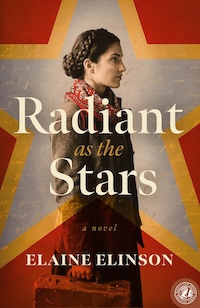
Radiant as the Stars is laced with fearless revolutionaries, passionate anarchists, nasty anti-Semites, impoverished Jews, hungry peasants, tortured political prisoners, sadistic jailers and more: the whole Russian human comedy in upheaval. It begins as an innocent love story and romance, picks up speed with a brazen assassination and ends with a blaze of resistance and repression. The novel takes readers into the past, but it also feels as fresh as the news that has emerged recently from places like Minneapolis, where peaceful protesters were beaten, shot and killed by agents of ICE who acted as barbarically as the agents of the tsar.
Radiant as the Stars feels like a novel that the author herself has lived. We see and hear and feel as Anna feels and sees and hears. We taste the bread, soup, gefilte fish and chicken that she devours, and we share with her her dreams for a better world.
As the co-author of Wherever There’s a Fight, which describes the feats of suffragists, strikers, immigrants and poets in California, Elinson is eminently qualified to write about people who make good trouble and aren’t cynical. Like the author herself, the main character reads novels and poetry, including the work of Pushkin. She wants bread and roses, an end to hunger and beauty, too. Don’t all genuine revolutionaries?
The writing is clear and precise, the prose punctuated with Jewish words and expressions such as a sheynew dank and got in himl. You hear Yiddish spoken, whispered and proclaimed. The narrative provides a series of moving images, races across an ever-changing landscape and recounts “a magical journey” that’s all too real and graphic. It also provides valuable information about The Bund, the union of Jewish workers founded in Vilnius, Lithuania, in 1897 that spread to the US and infused the labor movement.
As the descendant of Russian Jews who immigrated to the US in the early twentieth century and who became American citizens, I related to Elinson’s story and to her characters. My grandfather Aaron Quitkin voted for Eugene Victor Debs. Aaron called himself a socialist and denounced the Communists who turned to violence. His own daughter, my mother, much to his alarm joined the American Communist Party as did several of my aunts and uncles who aided the labor movement and civil rights struggles and were persecuted during the Red Scare of the 1950s.
I remember the iconic ad I saw at New York subway stations that depicted an American Indian eating a sandwich. I also remember the words, “You don’t have to be Jewish to love Levy’s real Jewish rye.” An ad for Radiant might say something similar. Indeed, you don’t have to be Jewish or a Red to enjoy Anna’s revolutionary adventures. If you have to read one novel that is both political and personal, you might pick this fine work of fiction by a woman who coordinates writing groups in San Francisco and who provides helpful comments and encouragement to one and all. Radiant might inspire you as Anna’s life inspired her granddaughter.