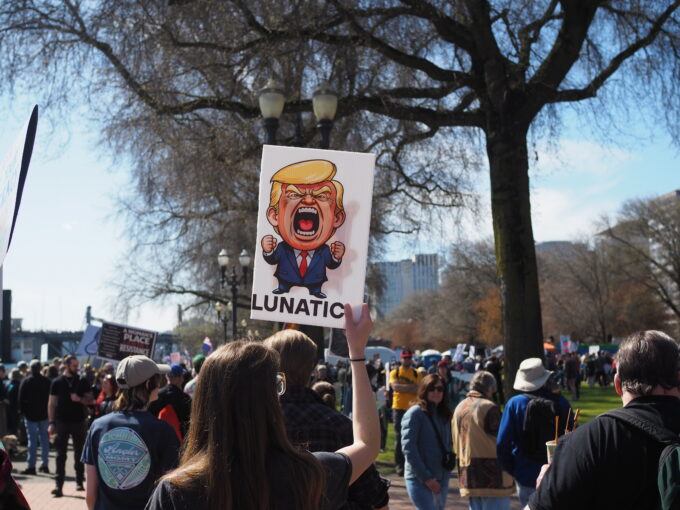
Photograph by Nathaniel St. Clair
Narcissism: Marked by grandiosity, pride, arrogance, and a constant need for attention and admiration.
Psychopathy: Characterized by high impulsivity, thrill-seeking, low empathy, and a complete lack of remorse for hurting others.
I am not aware of any article or editorial in the mainstream media that describes Donald J. Trump as a “pathological” or “psychopathic narcissist.” The New York Times’ Peter Baker, who writes regularly about Trump, is critical of the president, but frames his argument around Trump’s so-called “transactional” behavior.
In other words, Trump is simply bargaining or negotiating on a “give-and-take” or quid pro quo basis.” The transactional theory does not give any hint of the recklessness of this man or his danger to our nation. Indeed, the entire global community is living with this danger.
Baker’s most recent article (“TV Boycott Draining President of Lifeblood: All Eyes on Him,” New York Times, September 23, 2026, p, 1) is a perfect example of the false emphasis on Trump’s so-called transactional behavior. Baker emphasizes that Trump’s loss of television coverage is a “threat to the way that Mr. Trump has governed.” Baker adds that “not having the network cameras present for the big unveiling [the helipad at the White House] had to sting.”
But the problem of Trump’s potential actions is far more serious than his occasional frustration. His mental state appears to be increasingly disturbed and is made even more dangerous by his long-term belief in the importance of fear and his increasing emphasis on the use of force. His threat at the United Nations to “annihilate the Islamic Republic and to do it quickly, never giving them a chance to kill and destroy people and countries again,” was both shocking and terrifying. The fact that this threat was made at the UN’s General Assembly, where world leaders were pleading for international cooperation and the end to war, made it even more horrible.
While Trump’s grandiosity appears to stem from confidence, it is far more likely that fragile self-esteem finds him both dependent on constant praise from others and hypersensitive to criticism. He doesn’t seem to have close friendships, which is not uncommon with pathological narcissists.
Trump’s paranoia and lack of impulse control are most worrisome because it can lead to destructive acts. In his first term. Trump’s rants were followed by threats of a trade war that could hurt global economic output and would make the United States vulnerable to tariff retaliation from others. This is exactly what is happening in Trump’s second term. There were ugly exchanges between Trump and North Korea as well as Trump and Iran in the first term, and now we’re at war with Iran with no end in sight.
Meanwhile, the mainstream media remain focused on whatever distraction Trump throws their way, while the real threat to the United States and the American people remains the irrational and impulsive nature of the president himself. The combination of Trump’s narcissism, a losing war, growing economic and political insecurity, and international instability worsens the problems facing an anxious American public. It is difficult to imagine what two more years of Trump’s demagoguery and misogyny will do to America’s democracy and the world’s stability.