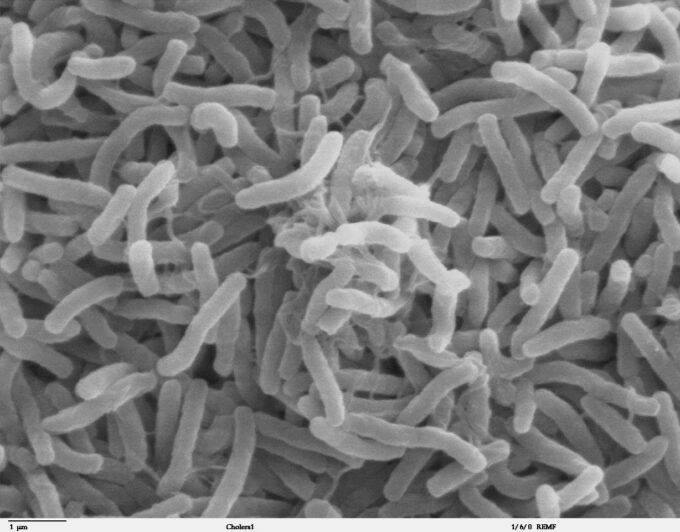
Image of Cholera bacteria SEM
In the 1830s, a wave of cholera spread across Europe, leaving thousands of dead in its wake. The relatively new nation of the United States hoped it would be spared. This hope was often couched in xenophobic and anti-European language. When cholera did hit the United States, moralists religious and otherwise told the people that only those with dirty and drunken lifestyles would be inflicted. Of course, as the illness spread—reaching epidemic proportions—the fact that those who succumbed came from all classes and all walks of life could not be explained away, no matter how much the moralists tried. Although it is true that a majority of the dead were poor, it cannot honestly be said that it was their habits or their ethnicity that caused them to get the disease, but their living conditions, a fact mostly left unsaid.
A new book titled Hidden Terrors: The Scourge of Cholera in Jackson’s America examines the epidemic of cholera in the United States, the reactions to it, and the socio-political ripples these caused. The author, historian Paul Kelton is also the author of other histories regarding the spread of disease and the manipulations of the narrative of those diseases in nineteenth century United States. As Kelton writes about the cholera epidemic, the similarities to the societal upheaval the recent COVID-19 pandemic caused are too obvious to avoid. Kelton does not need to remark on this—certain similarities are just too obvious.
The years of the cholera epidemic in the United States were years when Andrew Jackson was the president. The racist attitudes toward the indigenous and Black residents both enslaved and free that were prevalent among much of the US population at the time were a pillar of Jackson’s rule. One need look no further than his Indian Removal Act to understand this truth. The ethnic cleansing campaign waged under this legislation meant that tens of thousands of indigenous people—Cherokee and Choctaw foremost among them—were forcibly removed from their lands (nations) and sent westward under military guard so that the land they were expelled from could be given to white settlers. The movement of the native peoples exposed them to the cholera which in turn spread the disease west in their wake. Kelton remarks that the Choctaw would have experienced no deaths from cholera if they had been left alone; the ethnic cleansing caused the killing.
This phenomenon was replicated numerous times among other migrant residents, especially men hired to build a growing infrastructure in the country—canals, roads, etc. Many of these men were recent Irish immigrants whose presence was often resented both because of their transient status and their Irish nationality. Of course, the living quarters of the migrant workers was usually poor: no indoor plumbing, infested with rodents and insects, and overcrowded. This was the case whether the living quarters were provided by the employer or local residents. In an all too familiar sentiment, the workers were blamed for their own filthy conditions while those providing the quarters were absolved of responsibility and blame. A similar scenario played out in regards to the spread of the disease among the freed Blacks; most lived in poorly maintained residences while also being denied most medical services. There were no indoor plumbing facilities and little safe drinking water.
Regarding water, it is a well-known and established fact today that the bacteria that causes cholera flourishes in untreated water. However, in the 1830s most scientists and those fancying themselves as such insisted that the disease was carried through the air. Common treatments for those who could afford and access them included bleeding and other therapies since proven ineffective. In addition to the misinformation being proffered by scientists and doctors there was a multitude of remedies in the public conversation which had little basis in fact and were usually based in unfounded theories, ignorance, religious nonsense, bad medicine and superstition. Furthermore, as mentioned earlier, various public moralists seeking fame and money claimed that the epidemic would only touch alcoholics, sex addicts and workers, and other humans whose lifestyles repelled the upper classes and their preachers. When these claims proved to be nonsense, the moralists came up with other rationales, none which were any closer to the scientific facts.
Then there were the profiteers. Among this group of amoral (immoral?) capitalists was a company named Franklin, Armfield and Co. The company’s primary business was trading in human beings. In other words, they were slave traders. Like all those in the financial speculation business, Franklin and company bought low and sold high. As the epidemic intensified, especially in warm climates like the of New Orleans, the number of deaths among the enslaved grew rapidly. Slave trading businessmen took advantage of the situation and began buying humans in places where the cholera had diminished like Virginia and transporting their purchases south where they could fetch a substantial profit. Besides the essential evil of the slave trade itself there was the conditions of the transportation; many of the enslaved died on their way to New Orleans and many others died when they reached the property of their new owner. In addition, was the diffusion of the cholera along the way and the illegal and clandestine burial of cholera-ridden corpses by the slavers. The only person who answered for the illegal burials was an employee of Franklin’s who the owners placed all the blame. The rest of the enterprise was business as usual.
Hidden Terrors is a unique study of disease and its societal effects. Told primarily from the point of view of regular people from different walks of life, it is a tale of ignorance, moral rectitude and political expediency. For the reader of today, it is instructive, especially when considering the recent societal cataclysm generated in the global bout with COVID-19 from 2020-2021. The alarm, the fear and the confusion generated in both instances are remarkably similar. So are the profiteering, political manipulation and misinformation, and the misuses of power.