
Photo by Art Institute of Chicago
Employment does not necessarily guarantee economic security for many working families. That lesson is clearly evident in this week’s release of the Census Bureau’s annual income, poverty, and health insurance data for the year 2025.
Although annual earnings for full-time, full-year workers increased in 2025 compared to 2024, the poverty rate for full-time, year-round workers remained stable at 4.1 percent. However, the proportion of working individuals without full-time, year-round employment living in poverty was 15.5 percent, which is slightly higher than the figure reported in 2024.
These findings are based on the supplemental poverty measure (SPM), which reflects how families experience economic strain and meet basic needs. This measure incorporates evolving living standards, accounts for taxes, work and child-care expenses, health expenses, and adjusts thresholds according to geographic location and specific household circumstances.
In 2025, the SPM poverty threshold for a renting family of four, consisting of two adults and two children, is estimated to be approximately $41,700. Consequently, a gross wage of about $20 per hour is required for at least one full-time, year-round working household member to avoid poverty.
However, the available jobs do not always measure up. Many common jobs do not pay enough to lift individuals and families out of poverty. Wages are low, hours are often erratic, and the consistency and number of hours worked depend entirely on the employer’s discretion.
In another scenario, a family of three would require full-time, full-year work with at least an $18 hourly wage to stay above the SPM poverty line. But many working parents, especially non-salaried and single parents, may have to work reduced hours or leave the labor force at some point during the year. They often face barriers to work, including mental health, substance abuse, transportation, child care issues, or lack of support from the other parent.
While this week’s income poverty report offers a valuable overview of economic well-being, it may not encompass all aspects of economic insecurity experienced throughout the year. However, the annual SPM data highlight the significant impact of public programs on reducing poverty.
SPM poverty remains relatively stable compared to the previous year, with approximately 44.4 million people falling below the cutoff. This year’s report again highlights the significant impact that social programs have on reducing poverty, especially those targeting working families and children. For example, as shown in Figure 1 below, refundable tax credits lifted 3.3 million children out of poverty, including 2 million through the Earned Income Tax Credit (EITC) and 1.3 million through the refundable portion of the Child Tax Credit. The Supplemental Nutrition Assistance Program (SNAP) also kept 1.2 million children out of poverty. School lunch programs lifted another 650K children out of poverty.
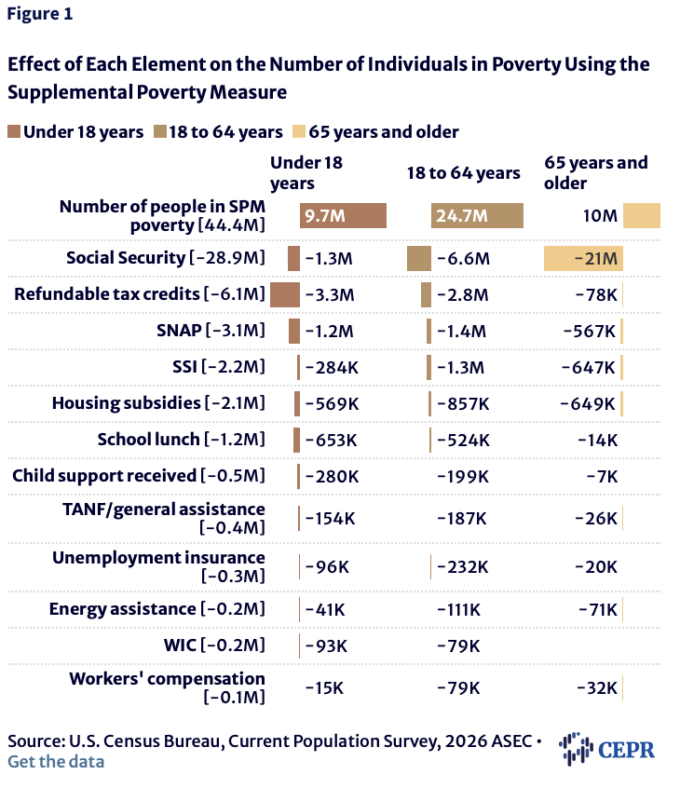
As anticipated, as the largest social insurance program, Social Security had the most noticeable poverty-reducing effect, keeping an estimated 21 million older adults out of poverty. Housing assistance programs also appeared to have a meaningful effect on reducing poverty. Without housing subsidies, an additional 2.1 million people would be in poverty, including 850K working-aged adults.
This chart illustrates the effect that each program individually has on reducing poverty; therefore, the overall effects should not be summed, as families may benefit from multiple programs simultaneously. Overall, many government programs play a crucial role in addressing the financial challenges faced by families beyond their earned income. Some programs, such as SNAP, provide ongoing monthly assistance for grocery expenses. Housing subsidies help reduce monthly rent burdens, while Supplemental Security Income offers monthly cash support for low-income individuals with disabilities. For those with earnings near the poverty line, ongoing public assistance can provide essential additional resources.
However, significant cuts to these programs – like those prescribed by the One Big Beautiful Bill Act – will likely lower the standard of living for millions, or push them into poverty in the coming years.
This first appeared on CERP.