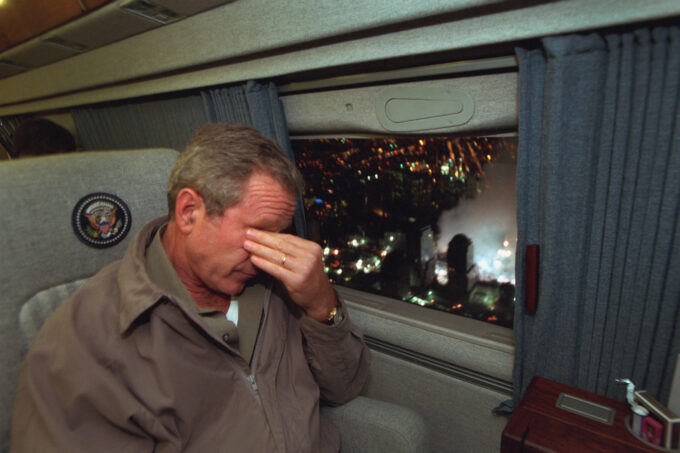
Photograph Source: Eric Draper – Public Domain
Last Friday, the Central Intelligence Agency released 69 presidential intelligence reports that contained no major new revelations and underplayed the intelligence failure that permitted the terrorist attacks of 9/11. The New York Times contributed to the underestimation by ignoring analytical failures that can be documented. As I have written in the past, the CIA’s intelligence collection was good enough to prevent the 9/11 attacks, but CIA leadership and its intelligence analysis were severely lacking. Any attack on the United States that takes place without strategic warning is by definition an intelligence failure.
Both the CIA and the New York Times give too much credit to then-CIA director George Tenet for calling attention to a possible terrorist attack against U.S. interests. Neither institution noted the charges in the CIA Inspector General’s report that cited Tenet’s inability to marshal the resources of the intelligence community and to generate a comprehensive approach to the problem of al Qaeda and terrorism.
Tenet did nothing to transfer funds or personnel to the program designed to counter al Qaeda, and most intelligence agencies were entirely unaware of Tenet’s feckless “Declaration of War” in 1998 after the attack on the U.S. embassies in Kenya and Tanzania by al Qaeda. The declaration was not hand-carried to the various principals in the intelligence community, but faxed to their watch offices where it was lost in the myriad pieces of paper that arrive there hourly. Tenet sounded the tocsin about the threat, but failed to follow through on his warnings. Nevertheless, he retired from the CIA in 2004 with the highest award that can be given to a civilian—the Presidential Medal of Freedom.
The 9/11 failure was particularly stunning because, in 1995, the CIA had access to the infamous Bojinka plot, which outlined such terrorist targets as Wall Street, the Pentagon, and even CIA headquarters. But the CIA never linked the activities and relations between Osama bin Laden, his deputy Ayman al-Zawahiri and Ramzi Yousef, who masterminded the 1993 World Trade Center bombing and drafted the Bojinka plot. Nor did the CIA recognize the crucial role of Khalid Sheik Mohammed, who was the mastermind behind 9/11—not bin Laden. Indeed, bin Laden was initially skeptical of KSM’s plan. CIA didn’t fully accept the reporting from foreign liaison services in the Philippines and Pakistan that linked Yousef, KSM’s nephew, to a plan to hijack and destroy U.S. airliners in the Pacific.
It has long been forgotten, but Rex Hudson of the Federal Research Division of the Library of Congress and University of Pennsylvania Professor of Political Science Stephen Gale, without the benefit of intelligence information and foreign intelligence liaison, anticipated the hijacking of commercial aircraft and warned the CIA’s National Intelligence Council and the Department of Transportation. Hudson identified a paradigm shift in terrorist tactics in his 1999 study, which had escaped the hundreds of analysts in the intelligence community. None of the presidential intelligence reports referred to the weaponizing of commercial aircraft or the possibility of targets in the United States.
One week after the 9/11 attacks, then-national security adviser Condoleezza Rice told the press corps, “This isn’t Pearl Harbor.” No, it was worse. Eighty years ago, the United States didn’t have a director of the Central Intelligence Agency, or fifteen intelligence agencies, or a combined intelligence budget of more than $50 billion to provide early warning of enemy attack. Just as intelligence was unimaginative, divided, and diffuse on the eve of Pearl Harbor, there was little innovative thinking on terrorism in the intelligence community prior to 9/11. But like Pearl Harbor, there was enough intelligence collected to prevent 9/11.
(Part II next week will discuss additional elements of the corporate policy and intelligence community failure of 9/11, which raises issues regarding current U.S. policy in the national security arena that require objective and tough-minded intelligence. The inability of the mainstream media to monitor and investigate the shortcomings of the intelligence community is one of the reasons that Reporters Without Borders that tracks press freedom now ranks the United States as its lowest since the organization started the index in 2002. The United States now ranks 64th, just above Panama and just below Botswana. Donald Trump’s efforts to stifle freedom of the press is, of course, the major reason for the U.S. decline.)