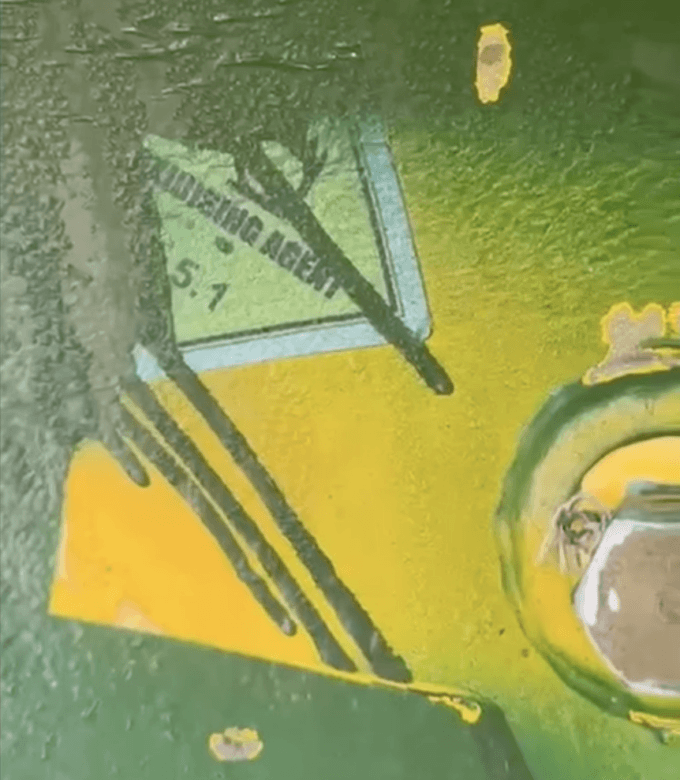
Chemical weapon canister in Sudan. (Screen capture from video posted to Instagram.)
Mounting evidence that chemical weapons may have been used in Sudan is raising an increasingly urgent question: not simply what happened, but whether the international machinery created to investigate such allegations is capable of acting before crucial evidence disappears.
That question has particular resonance for Santiago Oñate, the former Mexican Ambassador to the United Kingdom and former legal adviser to the Organisation for the Prohibition of Chemical Weapons (OPCW). Oñate spent years dealing with the legal and evidential questions surrounding alleged chemical-weapons use, including in relation to Syria.
I have a close contact who worked with the OPCW. I know that Oñate and his work on this subject, as well as his concern about Sudan, is worth taking seriously. His argument is not that every element of the case has already been proven. It is almost the opposite: the evidence has now reached the point at which failing to investigate it properly risks making proof impossible.
If anything, the allegations have grown considerably more substantial.
Workers at the Al-Jili oil refinery north of Khartoum have described an incident in September 2024 in which an aircraft passed overhead before an object fell without the blast, fire or shrapnel normally associated with a conventional explosive. Instead, witnesses described a yellow-white cloud, unusual chemical smells and men rapidly developing breathing difficulties. Around twenty workers were reportedly affected and two lost consciousness.
Subsequent investigations have sought to test those accounts against photographic, video and documentary evidence. France 24’s Observers unit reported that it had geolocated and authenticated material connected with the incident and investigated the provenance of a chlorine container found near the alleged impact site. In April 2025, the United States formally determined that the Sudanese government had used chemical weapons and subsequently imposed sanctions.
More recently, further reporting based on leaked Sudanese military material has added allegations concerning the manufacture and use of chlorine munitions.
None of this eliminates the need for forensic investigation. It makes that investigation more urgent.
As Oñate puts it: “There are important limits to what we know. No independent investigators have reached the alleged impact sites. There has been no environmental or biomedical sampling, laboratory analysis or forensic examination of recovered munitions. That is not an argument for withholding judgment indefinitely. It is an argument for investigating now.”
That distinction is important. An allegation of chemical-weapons use should not be treated as established merely because several reports point in the same direction. But neither should the absence of definitive forensic evidence become a reason for doing nothing when access to the evidence itself is being delayed.
Oñate knows from his OPCW experience how such cases have to be constructed. Investigators may need to combine witness testimony with evidence about munitions, delivery systems, symptoms, military capabilities, environmental samples and documentary records.
In Sudan, some of those evidential strands may already exist. Others remain inaccessible.
And time matters.
“Evidence degrades,” Oñate explains. “Digital files corrupt. Devices fail. Witnesses relocate or forget details. Records disappear. Waiting until the political circumstances are more convenient is not a neutral choice: it benefits those with an interest in ensuring that the truth becomes harder to establish.”
One potentially important example is a mobile telephone reportedly containing original photographs and video relating to the refinery incident. The device is said to have been water-damaged but remains in the possession of a witness. Whether useful forensic material can still be recovered from it is unknown. The longer such evidence remains unsecured, however, the greater the danger that an opportunity to establish what happened will be permanently lost.
There is also a broader institutional issue.
Sudan is a state party to the Chemical Weapons Convention, the treaty that not only prohibits chemical weapons but established an international system intended to uphold that prohibition. If credible allegations can simply remain uninvestigated because investigators cannot obtain access, the consequences extend well beyond Sudan.
Oñate is particularly forceful on this point: “If a state facing credible allegations can deny investigators access until evidence disappears and international attention moves elsewhere, the Convention risks becoming a statement of aspiration rather than an enforceable prohibition.”
That is why the appropriate international response need not depend upon prejudging the ultimate findings of an investigation.
Governments can press for independent technical access without declaring in advance what investigators will find. Evidence that can be preserved outside the alleged attack sites—including digital material, hospital records, refinery records, witness testimony and accounts from medical personnel—can be secured. And that work can be coordinated with the UN’s Independent International Fact-Finding Mission for Sudan and other bodies documenting violations committed during the conflict.
The distinction between investigation and accusation is essential. So is the distinction between uncertainty and indifference.
Sudan’s war has generated atrocities on an enormous scale. Against that background, an alleged chemical attack affecting a relatively small number of people might easily disappear into the catalogue of suffering. But chemical weapons have a particular significance because the international community has constructed one of its strongest legal prohibitions around their use.
As Oñate argues: “Sudan is becoming a test of something larger than this war: whether the international system for preventing chemical warfare still functions when confronted with credible evidence and political obstruction.”
There may not yet be enough independently verified evidence in the public domain to state conclusively what happened at Al-Jili, still less to establish the complete chain of responsibility for any chemical-weapons programme.
But that is precisely why an investigation matters.
The choice facing the international community is not between declaring the allegations proved and dismissing them as unproved. There is a third course: preserve the evidence, obtain access, investigate it independently and establish what happened while it is still possible to do so.
Or, as Oñate puts it: “There is now more than enough evidence to demand that those questions be answered.”
The danger is that, by the time the world decides it wants the answers, some of the evidence needed to provide them will already be gone.