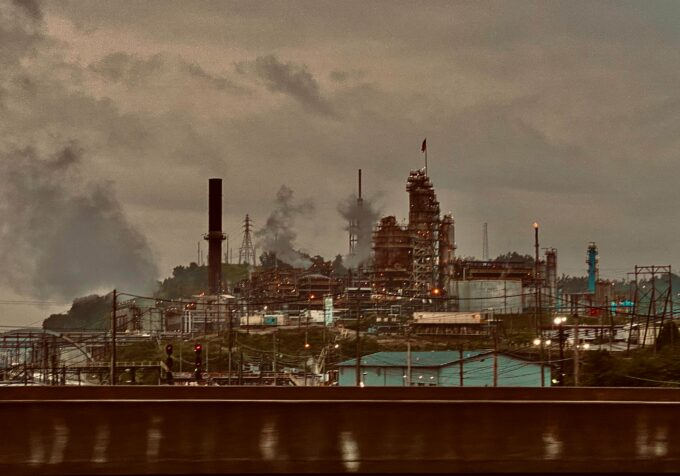
Oil refinery, Ashland, Kentucky. Photo: Jeffrey St. Clair.
As the Houthis seize the Red Sea coast of Yemen, with the apparent help of Iranian advisors and little effective resistance from the officially recognized government, the price of oil briefly spiked again to over $100 a barrel. Diesel fuel remains at record highs due to a lack of refinery capacity. This was in addition to a series of drone attacks, coming from Iraq, on the East-West Pipeline that has been increasingly used since the war began to take the pressure off the blocked Strait of Hormuz. Saudi Aramco was able to restart the pipeline after roughly 10 days but getting the pipeline back to normal capacity could take a couple of months. Meanwhile, getting oil through the Strait via shuttle escort is actually now the better option- though pricey given high insurance costs and the need to compensate the tanker crews for the risky trip.
On the other side of the world, the details of the Trump administration’s oil deal with Venezuela remain murky. Something about “100-year concessions for 17 oil fields with proven reserves of approximately 65 billion barrels” that the Venezuelan government (supposedly an interim government) will grant a company called North American Blue Energy Partners (NABEP) that didn’t even exist until two years ago. NABEP would have a joint venture with the U.S. government where the government would take a 35 percent equity stake and buy 20 percent of production at cost (meaning at the cost of production, cheaper than market cost) and have the right of first refusal for the other 80 percent.
Questions abound. The U.S. equity stake is to fall under the Pentagon’s Office of Strategic Capital (established under the Biden administration) whose statute says it doesn’t take equity stakes in companies (a Pentagon-written brief leaked to The Guardian refers to a workaround using “warrants” in NABEP: rights to purchase shares, rather than the shares themselves). The Venezuelan side lists a 25-year contract, nothing about concessions, and the Venezuelan constitution bars the government from signing over ownership of oil resources. The chief executive of NABEP is Alejandro Betancourt, who is under investigation by Swiss authorities for laundering money allegedly stolen from Venezuela’s state oil company (not long ago the U.S. government was investigating). NABEP will supposedly invest $100 billion in Venezuela but hasn’t disclosed a detailed financing structure.
Needless to say, there was no competitive process at work here. About half of the fields listed are ‘greenfields’, meaning not developed at all. According to recent analysis by Global Energy Monitor, it is now taking more than 15 years to get a field from discovery to production. Oil won’t be flowing to the U.S. strategic petroleum reserve any time soon. It is not at all clear that future U.S. administrations or Venezuelan governments will have any interest in the arrangement. Of course, none of this stops Trump from proclaiming the ‘biggest oil deal in world history.’
Trump, living always in the 1980s Art of the Deal era, has long branded himself as a wannabe J.R. Ewing, still pushing an ‘energy dominance’ based on declining energy sources. The U.S. Energy Department is putting more effort into saving retiring coal plants than building out growing sources. Last year, the department cancelled nearly $8 billion in clean energy grants (in court filings from July, the administration conceded that the cancellations are targeted in states represented by Democrats). Coal’s share of the U.S. electricity mix has fallen from 52% in 1990 to 17% in 2025, with production down 56% since 2008. Employment in the industry roughly halved over the same period.
Meanwhile, crude oil is still the world’s most traded commodity, but its power is declining. Last year, oil’s share of global energy fell below 30 percent, from its peak of 46 percent half a century ago, according to the International Energy Agency (IEA). The IEA’s latest World Energy Outlook forecasts that oil demand will peak around 2030 (the agency recently pushed its peak forecast past 2030). An interesting recent report by the climate change think tank E3G titled Playing the Oil Endgame examines the effect of declining oil revenues on petrostates.
Hearing the words ‘decline’ and ‘petrostate’ together could definitely be music to the ears. Petrostates, defined as countries where oil revenue accounts for over $1000 per capita or more than 10 percent of GDP, are more likely to be ruled by dictatorships- 50 percent more like according to Michael Ross’s book The Oil Curse. For all the justifiable scorn directed toward the likes of ExxonMobil and BP, 14 of the world’s 20 largest oil companies are state-controlled, accounting for roughly 80 percent of oil reserves (Saudi Aramco is the largest and most profitable). Flowing oil revenue tends to make governments less dependent on taxes and thereby unaccountable to citizens. The economies of petrostates outside the oil sector tend to stagnate and women’s rights are often quite lacking. As Emma Ashford explains in her book Oil, The State, and War, petrostates are also more likely to start wars. Oil wealth props up the global arms trade and provides petrostates with diplomatic leverage to start wars and fund violent proxies beyond their borders.
Of course, geology isn’t completely destiny. Places like Canada and Norway exist. However, a list of the 17 countries where oil makes up at least 40 percent of state revenue shows many of the countries fit that analysis. And as Playing the Oil Endgame explores, as oil demand and revenue decline, petrostates can face quite a dilemma. The 2014 oil price collapse was a large part of Venezuela’s economic crisis that sent almost 8 million people abroad. Add to a loss of revenue the local effects of climate change and debt payments- Angola already spends almost 30 percent of government revenue on servicing public debt, and it’s a potentially combustible mix.
Transitions can be tricky, to say the least. The House of Saud government has spoken endlessly on the desire to diversify its economy, sinking over $50 billion into its bizarre, narcissistic NEOM city project before winding it down, leaving mammoth-sized partially built structures to gather sand in the desert. Oil revenues still make up over half the state’s revenue. The oil-rich Niger Delta has long been a cauldron of violence and corruption, but over the past decade oil has gone from 75 percent of government revenue to around 25 percent. However, poverty in Nigeria has increased, not decreased.
Managing these risks is symbiotic with accelerating the spread of cleaner energy and mitigating the effects of global warming. International cooperation will be critical for both the energy transition and developmental aid to blunt any downsides. The 2015 refugee crisis and its awful lingering political aftershocks (like Trump, Le Pen, the AfD) show what a lack of such cooperation can bring. With greater global challenges coming fast, a greater global response will be needed.