Alfred W. McCoy has written an extremely powerful book, Cold War on Five Continents: A Global History of Empire and Espionage, giving us a new look at the Cold War: he convincingly argues that the primary focus should shift from the Washington, DC-Moscow axis, which has consumed so much attention over the years, to look at the impact on the countries and the peoples in which events really took place. Getting to read a book like this is a joy, for this man is an exemplary scholar and wonderful writer and truth-teller, especially in times when there are so many lies and obfuscations being batted around, and uneducated fools are arguing they should be listened to.
This book challenges those who think they understand the role of the United States in the world accurately since 1945: despite all the pious “horse hooey” (my term) about freedom and democracy that has been thrown around incessantly for the past 75 years or so, in reality the US has sought to dominate the rest of the world. It has done this through economic and political domination shown herein, not territorial acquisition. Understanding this, it will hopefully encourage a wide number of Americans to reconsider what they have taken for so long as granted. And if they don’t like what McCoy reveals, then they should get engaged with others across the country and the rest of the globe so as to help create what they want, to create their life-enhancing aspirations, while rejecting the collective fear that has been so ruthlessly manipulated by those who run this country.
In this review essay, I sketch out McCoy’s overall argument, trying to give a full flavor of his work, and then I analyze it. Truth in advertising: I have known Professor McCoy for over 30 years, meeting when I was a PhD student at the University of Wisconsin-Madison in 1993-94, and meeting with him during my episodic visits to Madison over the following years. We share a deep interest in the Philippines, from which I have learned considerably from him. And I’ve learned much from his more global writings, having reviewed his In the Shadows of the American Century: The Rise and Decline of US Global Power (see Scipes, 2018). So, while coming from a position of deep respect for him and his work, I also present challenges to him.
The material in this book covers the years 1947 until May 2025. Although this material was presented in one book, I think it should have been broken in two; and I’m going to utilize this approach when reviewing the book.
McCoy’s initial approach is to try to add to our understanding of the Cold War (1947-91). In his research, he kept coming up with individuals whom he calls “men on the spot”; he notes that almost all of them have been male. These men, often determining counterinsurgency efforts for different imperial countries at particular times and places, have a vastly disproportionate impact on the outcome in that particular country. He claims that looking at these various operatives gives us a new and additional way of understanding the Cold War. And “Viewed from its peripheries in Manila or Luanda, rather than from the superpower capitals of Moscow and Washington, the Cold War no longer seems a unique contest between capitalism and communism. Instead, it becomes another chapter in a continuing, centuries-long struggle between rival empires, competing this time not just for lands, lucre, or even hegemony but for the ascent of an entire world order.”
Further, these men on the spot “gained autonomy for action through a more complex interplay of four key historical conditions—the relentless superpower rivalry between Moscow and Washington; the geopolitics that influenced the ever-shifting locus of Cold War crises; the covert operations that rival powers used to advance their hegemony without the risk of nuclear war; and the decolonization that opened new areas to superpower rivalry. Those four elements will drive this book’s narrative across countries and continents, thereby revealing the surprisingly significant role of these men who have left their fingerprints, largely unnoticed, on the crime scenes of world history.”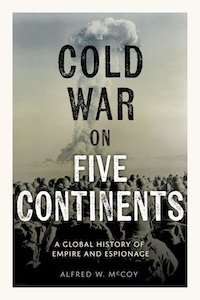
Notice two things here: first, unlike most studies of the Cold War that focus on the conflict between the US and the Soviet Union, McCoy focuses on the situation in the countries that the imperial country is trying to subjugate; so not Washington and Moscow, but Seoul, Manila, Teheran, Guatemala City, Kinshasha, Luanda, Jakarta, Santiago, etc. (A large number of cases are places that the US wanted to ensure control, although there is some discussion of French efforts in Africa and British in Malaysia who partook in extensive psyops in Indonesia.)
Making this shift allows McCoy great purchase in his project. For one thing, it allows him the opportunity to show what actually happened on the ground in these countries, and it gives a very different flavor than what we have all been told over the years: this has not been some “heroic” project to support democracy and human well-being!
Second, McCoy discusses economic, political, military, and diplomatic power in each of these cases, but where he brings incredible knowledge to bear is in his understanding the interaction between counter-insurgency and what he calls the criminal “netherworld”; i.e., gangsters and other criminals who are often involved in the drug trade.
(A bit of historical background: McCoy’s first book was titled Politics of Heroin in Southeast Asia (1972), where he detailed the CIA’s collaboration with (opium) poppy growing anti-communist war lords in northern Laos and Thailand; in exchange for anti-communist efforts particularly against China, the CIA flew the poppies to Bangkok where they were processed into opium and its derivative, heroin, at least some of which went to Saigon and into the arms of US troops during the American war against Vietnam. Really. The CIA tried to get his book suppressed prior to publication, as he mentions in this book, but failed. With his continuing research on drug trafficking networks, he’s expanded his interests beyond Southeast Asia, so subsequently, he refers to this book as The Politics of Heroin.)
A note on terminology that I think would clarify things in the book. The so-called “advanced” countries, especially those in the so-called “west,” should really be identified by their commonality: they are imperialist countries. They have colonized countries in Africa, Asia, Latin America and the Middle East, and stolen their raw materials, natural resources, and sometimes the people from these countries, regardless of the detrimental impact on the affected peoples and countries, and taken them back to the “home” (imperial) country to aid in its development. Sometimes their settlers have stolen the land and utilized the resources for the well-being of themselves and their particular colonial government, as in the US, Canada, Israel/Palestine, South Africa, Australia and New Zealand; this is known as “settler” imperialism. Because of their imperialism, these countries have much higher standards of living and are often referred to as “developed” countries. Yet, calling them ”advanced” or “First World,” or “modern,” etc., obfuscates the essential interaction with these different countries: it is an imperialist relationship of the stronger nation dominating the weaker. Period.
These colonies or former colonies have one thing in common: they have been victims of imperialism, and each has suffered tremendously, even though the impact of imperialism has varied by country doing it and the way it has been done has varied by colony; i.e., the English treated India differently from Nigeria which also different from how the American colonies were initially treated; the French differed from the English, but still treated Vietnam differently from Algeria, etc., etc.
So, what we see in McCoy’s study is that most of the men on the spot have been agents of imperial countries—overwhelmingly from the US—and they have worked with others to dominate their respective country of operation. And yes, they have worked with their respective criminal netherworld whenever they deemed it necessary to carry out their operations.
We can see this by looking at Indonesia, an island archipelago around the equator in Southeast Asia. I recently reviewed Vincent Bevins’ excellent book, The Jakarta Method: Washington’s Anticommunist Crusade and the Mass Murder Program that Shaped Our World (Scipes, 2025). Bevins was writing about the 1965 military coup in Indonesia, where between 500,000 and a million people were killed in approximately a six-month period, and the resulting process was shared in 23 other countries around the world, albeit not at that same level of brutality. Bevins had detailed several aspects of the case, but he did not have information on what actually happened the night of the coup; and he wisely stayed away from speculating about what happened.
However, McCoy provides evidence from that night. In a chapter with way too much to cover in a review, McCoy writes, an official document accidentally released that was not supposed to ever be leaked to the US public showed, “In marked contrast to long-standing denials of any American role in a military coup that had massacred a million Indonesian communists, the volume showed that the US embassy had been deeply complicit, delivering lists of communist leaders ‘being used by Indonesian security authorities’ for the slaughter of those very communists. Through such revelations, the official story began an unraveling that continues to the present day, showing American and British involvement in the greatest mass murder of the Cold War era.”
What we get from this is a much more accurate picture of the impact of the Cold War on these countries and their populations. After all, McCoy estimates that 20 million people were killed during the Cold War. And they weren’t in the US, Britain, France, or the Netherlands! (While early CIA operations especially took place in France and Italy—both imperial countries—during in 1947-48, they were used to split labor movements and undermine oppositional political parties, to deny political outcomes they didn’t want, but this is qualitatively different and far less harmful than their tactics used in the colonized or formerly colonized countries.)
Interestingly, McCoy also provides accounts of men on the spot in Vietnam and Southern Africa who are from former colonies. One, a Vietnamese who was trained by Edward Lansdale—a US man on the spot in the Philippines and later Vietnam—and who yet later provided incredibly detailed information about US military plans and operations over the years to the Vietnamese liberation forces. The second, a Cuban, played a key role in defeating South African armies in the Congo.
The key point that McCoy made, backed by extensive and wide-ranging research—including personally interviewing a number of these men who had been at one time or the other “on the spot”—is that these men generally played an extremely important role in advancing counterinsurgency—including death and torture in their repertoires—for the imperial powers in the countries in which they were involved. Further, I think McCoy should get recognition for choosing and focusing on these various men on the spot; by examining their actions, he discovered arguably the single most important operatives in these operations, and by exposing them and their activities, has made it impossible for “defenders of the Empire” to undercut his analysis.
However, by focusing on these individuals, he dissipated somewhat his larger charge: I wish he had emphasized much more that no matter what is said by anyone, the US has engaged in big-power politics, especially since 1945. That might makes right; a more accurate term, still, is imperialism.
His evidence directly undercuts the lies the American public has been told by both Democrat and Republican leaders: we have been told that the US is the center of the “free world,” that we operate around the world to promote “democracy,” that if we intervene in another country, it is a “humanistic intervention,” etc. As one can see from McCoy patiently detailed research, these are each a lie. What we have in reality is a US Empire than is headquartered and commanded in the United States, and its project is to control the world.
If you have any doubt of that, think about Trump’s attacking Iran on February 28, 2026; the immediate historical parallels are the Nazi invasion of Poland on September 1, 1939, and Japan’s attack on Pearl Harbor on December 7, 1941. But somehow, I cannot remember the mainstream media ever making those historical parallels.
Now I said above that I thought this book should have been broken into two parts instead of one. The first part is an Al McCoy special: a magisterial work of great imagination, broad scope and deep research, clear writing, and it has the advantage of a supposed common foe: communism in the form of the Soviet Union. This gives this work an impressive focus, the worldwide battle against “the” evil empire. [It fits in with Bevins’ The Jakarta Method, and Jeff Schuhrke’s 2024 book on the “labor imperialism” (my term) of the AFL-CIO, Blue Collar Empire: The Untold Story of US Labor’s Global Anticommunist Crusade; (see Scipes, 2024 for my review).]
Yet the subsequent period (1991-2025) lacks that same targeting; we can’t blame all of this on the “commies,” and accordingly, the book loses its sharpness.
Now, the reality of the 1947-91 period was that whether the “Communists” were involved or not—and in most cases, they were not—because they were so “evil,” they got blamed for resisting imperialism. In other words, what I’m arguing is that the struggles around the world, against the US and its allies, were in reality indigenous struggle against imperialism and not some Soviet-instigated project to conquer the world, even though the Soviets might have provided some support to particular indigenous struggles in one way or the other.
(The reality, as I detail in another article, is that the Soviet Union saw its “global revolution” project fall apart when the revolutionary effort in Germany failed by 1923; according to Ken Post (1997), they turned their focus to the “periphery” of the world economy, and even renounced revolution in the imperial countries by 1935, after seeing the Nazis seize power in Germany; in other words, by 1935, they had formally shifted their efforts from exporting revolution globally to defending the Soviet Union.)
Without the “Communists” to blame, post-1991, things get much messier and inchoate.
But before leaving for the post-Cold War period, McCoy spends a fairly substantial chapter discussing the role of mobilized people in ending the Cold War, starting with the “People’s Power” revolution in the Philippines in February 1986 and preceding in different countries around the world, some peaceful although some ending in repression, but including the uprisings in Eastern Europe and leading to the dissolution of the Soviet Union in 1991. This was a break from the earlier part of the book, and really doesn’t follow his earlier chapters, but I can see it being included, as in trying to “wrap up” his extensive analysis.
What I cannot see being included, however, was his stretching the manuscript to discuss “the New Cold War,” from basically 1991 to 2025. It has had a very different dynamic that the Cold War, and his account is presented via sketching rather than the detailed examination he gave of the earlier part of the book. He does not go into the detail that the period really needs; for example, he does not talk about the attacks of 9-11 (2001) and the following Global War on Terror (GWOT). He does not discuss the election of Hugo Chavez of Venezuela in 1998, and the Chavez regime’s effects on Latin America. The debacles of the US invasions of Iraq and Afghanistan certainly deserve much more analysis; especially the development of ISIS in Western Asia. His discussion of the “cause” of the Ukraine war with Russia is way too limited. He does not delve into Israel’s genocide against the Palestinians.
To me, this period is one that deserves its own detailed analysis by McCoy, not just this sketching. I hope he will do a full work on this period, because he is one of a very small number of analysts, especially in the US, who can do justice to the whole world. I just wish his editors held his reach a little more tightly in this current book.
Nonetheless, minor quibbling: this is an outstanding work that deserves wide readership and broad discussion.
For my social democratic friends and those who only want to focus on the domestic US situation, you simply cannot ignore what McCoy documents from around the world: the US Empire is a global oppressor; the war against Iran is not an aberration. You cannot understand the development of the US outside of the global context in which it is located, affecting other countries and being affected by them (for example, see prices: gasoline and diesel).
We have got to figure out how to discuss these findings by McCoy with to date non-politicized folks and get them to understand that we need to turn off our TVs, and put aside our obsessions with sports and sports betting, as well as with celebrities and fashion trends, and join with people around the world to create a new one—beginning now, if not years ago!
Alfred W. McCoy has made another major contribution to struggles for global liberation
Resources
McCoy, Alfred W. 1972. The Politics of Heroin in Southeast Asia. New York: Harper and Row.
Post, Ken. 1997. Revolution’s Other World: Communism and the Periphery, 1917-39. New York: St. Martin’s Press.
Scipes, Kim.
— 2018. “‘In the Shadows of the American Century: The Rise and Decline of US Global Power: A Review Essay.” Class, Race and Corporate Power, Vol. 6, Iss. 1, Art. 7.
— 2024. “Review: Blue Collar Empire: The Untold Story of US Labor’s Global Anticommunist Crusade by Jeff Schuhrke.” Z Network.org, October 22.
— 2025. “The Jakarta Method: Washington’s Anticommunist Crusade and the Mass Murder Program that Shaped Our World: A Book Review Essay.“ Z Network.org, November 12.