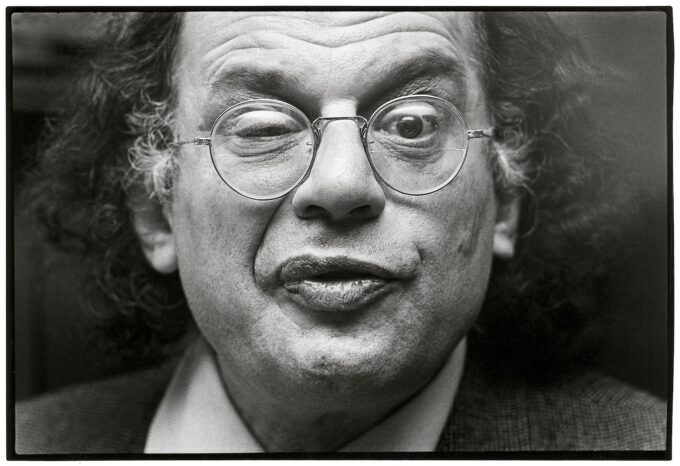
Allen Ginsberg in 1979. Photo: Michiel Hendryckx. CC BY-SA 3.0
The postwar Beat generation – and the ensuing counterculture — is remembered now, three-quarters of a century later, for one word, Howl, the title of Allen Ginsberg’s 1956 poem. It begins with the following lines:
In a tender introduction to the poem, William Carlos Williams reminds readers, “We are blind and live our blind lives out in blindness.” But, he adds: “Poets are damned but they are not blind, they see with the eyes of the angels. This poet sees through and all around the horrors he partakes of in the very intimate details of his poem. He avoids nothing but experiences it to the hilt. He contains it.”
And Williams warned, “Hold back the edges of your gowns, Ladies, we are going through hell.”
+++
After 15 years of the Great Depression and World War II, postwar America faced serious challenges, both internationally and domestically. Foreign policy was shaped by George F. Kennan’s theory of “containment”–aka the Truman Doctrine — that sought to prevent the spread of Soviet communism. And domestic affairs were shaped by a parallel notion of “containment,” a culture war to contain the unexpected excesses of affluence.
The postwar GI Bill helped fuel growing affluence and brought an improved quality of life for many. It facilitated the rise of suburbia, enabling urban renters to become first-time home buyers and saw high-school grads go to college; however, restrictive covenants and other policies blocked African Americans from much of the postwar prosperity. Growing affluence fueled a mass consumer revolution marked by the purchase of millions of cars, TV sets and other products. Marriage and birth rates rose exponentially. And sexuality was ever-increasingly commercialized in advertising, fashion and popular culture.
Even after the New Deal and victory in a global war, large segments of society fiercely tried to reinstall the “old” moral values. As a new historical sensibility was being fashioned, many old-school Republicans and conservative Christians held on to traditionalist notions of masculinity, the family, class, patriotism and race relations. They felt threatened and sought to contain the tensions generated by an ever-increasing consumer society and its more “liberal” values.
The cultural and political tensions that profoundly split – and, in time, shaped — the country during a critical period of U.S. history. These tensions gave birth to the more secular America that defined the country for decades to come, especially marked by the civil rights movement, the counterculture and the women’s liberation movement. And none gave greater voice to this insurgency than Allen Ginsberg and the Beats.
What Ginsberg (1926-1997) saw truly frightened him and many others who came of age during the post-World War II era. It was a period of economic recovery and a new global order, of widescale upward mobility, white flight to the suburbs and persistent racial segregation, and cultural conformity with young people expected to go to school, get jobs, live moral – i.e., heterosexual — lives, marry and have children. It was an era in which conformity was policed by the House Committee on Un-American Activities (HUAC), Sen. Joseph McCarthy’s (R-WI) anti-communist hearings and comic book burnings.
On October 13, 1955, Ginsberg read his poem Howl at the 6 Gallery (3119 Fillmore Street), a rundown experimental art gallery in a largely Black neighborhood of San Francisco. The following year, Ginsburg’s book, Howl and Other Poems, was published by City Lights, a bookstore and publisher, founded by Lawrence Ferlinghetti. He and Shigeyosi “Shig” Murao, the store manager, were arrested on June 3, 1957, on obscenity charges. Critics were offended by lines like:
Their trial ended with Judge W. J. Clayton Horn ruling that Howl was not obscene, stating, “… An author should be real in treating his subject and be allowed to express his thoughts and ideas in his own words.” It was a landmark case protecting free expression and brought San Francisco’s “Beat” movement national attention, including coverage in Esquire, Life, Playboy and Readers’ Digest.
+++
Jack Kerouac (1922-1969), author of On the Road (1957), insisted that “Beat” meant beatific and offered a different interpretation as to the origin of term. One scholar argues that a reporter asked him, who “finally came up with it . . . he said, ‘You know, this is really a beat generation.’” He believed that the terms suggested something more than mere weariness, something that implied the feeling of having been used, of being raw.
[W]hen I came in in 1950, people were trying to write those lyric stanzas, but without music … [we] moved away from a fake lyric, that is to say a harassed lyric that did not have the musical accompaniment, but just spoken language, but arranged as if it were a song. [We] moved away to the use of living language rather than a dead form and began rewriting the idea of rhythm and measure.
And the “Beats”? They included poets, writers, artists and other visionaries as well as the poor, the unemployed and disenfranchised workers, as well as drug addicts, criminals, the mentally ill and, of course, homosexuals.
Often overlooked, as Arianna Garofalo argues, Howl offers a radical critique of capitalism. Americans “were all enslaved by the dollar”–quoting Howl–“to the one-eyed shrew of the heterosexual dollar …” They “burned cigarette holes in their arms protesting the narcotic tobacco haze of Capitalism.” Invoking the Biblical character, Moloch, Ginsburg rages:
A decade before publishing Howl, Ginsberg was a student at Columbia University, where he met Kerouac. In ‘49, he was a 23-year-old senior and was arrested riding with his lover in a stolen car with stolen goods. To circumvent prison, he agreed to be hospitalized at Columbia Presbyterian Hospital’s Psychiatric Institute as part of a plea bargain and served eight months. After release, he developed a friendship with William Burroughs, a Harvard graduate and author of Naked Lunch (1959), who lived in Greenwich Village. In 1958, Ginsberg moved to the Lower East Side with his partner Peter Orlovsky.
In On the Road, Kerouac writes: “Suddenly I found myself on Times Square.” He then adds:
I had traveled eight thousand miles around the American continent and I was back on Times Square; and right in the middle of a rush hour, too, seeing with my innocent road-eyes the absolute madness and fantastic hoorair of New York with its millions and millions hustling forever for a buck among themselves, the mad dream — grabbing, taking, giving, sighing, dying, just so they could be buried in those awful cemetery cities beyond Long Island City
Kerouac knew New York.
+++
During the postwar decade, the Beat poets were regular habitués of Times Square–aka the forty-deuce. Ginsberg, Kerouac, Burroughs and Herbert Huncke, the self-proclaimed “Junkie King of Times Square,” called it a second home. They regularly visited the Angle Bar (42nd Street and Eighth Avenue) that was, in Huncke’s words, “where pimps and drug dealers and small-time crooks hung out.” Kerouac liked the Playland Arcade (246 West 42nd Street), especially its Pokerino pinball game.
Much of their time was spent at Bickford’s Cafeteria (225 West 42nd Street). “Not only did they have very good food, excellent food and very cheap, but also they were all meeting places, drug meeting places …,” Burroughs recalled. “The 42nd St. Bickford’s was a notorious hang-out for thieves and pimps and whores and fags and dope pushers and buyers and everything.” Ginsberg, who once worked as a dishwasher and floor sweeper at the eatery, immortalized it in Howl:

Perhaps most controversial, the Beats rejected male stereotypes — i.e., heterosexual married breadwinner — by promoting male friendships, including explicit homosexual relations (e.g., Ginsberg, Kerouac). However, their advocacy of male bonding diminished the role of women. The scholar Lianne Tan argues, “Beats writer William Burroughs was often seen as a committed misogynist who has compared women to ‘junk’, and infamously accidentally killed his wife while trying to shoot a gin glass off her head.”
Sadly, most accounts of the Beats focus on male writers and ignore the place of women. As the scholar Elena Maria Rogalle states, “Women Beats had the responsibilities of maintaining the domestic sphere while also working outside the home, with some providing financial support for their artistic male counterparts.” And she adds, “The women Beats’ domestic sphere was a place of community and a place of transformation.” Among these women were Diane di Prima, Anne Waldman, Joanne Kyger, Joyce Johnson and Elise Cowan as well as Alene Lee and ruth weiss .
June 3, 2026, is the 100th anniversary of Allen Ginsburg’s birth, a day to remember a remarkable man as well as the movements he helped inspire.