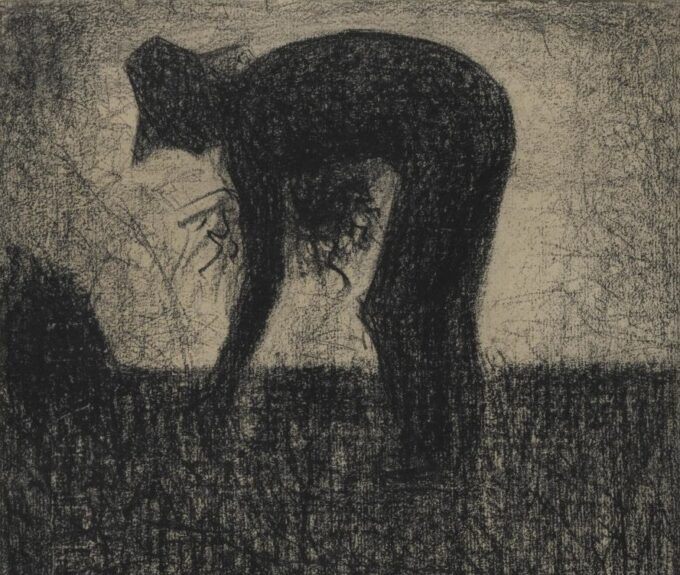
A Man Gleaning, George Seurat. (British Museum).
This essay was published as the Afterword to “Who Gets the Remainder? The Ethics and Politics of Gleaning,” edited by Amiel Bize and Xenia Cherkaev, in History & Anthropology.
The whole history of capitalism begins with the expropriation of people from the land, turning it into money and them into nothings. The passage from nothing to money is conducted by work, and yet people will cling on and find a way out of no way, because no expropriation is ever total. This is the evidence of remainders, or broadly speaking, the evidence of gleaning.
The essays in Who Gets the Remainder? The Ethics and Politics of Gleaning, have an amazing range of subjects from roadside exchanges of siphoned fuel in East Africa, to the ‘three stalks’ rule of the Hebrew Mishnah, to the scrap metal dealings in Tbilisi, Georgia and Nairobi, Kenya, to artisanal gold mining in Burkina Faso, to Danish ‘fusk’, or Soviet ‘homers’, to the repurposing of beams, joists, and bannisters of abandoned houses in the American rust belt. Xenia Cherkaev and Amiel Bize provide an introduction to these exceptions to the usus, fructus, and abusus of private property. Indeed, such exceptions are the basis of another world of creativity, moral or ethical value, and belonging. What is waste or wild, what is tacitly whispered, what is illicit, sometimes criminalized, and often winked at, all take what was abused and put it to use, even fructifying it as forms of the commons.
It is an encyclopedic project gathered brilliantly and told not without a touch of humour. It rests on investigation and practice, not theory or utopia, helping us see that another world is possible. To this scholarly project we want to sound a religious, a Marxist, and an English note.
Religion. The religious note offers values of human agency and faith in history
The Book of Ruth is at the beginning of the Hebrew Bible. Ruth is a gleaner as well as an outsider. The heart of the story is gleaning, that is, the activity of gathering the stalks and ears of grain left on the ground after the reapers had done harvesting. Gleaning enables her to cross tribal borders, to become accepted by harvesters and proprietors alike, and to marry Boaz, a landlord.
The Book of John is the last of the Gospels in the Christian Bible. Chapter six, verse twelve expresses the aftermath of a ‘miracle’, or clean-up time, time to glean, where, after five loaves and two fishes fed 5,000 people contentedly, Jesus says to his disciples, ‘collect the pieces left over so that nothing may be lost’. This they did and filled twelve baskets of left-overs from the original five barley loaves. Ever since, workers, on hearing how Jesus led his disciples in gleaning, could relate to their own experiences in shop, field, and home with the remainders or what’s left over after production. What had formerly belonged to the craftsmen and craftswomen as part of their customary compensation package will be criminalized.
The history of the commons has a semantics of its own – pannage, chiminage, wainage, estovers, etc. Every craft and trade had its ‘usages’ or ‘perquisites’ or ‘customs’ or ‘fat’ to use the general colloquial term. Servants received vails; shoemakers received clickings; hatters received buggings; the tanner took rumps and birrs; the forester took lops and tops; watchmakers received scrapings; tailors took cabbage; silk weavers took ends; wool weavers took fents and thrums; shipwrights chips; dockers took spillings or scrapings; lumpers took sweepings; coopers waxers; pinions and noils for the wool and silk comber, and on and on in the usually hidden contest across the length and breadth of homo faber, man the maker. These many customary usages were deemed legally criminal and economically inefficient. They are the semantic expression of the incomplete separation of the worker from his or her tools and materials of production. They belonged to the worker’s common.
Taking them away entirely led to immiseration of the craftsperson, the criminalization by police, and technological innovation. It might lead to revolution. In the summer of 1789 in France, the peasants rose up during the grand peur, stating their grievances in cahiers de doléance. The historian, George Lefebvre, provides an important clue. The sickle, he says, was a friendly instrument to the gleaners, as bending over required more frequent standing up for relief than did the swaying scythe, which cut closer to the ground. The commons has a user-friendly technology of its own. The sickle left more behind.
That was France. During the English Revolution of the 1640s, Abiezer Coppe advocated neither ‘sword levelling’ nor ‘digger levelling’, yet he prophesized how ‘the substantiality of levelling is coming’. So, against the great ones of the earth, he wrote
Well! Do what you will or can, know you have been warned. It is not for nothing, that I the Lord with a strong wind cut off (as with a sickle) the fullest, fairest ears of corn this harvest, and drop’t them on purpose for the poor, who had as much right to them, as those that (impudently and wickedly, thievishly and hoggishly) stile themselves the owners of the Land.
It’s not the first time that religion, and Biblical knowledge, served the class struggle.
Marx. The Marxist Note Offers a Materialist Approach of Class Struggle
Raoul Peck’s film, The Young Karl Marx (2017) begins with a scene of poor people gathering dead wood in a forest, which they customarily had done for centuries. But the government has made it illegal to collect the wood as it is now legally private property of the landlords who profitably float it down the Rhine River to Dutch shipyards and to English builders. Mounted troops charge through the forest to drive out the local people gathering winter’s fuel.1 The poor are left behind, cold and without even a stick for the fire.
The nineteenth-century forest world of the Grimm fairy tales, set among commoners of Marx’s time, was coming to an end as commerce and capitalism took over. Faced with this, Marx went to London for the rest of his life, an exile, an immigrant, a revolutionary in the capital of imperial convergences. Marx, in his 1857 Preface to the Critique of Political Economy, said that the theft of wood articles of 1842 led him to political economy. He writes,
We demand for the poor a customary right, and indeed one which is not of a local character but is a customary right of the poor in all countries. It is by activity that poverty acquires its right. By its act of gathering, the elemental class of human society appoints itself to introduce order among the products of the elemental power of nature.
The stress is on the word ‘elemental’. It refers to humans and to nature. Later he writes, ‘The same thing holds good also in regard to gleaning after the harvest and similar customary rights’.
In 1759 an Irishman, Oliver Goldsmith (‘Custom and Law Compared’), cites John of Antioch: ‘The enslaved are the fittest to be governed by laws, and free men by custom’. Custom ‘is kept by the people themselves, and observed with willing obedience. The observance of it must, therefore, be a mark of freedom … .’ ‘Thus nothing can be more certain than that numerous written laws are a sign of a degenerate community, and are frequently not the consequence of vicious morals in a state, but the causes … .’
In 1788 the Court of Common Pleas, a high court of England, ruled that ‘no person has, at common law, a right to glean in the harvest field’. And the community degenerated, as Goldsmith and John anticipated.
Marx wrote that his most original contribution was analysis of ‘the irrationality of the wage’. He showed how the buying and selling of labour power, itself the result of the loss of subsistence commons, concealed unpaid labour or surplus-value. This is politically and historically important because the wage conceals the unpaid labour to the waged while revealing it to the unwaged. The wage is white, said W.E.B. Dubois. Indeed, the wage becomes a structural means of political division as the basis of slave production and women’s reproduction, while all social relations were poisoned by white supremacy and patriarchal misogyny.
England. England Offers History, Custom, and Locale. Its Social History Depends on Two Millennia of the Bible and Two Centuries on Marx
It’s an old story in England. The Great Charters of Liberty of medieval times protected widow’s estovers. In addition to estovers (gathering wood), the charters spoke of chiminage (right to roam), pannage (acorns and mast for pigs), herbage (grazing for livestock), for fuel, sustenance, and pathways. Together they formed a web of communal rights and powers providing people with access to means of production and subsistence. In 1766, an English law was passed, making it an offence to ‘willfully cut or break down, bark, burn, pluck up, lop, top, crop, or otherwise deface, damage, despoil or destroy or carry away any Timber tree’.
The story of the criminalization of custom was the theme of ‘the Warwick school’ of social history led by E.P. Thompson. Albion’s Fatal Tree (Hay et al. 1975) and Whigs and Hunters (Thompson 1975) were the pillars of that approach.2 J. Neeson’s wonderful book, Commoners, really established the reality of the destruction of the commons (1993). Robert Malcolmson’s book on The Pig in English history was significant (Malcomson and Mastoris 1998). Another associate of Warwick, David Morgan, was a cow man, whose decades of farm labour made his observations and findings directly valuable, including what he offers about gleaning.3 Here, in Nottinghamshire, in 1860, is the proclaiming of a Queen of the Gleaners:
The villager crier having ‘proclaimed the Queen’, nearly 100 gleaners assembled at the end of the village. Women with their infant charges, boys with green boughs, and girls with flowers, the whole wearing gleaning-pockets; children’s carriages and wheelbarrows, dressed in green and laden with babies, etc., were in requisition … . [A] royal salute was shouted by the boys, and the crown brought out of its temporary depository … .
Then David Morgan quotes the proclamation speech. Assembly, sovereignty, and right were the ideas expressed in this politics ‘from below’.
John Grout remembers the harvesting in East Anglia. In lieu of church, ‘The holy time was the harvest’. Thirty mowers reaped by hand.
“The lord sat atop the last load to leave the field, and then the women and children came to glean the stubble. … we all went shouting home. Shouting in the empty old fields – I don’t know why. But that’s what we did. We’d shout so loud that the boys in the next village would shout back.4”
It is as if the community in its triumph of collective labour let out a collective exhalation.
John Grout joined religion and production inviting an anthropology of work and liturgy. Ronald Blythe’s magnificent Akenfield supplies transcriptions of oral testimony of gleaning in twentieth-century Sussex. Emily Leggett remembered,
“We women and children went gleaning when the last wagons had left the field. We picked up the corn for mother and she cut the ears off with her pig-knife, and put them in a sack. We were allowed to keep all this. We fed it to the fowls or ground it into flour.”
Blythe reflects on the testimonies he gathered as follows. ‘Deep in the nature of such men [and women] and elemental to their entire being here is the internationalism of the planted earth … .’ Again ‘elemental’ is the word of choice for these practices.
The leader of our Warwick collective was E.P. Thompson who showed that custom lies at the interface of law and praxis. He quotes from Samuel Carter in Lex Custumaria (1696). Custom becomes law by its antiquity, continuance, certainty, and reason. Its continuance depends on oral tradition.
“A Custom which hath obtained the force of a Law, is always said to be Jus non scriptum, for it cannot be made or created, either by Charter or by Parliament, which are Acts reduced to Writing, and are always matter of Record: But being only matter of Fact, and consisting in Use and Practice, it can be recorded and registered no where but in the Memory of the People.”
Our ‘Warwick school’ had this in common with anthropologists, a longing to abstract to universals from the living testimony of real people. Yet we eschewed theory and resorted to antiquarian ‘discoveries’ of yet another instance of whatever custom or ‘praxis’ we were examining. Edward Thompson called this ‘the empirical idiom’, though it might lead to evasions. Custom brought with it the lore of rituals and the culture of song and sayings. The Warwick School drew on two centuries of English parochial history and its supreme emphasis on locale. The phrase, ‘when the memory of man runneth not’ is often found in older descriptions of customary right. A moment’s thought reveals, therefore, the authority of the village elders who were the keepers of the communal memory and whose knowledge was passed on by word of mouth and communal celebration. (Lenin scornfully called them grandmothers’ tales.)
I fear that I am offering merely scholarly gleanings of my own when instead we need a framework: we need the shooked, stacked, and carted grain of the whole field, all the bread of life past, present, and future. Again, a framework rather than rhetoric is required (Xenia Cherkaev offers ‘a general theory’). The grain shipments out of Odessa come to mind, hungry bellies of Somalia, and the cultivators of the uprooted olive trees of Palestine.
In 1819, the year of the Peterloo Massacre, which is of legendary significance to the history of world trade unions, was also a year of many newspaper articles reporting on the criminalization of gleaning. It was also the year of a lyrical expression of English romanticism in John Keats, ‘Ode to a Nightingale’ (1819). Its seventh stanza goes like this:
Thou wast not born for death, immortal Bird!
No hungry generations tread thee down;
The voice I hear this passing night was heard
In ancient days by emperor and clown:
Perhaps the selfsame song that found a path
Through the sad heart of Ruth when, sick for home,
She stood in tears amid the alien corn;
The same that ofttimes hath
Charmed magic casements, opening on the foam
Or perilous seas, in faery lands forlorn.
Keats, faced with the devastations of hunger, violence, and upper-class theft of land, wrote romantically and found aegis in the nightingale. I like to think that we did too at the conclusion of the conference at which these pathbreaking essays were presented.
We departed from Ithaca, New York, to our separate ways, but before doing so, by the light of the full moon in the depths of the Cascadilla Gorge, we found ourselves in separate languages singing the same tune, nightingale-like, “The Internationale.”
Notes.
1. Daniel Bensaïd (2021), Pierre Lascoumes and Hartwig Zander, Marx: du “vol de bois” à la critique du droit (1984), and Peter Linebaugh, Stop, Thief! The Commons, Enclosures, and Resistance (2014).
2. Later came The London Hanged (Linebaugh 1991), Magna Carta Manifesto (2008), and Red Round Globe Hot Burning (2019), my books inspired by colleagues at Warwick.
3. David’s essay can be found in Raphael Samuel (ed.), Village Life and Labour (London, 1975).
4. Ronald Blythe (1973, 56).
References.
Bensaïd, Daniel. 2021. The Dispossessed: Karl Marx’s Debates on wood theft and the rights of the poor. Minneapolis: University of Minnesota Press.
Blythe, Ronald. 1973. Akenfield: Portrait of an English Village. London: Guild Publishing.
Hay, C. Douglas, Peter Linebaugh, John G. Rule, E. P. Thompson, and Cal Winslow. 1975. Albion’s Fatal Tree: Crime and Society in Eighteenth-Century England. New York: Pantheon Books.
Lascoumes, Pierre, and Hartwig Zander. 1984. Marx: du ‘vol de bois’ à la critique du droit. Paris: Presses universitaires de France.
Linebaugh, Peter. 1991. The London Hanged: Crime and Civil Society in the Eighteenth Century. London: Penguin Books.
Linebaugh, Peter. 2008. The Magna Carta Manifesto Liberties and Commons. Berkeley: University of California Press.
Linebaugh, Peter. 2014. Stop, Thief! The Commons, Enclosures, and Resistance. Oakland, CA: PM Press.
Linebaugh, Peter. 2019. Red Round Globe Hot Burning A Tale at the Crossroads of Commons and Closure, of Love and Terror, of Race and Class, and of Kate and Ned Despard. Oakland, CA: University of California Press.
Malcolmson, Robert, and Stephanos Mastoris. 1998. The English Pig: A History. London and Rio Grande: The Hambledon Press.
Morgan, David H. 1975. “The place of havesters in nineteenth-century village life.” In Village Life and Labour, edited by Raphael Samuel, 27–72. London: Routledge & Kegan Paul Ltd.
Neeson, J. M. 1993. Commoners: Common Right, Enclosure and Social Change in England, 1700-1820. Cambridge: Past and Present Publications, Cambridge University Press.
Thompson, E. P. 1975. Whigs and Hunters: The Origin of the Black Act. New York: Pantheon Books.