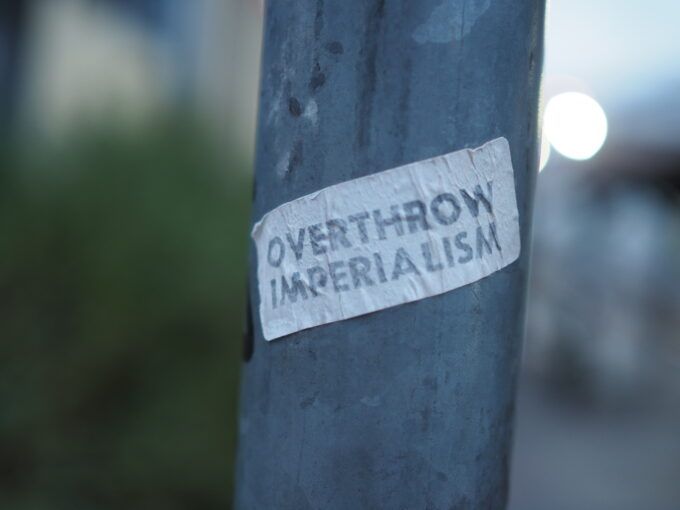
Photograph by Nathaniel St. Clair
Cultural workers develop their work, in the short and long term, against the background of a terrible world scenario. This, as is hopefully clear, is the case especially in the ‘Middle East’, characterised by an ongoing genocide of a particular dispossessed ethnic group and a war that can potentially escalate towards WWIII which, if this worse case scenario were to come to pass, may well be ‘the war to end all wars’ and the planet on which it is waged. This situation indeed posed a series of pressing challenges for the global community.
One is to work collectively towards reviving the idea of an ‘Educated Public’ engaging in well-informed debate, predicated on reason and feeling, to address questions from all standpoints and not simply ethnocentrically. Ethnocentrism and more precisely Eurocentrism has been one of the limits of my own formation, including formal education, which, I would like to think, many conscientious people, committed to universal social and ecological justice, are striving to break away from, though, like many other things, this remains an ongoing struggle.
The debate would be informed by robust research and respect for those agencies that provide it, which must be supported rather than repudiated, as has unfortunately been the case with Covid-19. In an age when it is becoming increasingly difficult to separate fact from fiction, often through abuse of the intellect, human or otherwise, this becomes more urgent than ever. The quest for ‘truth’ remains a key imperative for critical education. Of course, what constitutes ‘ truth’ remains a contentious issue, hence my placing the word in single quotes. This does not negate the importance of engaging in such a quest, predicated on sound findings, that pushes the boundaries of knowledge and understanding further.
Education would necessitate communication under democratic conditions at all levels, as Jurgen Habermas, who passed away recently, is famous for having written, though recently arousing controversy, among many who revered him, for his jaundiced view of the ‘Middle East’ situation. Note that I also place terms such as ‘ North’ and ‘ South’, ‘ East’ and ‘West’, ‘Near Eastern’ and ‘Middle East’ in single quotes, taking my cue from Nawal El-Saadawi in asking: ‘Middle East’ in relation to whom? ( read : which imperial centre?). In this case, as she rightly points out, the answer is, of course, London. These are, needless to say, relative imperial constructions.
These constructions, alas, feature in such institutions as the U.N., with their own flaws and occlusions. And yet, concern about the rule of international law, as expressed by Francesca Albanese, a crag of sanity in the contemporary ocean of illegal madness, leads me to call for respect to be shown towards the UN – an institution created to sustain this global ‘public sphere’, in the aftermath of two catastrophic World Wars. And yet the irresponsible, uncouth US leader, who is under the influence of a Zionist-driven state, a state that, in turn, depends on US Congress support and funding, is barking ominously: Might is right, and we the powerful, can carry out our actions with impunity. The UN is a key institution that has, through UNESCO, served as an enabler of education, both formal and informal, and of cultural preservation and activity over the years. The mega and filthy-rich techno-barons who currently dominate the world in an era which Yannis Varoufakis arguably calls one of techno-feudalism, treat this institution with contempt. I consider it urgent to nurture respect for institutions, such as the UN, that can serve as beacons of hope for democratic processes, despite the shackles placed along the way: e.g., vetoes and the exclusive nature of mechanisms such as membership in the UN Security Council. One also has to contend with the classic Fascist playbook tendency to ride roughshod over its many resolutions. Education, to the contrary, would, when conceived of in its wider sense, be seen as an essential ingredient of a socially inclusive, not simply bourgeois, international public sphere.
Cultural workers, including educators, having social and larger ecological justice at heart, are therefore called upon to foster a critical education serving as an antidote to a world in which, alas, 0as Thucydides wrote, in the ‘ Melian Dialogue’ in the History of the Pelopponesian War (416 BC): “the strong do what they can, and the weak suffer what they must.” Under these situations, which have characterised hegemonic powers and their foreign expansionist policies for years, talk of ‘democracy’, and specifically ‘ Education for Democracy’, sounds ever so hollow. This has implications, I would modestly suggest, for the teaching of history in our schools and other educational settings. And I say this while confessing that I am not a professionally trained historian, though the historical dimension, alongside other dimensions, remains an important one in my Sociology specialisation. History repeats itself, though, contrary to what Karl Marx declared in The 18th Brumaire of Napoleon III, it often ends in tragedy rather than farce. I would suggest that it can show that when any government, which is popularly elected and acts in the interest of the sovereign nation that chose it, is toppled through colonial covert and overt actions, to gain access to precious resources such as oil, talk of ‘democracy’ sounds ludicrous. This was the case with Iran and the toppling of the democratically elected Mohammad Mossadegh in 1953 following his attempt to nationalise oil. It was the case with Salvador Allende in Chile and his attempts at nationalising copper and other policies, certainly at odds with Milton Friedman and Arnold Harberger’s Neoliberal policies ( called monetarism among other things then) intended to be transmitted to the country via the ‘Chicago Boys’.
Examples of such reactions to leaders who seek to nationalise resources are legion, perhaps dissuading certain countries from digging for oil, perhaps disregarding expert assurance of its existence in the territory, for fear of drawing imperial attention and losing any shred of sovereignty enjoyed. History and other social disciplines would show that the post-WWII attempts at ‘exporting democracy’ through military offensives rendered the concept a sham. It is, in many cases, such as Iraq, Venezuela, Libya, East Timor and Iran, and to name but a few, a ruse to simply accommodate the demands and geopolitical interests of some, notably the so-called ‘seven sisters’ multinational oil companies, now reduced to just a giant foursome, following mergers and takeovers. The case of Italian Enrico Mattei in the early sixties comes to mind. Head of ENI (Ente Nazionale Idrocarburi- Italy’s National Fuel Trust which replaced the Fascist state’s Agip), who coined the phrase ‘ le sette sorelle’ ( the seven sisters) and who entered into bilateral agreements with former colonies, deemed detrimental to these seven corporations but advantageous to the former colonized, Mattei disappeared in thin air while flying back, in a private plane, from a commitment in Catania Sicily. The subsequent poser was: an accident or a cold-blooded, calculated murder of the three persons on board the plane? The jury has, throughout all these years, remained out on this.
Critical educators and other social and ecological justice cultural workers can continue to resist the global machinations of Empire and stimulate dreams. We can offer, and many have offered, a semblance of genuine critical democracy in the limited specific pockets in which we operate, as has always been the case with, for example, popular education, often blurring the boundaries between different age groups, in contrast to formalised ‘Western’ inflected conventional formal education. In popular education settings, it is customary to discover school-age children learning alongside their guardians, in the past to eschew hazardous long walks to and from schools located at great distances from their homes, especially during turbulent times such as civil wars, risking treading over mines or being abducted to join the army or even being kidnapped for ransom. They would prefer to offer hands for work in the fields during daylight time and join nonformal education settings in the evenings. Popular education is a key source of learning in the geographical ‘majority world’, especially among beleaguered communities such as Palestinian ones in Gaza, the West Bank and Lebanon.
Beyond the very valid areas of schooling, popular and higher education, it is proposed that cultural operators conceive of education and culture in their broader contexts, the two being inextricably intertwined. Broadly oriented, educational and cultural work entails being concerned with the plight of everyone and everything, trying to avoid the alas hegemonic idea of me ne frego, the Italian expression for the English: I do not give a damn. Not giving a damn for anything where there is nothing ‘in it for me’ or ‘us’ as an interest group is the classic posture that derives from a Capitalist ethos distinguished by excessive individualism and atomisation. Don Lorenzo Milani and the School of Barbiana’s motto ‘ I care’, in the 1968 movement rallying classic, Lettera a una Professoressa (Letter to a Teacher) would be the mantra critical cultural workers and educators would possibly pursue in their strides in initial, vocational, early childhood, the visual arts, drama, music, higher and adult education. More strides continue to be made in areas such as community education and action, and in the all-encompassing process of Community Development, tapping into the cultural/educational potential of local community hubs within specific places, including village hubs.
Higher Education is a domain worth fighting for, treated unequivocally as the ‘enemy’ [within] in Imperial centers such as Washington D.C., a term once attributed to Richard Nixon and echoed more recently by J.D Vance, as the Empire brooks no dissent from well-educated, informed and conscientious students and academics, including those who demonstrate the ability to not only know but also feel. People displaying critical consciousness and acumen engage with others in ‘dangerous’ work to stem the tide of fascism aimed at engendering a chloroform society. This would be one replete with sociopaths, devoid of empathy and, in Hannah Arendt’s words, in contexts primed for totalitarianism, manifesting what she calls, in Eichmann in Jerusalem, ‘ the banality of evil’ the subtitle of her 1963 book. In reaction to all this, despite the neofacist mantra of ‘so what?’, the reaction Brazilians attributed to former President Jair Bolsonaro and his ilk, connected to what they call ‘negacionismo’, critical cultural workers would strive to remain steadfast to the kind of society that values research and teaching, the latter based on discernment, critical consciousness and robust knowledge.
While critically embracing modern media and technologies, making genuinely democratic use of them for the benefit of all, not the techno-feudal overlords and their proteges, one would have to hold ethical concerns uppermost in importance. Concerns include those recently expressed by my Italian colleague, Dr Gisella Vismara: the human and environmental costs of generative AI. Precisely, the concern is for the plight of the many exploited workers in the ‘Global South’. They are often “underpaid and unprotected to label and ‘clean’ the data that fuels these systems”. There is concern for the untold harm and massive environmental impact “caused by the energy and water resources these infrastructures consume.” University faculty like other researchers and me, in different research institutions or units, are encouraged to keep all this in mind when asked by publishers of our work, the product of our academic labours, also subject to exploitation, to sign AI-related licensing opt-ins.
All of the foregoing would be pertinent to our efforts i critical education and cultural action over the forthcoming years. One would, however, have to continue to harp on what Brazilian educator Paulo Freire and his team called the ‘limit situations’ involved in such action. Back to Marx in The 18th Brumaire…people can make change but not under conditions of their own choosing. One would hopefully remain fully aware that, although indispensable for engendering a democratic ethos and imaginary, education and cultural action should not be accorded powers beyond their reach. They cannot change society and its structures on their own. Each is not an independent variable. Each can nevertheless still constitute an indispensable one.