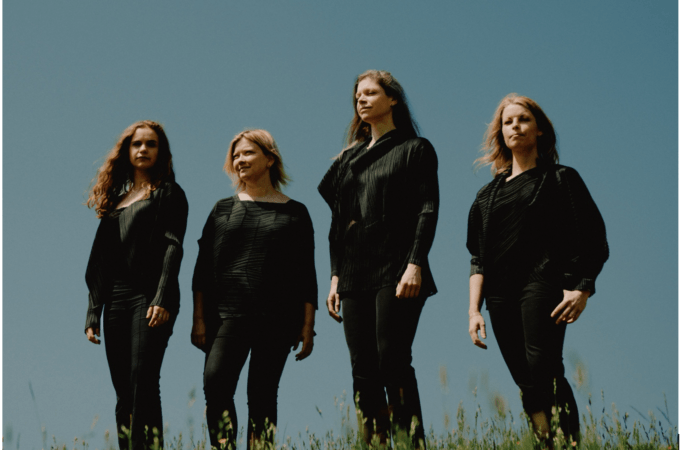
The Chiaroscuro Quartet. Photo: Josh McKinley.
The Chiaroscuro Quartet was founded in 2005 at London’s Royal College of Music by four young string players who shared a fascination with and commitment to playing on gut rather than wire strings and using bows like those of their 18th- and early 19th-century predecessors. The group deployed earlier technologies and materials not simply to buttress claims of authenticity but rather to explore sonorities and textures that could reanimate the classic string quartet repertory. The name the ensemble chose for itself forecast this mission of discovery. Old tools can shed light on the past and, more importantly, produce new insights in the present. The dark is also to be basked in. Contrast is key.
Unlike that of the Starship Enterprise, this mission has been one of more than five years. Two decades on, this all-female group is still boldly, brilliantly going where many men have gone before, but not in this way, not with such panache and pathos, quiet and bold commitment to the shared project of exploring, in concerts and a steady output of award-winning recordings, the quartets of Haydn, Mozart, Beethoven, and Schubert. In 2022, the group brought a quartet by Emilie Mayer, a 19th-century luminary long since eclipsed, to Berlin’s Boulez Saal, where I heard them last week in an illuminating, inspiring evening program of three of Haydn’s “Sun” Quartets, op. 20, so nicknamed because of the daybreak depicted on one of the early editions of the works. Composed in 1772 and presenting a kind of intermediate culmination of Haydn’s pioneering efforts in the genre that he would go on to develop and deepen in eleven more collections of quartets printed over the last three decades of the century, the entire “Sun” set of six can be heard on two Chiaroscuro CDs released ten years ago.
I first encountered the fabulous foursome in 2015 at Cornell University’s annual MayFest, which happens to be taking place again over this weekend in the verdant hills above Lake Cayuga in Ithaca, New York. In that incarnation of the quartet, the three founding members—north European women of fair complexion—were joined by the tall, dark Iberian, Pablo Hernán Benedí, as second violinist. In the humid and hot spring weather bearing down on Cornell’s old and porous concert hall for chamber music, Schubert’s “Death and the Maiden” found new shades of gloom, but also a strange, sorrowful beauty that admitted luminous visions of what could come after all this.
Pablo stayed at our house near the Cornell campus during that festival, and he entertained our two young string-playing daughters with riddles. They have heard the quartet whenever we can in subsequent concerts in Europe.
Pablo recently left the Chiaroscuro after many years in the group as he pursues other avenues that his talent and musical imagination have opened for him, including serving as the concertmaster of the excellent period-instrument Balthasar Neumann Orchestra.
I am happy to be able to report that the sparky and sensitive musicianship of Pablo’s successor, French violinist Charlotte Saluste-Bridoux, promises another glowing phase for the Chiaroscuro Quartet.
The ensemble’s gut strings are strung across antiques of museum quality. Saluste-Bridoux, violist Emilie Hörnlund, and cellist Claire Thirion all have instruments from the first two decades of the 18th century. Leader Alina Ibragimova plays a violin from 1570 made by the putative inventor of the instrument, Andrea Amati, and on loan to her from the Jumpstart Jr. Foundation of Amsterdam. This venerable, irreplaceable violin—in service to generations of musicians over its life of four-and-a-half centuries—is more than a resonant box of wood. An unownable heirloom, the instrument is an ever-ready interlocutor for Ibragimova and her unerring taste and technique, conviction and character. She dazzles when the music calls for dazzle, but she never grandstands. Amid declarations of virtuosity, the Amati offers hushed assurances just above the threshold of hearing.
Haydn’s many publications of string quartets that appeared across the second half of the 18th century were not intended as concert music, but rather for private and sometimes semi-public delight and distraction.
Given the nineteenth-century transformation of their status into concert hall classics, they can find no better venue for their presentation than the interlaced architectural ovals of the Frank Gehry-designed Boulez Saal, whose hovering intimacy can be seen and heard to approximate the dimensions and atmosphere of older spaces even as the auditorium quietly asserts its modernity.
Rather than sit, the quartet stands, except for cellist Thirion, who was seated but raised to her upper-string colleagues’ level on a wooden platform. This set-up grants freedom of body language and bearing that responds to the music and also conveys further layers of meaning. Live performance becomes even more alive, more dynamic.
Having tuned before entering the auditorium—you can’t say “offstage” since the wooden floor of the Boulez Saal is where the musicians play—the four women exchanged a collective smile, then effortlessly opened the evening’s conversation among themselves in warm and welcoming first “Sun” quartet E-flat.
The elegant melody bursts into a fast upward-running scale, then relaxes into a trill that rounds out the opening phrase. One imagines lace cuffs whose coy formality are lightly—not starchily!—and elegantly ruffled by Ibragimova in a way that might be heard to mock the music’s own foppishness. This decoration is then gently chortled over by buoyant, almost boisterous, arpeggio triplets from cellist Thirion.
Perhaps it is something of a joke that this opening movement of the “Sun” set begins as a trio, the second violin made to listen and wait as the first presents, then re-presents, the theme. A pair of successive trills from the first violin usher in the second’s entrance with the theme, now transposed up by a fifth and jostled along by bouncing octaves that have moved from the cello to Hörnlund’s viola. Hörnlund is a most patient and perceptive partner, cleverly commenting and sometimes questioning, never allowing herself either a grumpy intrusion or a hiatus of wandering attention.
Is the second violinist’s outburst a display of one-upwomanship or Haydn’s proto-democratic concession to equal time for all? The quartets and the evening will show, in too many ways to describe here, how cooperation and dialogue are the ideals, even when, later in this opening movement, the glinting triplets first mooted by the cello are taken up unaccompanied by the first violin reasserting old hierarchies.
Another witticism follows in placing the minuet as the second, not the usual third, of the four movements. This minuet stages a winking juxtaposition of its bright and simple major theme with its minor mirror image—sonic chiaroscuro in action. After a giant leap in ensemble register from high to low, a shared phrase is delivered more softly than whispers—consoling or conspiratorial, plotting later jests or transgressions.
The third movement—marked Affetuoso e sostenuto—is an almost inexorably sustained hymn of endearment. The Chiaroscuro imbued it with an authenticity deriving not from the dictates of 18th-century music treatises, but from truly felt humane emotion. The E-flat quartet’s flippant finale, done at near light speed, supplies not just musical contrast to what came before, but is happy to prove that heartfelt sentiment eventually wearies the soul and must eventually give way to devil-may-care release.
The poised and often impish aesthetics of Haydn’s Classical style come to life on the Chiaroscuro’s instruments of Baroque vintage. They are also adept at conjuring the contrapuntal ghosts that move in those shadows not reached by the Enlightenment sun. The program’s first half ended with the F-minor quartet, op. 20, no. 5, which concludes with a Fuga a due soggetti (fugue with two subjects). The principal theme pendulums across a medieval-sounding fifth, then rises a semitone before leaping down the torturous interval of a diminished seventh. This law-giving pronouncement is harried by a quicker, impudent countersubject that butts in on a devilish tritone (a diminished fourth). In the contest between the churchly and the infernal, the Chiaroscuro proved that earnestness and erudition can be electric.
Before the bagatelle encore that the enthusiastic and seemingly expert audience demanded and was graciously given, the planned program finished with the second “Sun” quartet and its final fugue. This movement boasts not two but four subjects combined in a vaulting gigue that is to be played throughout, as Haydn directs, “under your breath” (sempre sotto voce). As the voices harry one another, the quiet is enforced until the last page when Haydn ratchets the volume up first to piano (that this is merely “soft” emphasizes in retrospect how close to silence the fugue had been up to that point), and then, at last, he opens up to a full-throttle forte as the four themes cavort in close quarters, maybe even quarrel, the main motive turned upside down and against itself.
A quartet of fugue subjects parceled out amongst four players in vibrant dialogue and debate makes not just for a demonstration of Haydn’s contrapuntal credentials but also counts as a manifesto of equality among the four musicians. In the manuscript, Haydn wrote Laus. Omnip. Deo. Sic fugit amicus amicum: — “Praise God. Thus, one friend flees another friend.”
There was flight but no fright as the Chiaroscuro brought it all together in joyous, generous consonance at the end as Haydn ditches the madcap combinatorial games and has the previously independent lines join in a unanimous unison acclamation that serpentines upward, then tumbles back in arpeggios and into the bright, brisk final chords using three (or in the case of the cello, all four) strings of every instrument.
No group plays softer, more intimately or intensely, and no group chases the shadows away with brighter, kinder light or more friendly humor and human feeling than the Chiaroscuro.