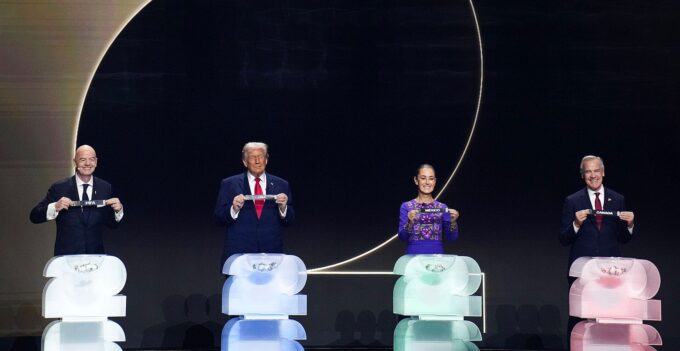
From left, FIFA President Gianni Infantino, U.S. President Donald Trump, Mexico president Claudia Sheinbaum and Canada Prime minister Mark Carney during the FIFA World Cup 2026 official draw at the John F. Kennedy Center for the Performing Arts in Washington, D.C., December 5, 2025. (Official State Department photo by Freddie Everett)
Diego Maradona took the ball near halfway, skipped past five England players, rounded the goalkeeper, and calmly scored what is still regarded as the greatest goal in World Cup history. How can we forget?
Carlos Alberto finished a sweeping Brazilian move with a thunderous first-time strike after the ball flowed effortlessly through the entire team against Italy in 1970. Pure bliss.
Then there was Dennis Bergkamp in 1998—one impossibly deft touch to kill a long pass, another to slip past his defender, and a third to curl the winner beyond Argentina. I could hardly believe my eyes.
Can we expect some magic at the forthcoming World Cup? Or will a floundering Trump spend the tournament antagonising co-hosts Mexico and Canada badly enough to drain the joy from it all? Only four weeks to go.
Meanwhile, all eyes were on how noticeably scaled-down the Victory Day parade on Moscow’s Red Square would be. “No tanks, no internet, simmering discontent,” as France 24 put it. At a moment when so many countries, including the UK, are struggling domestically, you wonder whether the world is overdue a little peace and love instead of this relentless cycle of militarised spectacle, however depleted of hardware this time round.
Does Russia see the writing on the wall? Of the four Ukrainian provinces claimed since the invasion, only Luhansk has been fully occupied. Western estimates suggest Russian military casualties may now be approaching a million, including hundreds of thousands killed.
And what is the point of leaders endlessly parading tanks, missiles and military hardware anyway? It rarely projects strength. Often it looks like insecurity dressed up as patriotism. Fewer weapons on display should be considered a sign of civilisation, not weakness. Bring the troops home.
It has been interesting to watch parts of the UK press finally catch up with what is happening inside the trade union movement. The day after my latest union piece, one major broadsheet splashed on union bosses turning against Keir Starmer ahead of the local elections.
Taking matters into their own hands, it said, union leaders were preparing to discuss the results and decide what to do. They are getting bolshy again.
And if you want culture amid the pain, by most accounts the standout event in London last week was not the Tracey Emin show at Tate Modern but Rosalía at O2.
It seems Rosalía is what happens when traditional flamenco crashes into a neon-lit cyberpunk nightclub at 2 a.m. and somehow walks away with a Grammy. Razor-sharp vocals. Experimental beats. Motorcycle-jacket swagger. A part in Euphoria. A full orchestra. Avant-garde fashion. One moment heartbreak in a cathedral, the next bass-heavy chaos with designer nails tapping the microphone.
Rosalía may be the real art-school visionary, Ms Emin.
A distinctly European angle is emerging in the Gulf region, as a leaked US intelligence assessment suggests Iran still possesses significant ballistic missile capabilities, in fact 70 per cent of its prewar missile stockpile and 75 percent of mobile launchers. The Europeans are led primarily by France and the UK.
The French aircraft carrier Charles de Gaulle and its escort group are moving through the Red Sea as part of planning for a possible Franco-British maritime security mission around the Strait of Hormuz.
Paris is presenting it as a defensive, multinational European-led effort aimed at protecting commercial shipping and stabilising trade and insurance flows—careful to present it not as participation in a direct US operation.
That distinction matters.
France has long preferred a semi-independent Gulf security posture through initiatives such as the European Maritime Awareness mission in the Strait of Hormuz, deliberately separate from direct US naval command.
Current discussions build on precisely that: Europeans protecting freedom of navigation while avoiding the appearance of joining a direct US-Iran confrontation.
It all seems very precarious.
The French carrier group south of Suez positions Rafale aircraft and escorts within reach of Hormuz without entering the Gulf itself. The deployment is presumably meant as a way for Europe to project strength while maintaining distance.
UK involvement is centred on the sort of multinational planning conferences in London, Royal Navy mine-countermeasure expertise, escort coordination, intelligence and logistics, and specialist deployments rather than a full carrier strike group.
One major discussion is mine warfare. Analysts believe the Royal Navy could offer a key support ship, or mothership, for autonomous mine-hunting systems designed to monitor or clear Iranian mines seeded in the Strait.
Politically, after the recent local elections pummelling by Reform, Keir Starmer is trying to walk a narrow line indeed. The UK wants to remain aligned with Washington while simultaneously supporting a more legally framed European mission.
There is also a practical reality beneath all this diplomacy: the Royal Navy is stretched. Britain’s carrier force is still recovering from years of intensive deployments and maintenance problems, ironically enough often tied to its increasingly integrated and these days underreported operations with the United States.
Perhaps that is why football still matters so much. It offers nations a way to project themselves without warships, sanctions or missile ranges.
Anyone for a France versus England World Cup final?
Picture it.
A humid July night. Manhattan glowing in the distance. Eighty thousand people losing their minds—though none quite matching the raucously erudite and jubilantly travelling Scots earlier in the tournament.
The clock hits 117 minutes. England think they have survived.
Then maybe Eduardo Camavinga wins the ball in midfield, glides past Declan Rice and slips a pass wide to Michael Olise. One feint freezes Nico O’Reilly. The cross comes low and vicious across the six-yard box.
Kylian Mbappé darts between Harry Maguire and Marc Guéhi and flicks the ball past Jordan Pickford at the near post.
For one single second the stadium falls silent.
Then the French end detonates in blue smoke and noise as France steal the World Cup final 2–1.
Don’t say that.