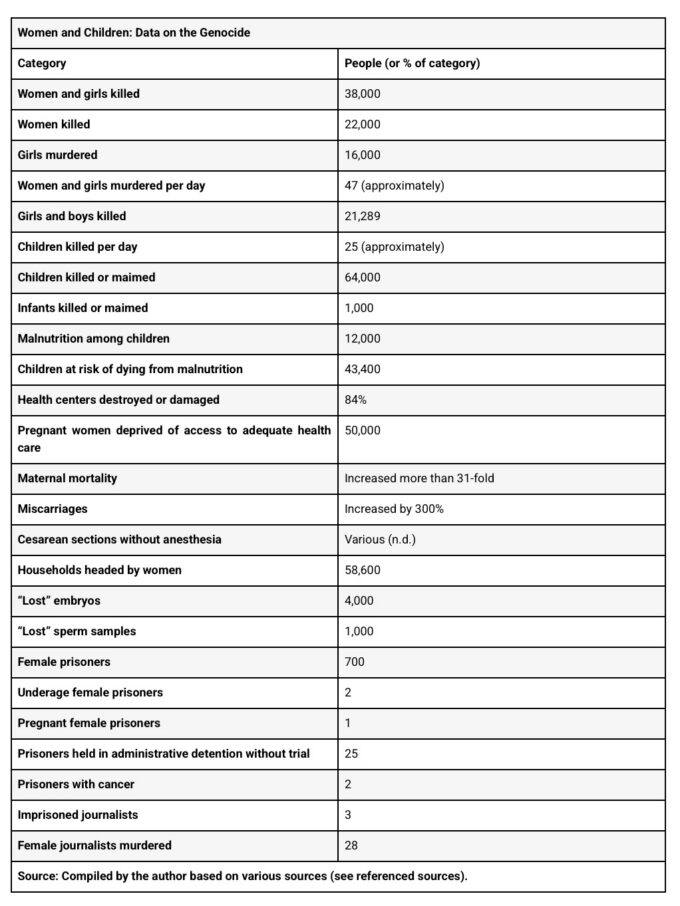
In the context of the genocide suffered by the Palestinian people, the bodies of women and girls are used as weapons of war by Israel, with the complicity of the United States. They endure multiple forms of violence: intimidation, threats, physical assaults, displacement, dispossession, forced nudity, groping, rape, mutilation, and murder, among others.
More than 22,000 women and 16,000 girls have been killed in Gaza in the context of the genocide. This means that 47 women and girls die every day, according to the UN Women report *The Cost of War in Gaza for Women and Girls* (2026, April 17)[2], which means that two women and girls die every hour. This constitutes barbarism—or, rather, killing them is a strategy within the context of genocide.
They are murdered, among other reasons, to ensure that future generations are not born. That is to say, women—conceived as givers of life—are deprived of their own existence so that they do not carry future Palestinian generations in their wombs. Thus, from their genocidal conception, by killing women, they “ensure” the extinction of the offspring.
But if women have already given birth, if they are already mothers, their daughters and sons are mutilated or murdered before their eyes or in their presence. There are numerous accounts of this. One of them is the case of Dr. Alaa al-Najjar, a Palestinian pediatrician, who lost nine of her ten children in May 2025: while she and her husband were treating patients who were victims of the genocide, their home was bombed.
Losing any family member is painful, but losing a son or daughter amounts to “death in life.” Since October 7, 2023, according to the United Nations Children’s Fund (UNICEF), 21,289 children have died (UNICEF, 2026)[3], meaning that one-third of the deaths have been of minors. Or to put it another way, 25 children have been killed every day—one every hour. The questions that arise: First, why kill the civilian population; second, why kill children. The answer, in addition to devastating the general population and demonstrating the barbarity of which they are capable, centers on cutting short the future and exterminating the Palestinian people. In addition to the deaths, there are the children who have been maimed, or the thousands who may be trapped under the rubble. In this regard, UNICEF documented that at least “64,000 children in the Gaza Strip, including at least 1,000 infants,” had been killed, died, or were maimed (UNICEF, 2025, October 8)[4].
Added to this is the reality of watching children die of starvation. According to the World Health Organization (WHO), “In July [2025] alone, there were more than 12,000 children suffering from acute malnutrition. This is the highest figure ever recorded, representing a sixfold increase since the beginning of the year” (WHO, 2025, August 22)[5]. Furthermore, based on its report on the Integrated Food Security Phase Classification (IPC), the WHO states that “Since the last IPC analysis, conducted in May, the number of children projected to be at severe risk of death from malnutrition by the end of June 2026 has tripled, rising from 14,100 to 43,400” (WHO, 2025, August 22)[6].
The story doesn’t end here. We must also consider the strategy targeting pregnant women. With the healthcare system destroyed—preventing proper monitoring of pregnancies—many pregnancies have become complicated and ended in miscarriage. In this regard, Human Rights Watch (HRW) notes that “nearly 84% of health facilities were destroyed or damaged” (HRW, 2025)[7]. With this collapse of the healthcare system, HRW states, “an estimated 50,000 pregnant women and girls in Gaza were deprived of access to adequate care, and the risk of serious health complications during pregnancy, childbirth, and the postpartum period increased” (HRW, 2025)[8]. Regarding the pregnancy situation, a study indicates that the pregnancy-related mortality rate is 948 per 100,000 pregnancies. In contrast, the maternal mortality rate, prior to the onset of the genocide, was 30 per 100,000 live births (Jamaluddine et al., 2026, March 30)[9]. This implies that maternal mortality has increased more than 31-fold. But added to this is something extremely important: the issue of nutrition. Due to the economic blockade imposed by Israel (and the collapse of the local economy), women are unable to obtain sufficient nutrients, leading to hunger, which affects pregnancy. Against this backdrop, there has been a 300% increase in the number of miscarriages in Gaza (HRW, 2025)[10].
To this, which is already extremely tragic, is added something brutal: emergency C-sections without anesthesia, documented by Care International since 2023. I don’t know if all of us are capable of imagining the pain and anguish that mothers must feel and endure as they “bring life” into the world in a context of extreme inhumanity, even at the risk of the mother’s own death. And as if that were not enough, the aforementioned non-governmental organization states, “Due to a lack of capacity in hospitals, women are discharged just three hours after giving birth” (Care International, 2023, October 30)[11]. I say again, there is no greater brutality or inhumanity.
However, added to this is the fact that once women return to their homes—even in the context of genocide, whether or not they have just given birth, whether they are experiencing the heart-wrenching pain of losing a loved one—they continue to perform the intense work of caregiving (for sons, daughters, partners, the elderly, the sick, and the disabled), which generally falls on them. On this point, UN Women notes:
Even in desperation, women keep life going. They prepare communal meals from leftovers, comfort neighbors, care for the sick and the elderly, teach children in tents, and provide first aid. The burden of care and survival is immense, with almost no resources. More than 58,600 households in Gaza are now headed by women (UN Women, 2025, September 12)[12].
But there is also another appalling development that adds up to yet another genocidal strategy. The attacks on and destruction of fertility clinics have led to the devastation of the reproductive health system—actions which, the UN notes, have been deliberate[13]. On this matter, the organization states: “In December 2023, Israeli bombings also struck the Al Basma In Vitro Fertilization Center, the largest fertility clinic in Gaza, resulting in the loss of more than 4,000 embryos and 1,000 samples of sperm and unfertilized eggs” (UN, 2025, December 12)[14]. In other words, it is not enough to murder women, girls, boys, and babies; embryos and sperm must also be exterminated in order to ensure, on all “fronts,” the extermination of the Palestinian people.
However, speaking of women in the context of genocide, there is another realm where Palestinian women also endure the worst forms of violence: prisons. Since October 7, 2023, the number of women arrested has reached 700 cases, most of whom are accused of “incitement,” according to the Palestinian Prisoners’ Society. The Society adds that among the female prisoners, there are “two minors, one prisoner who is three months pregnant, 25 administrative detainees held without trial or charges, three journalists, two prisoners with cancer…” (Palestinian Prisoners’ Club, 2026, April 22)[15]. The Club, citing from the Peace Protection Service, notes that “female prisoners face harsh detention conditions, including starvation, deprivation, medical neglect, [physical and sexual] abuse, isolation, and assaults, including body searches [forced strip searches]” (Palestinian Prisoners’ Club, 2026, April 22)[16]. In some cases, women are detained as hostages to pressure their families into surrendering in exchange for their release. In other words, women continue to be used here as a “weapon of war.”
Finally, I would like to address a topic of great relevance—not because the suffering of women in the context of genocide ends here (we have yet to address the extreme menstrual poverty endured by adolescent girls and women in the Gaza Strip; the profound deterioration of Palestinian women’s mental health; and many other issues)—but rather the case of women journalists. Being a journalist has become an extreme risk in the context of genocide, but for a female journalist, the risk is even greater. Female journalists covering the genocide in Gaza have suffered threats, psychological abuse, physical abuse, imprisonment, forced stripping, sexual assault[17], and murder. In April 2025, there were reports of 28 female journalists killed (UN, 2025, May 2). They have become a target of attack by Israel.
In the face of all this atrocity, the questions we continue to ask ourselves are: what else must happen for the genocide to stop; and who can put an end to such barbarity. It seems we have already witnessed every atrocity “that has ever been and will ever be.” Enough is enough! No woman, no girl, no baby should have to be killed to carry out a project of imperial colonization, dispossession, appropriation, and extermination—in this case, of the Palestinian people. That is why we continue sailing toward the Gaza Strip on a peaceful mission that aims, by appealing to the concept of humanity, to bring support and humanitarian aid, but above all to contribute to ending the genocidal blockade that Israel and the United States are imposing on the Palestinian people.
Notes.
[2] https://www.unwomen.org/en/digital-library/publications/2026/04/advocacy-brief-the-cost-of-war-in-gaza-on-women-and-girls
[3] https://www.unicef.es/causas/emergencias/gaza
[4] https://www.unicef.org/es/comunicados-prensa/dos-anos-guerra-cruel-destrozado-infancia-en-gaza
[5] https://www.who.int/es/news/item/22-08-2025-famine-confirmed-for-first-time-in-gaza
[6] https://www.who.int/es/news/item/22-08-2025-famine-confirmed-for-first-time-in-gaza
[7] https://www.hrw.org/es/world-report/2025/country-chapters/israel-and-palestine
[8] https://www.hrw.org/es/world-report/2025/country-chapters/israel-and-palestine
[9] https://cdn.who.int/media/docs/default-source/bulletin/online-first/blt.25.293829.pdf?sfvrsn=deaf42c5_3&utm
[10] https://www.hrw.org/es/world-report/2025/country-chapters/israel-and-palestine
[11] https://www.care.org/media-and-press/gazacollapsing-medical-conditions-exacerbate-risks-of-maternal-newborn-mortality/
[12] https://www.unwomen.org/en/news-stories/feature-story/2025/09/what-it-means-to-be-a-woman-in-gaza-today#_ftn2
[13] https://www.swissinfo.ch/spa/la-onu-acusa-a-israel-de-%22actos-genocidas%22-por-ataques-a-la-salud-reproductiva-en-gaza/89005651
[14] https://palestine.un.org/en/307014-amid-violence-and-displacement-reproductive-health-crisis-gaza?utm
[15] https://www.ppsmo.ps/home/news/18237?culture=ar-SA
[16] https://www.ppsmo.ps/home/news/18237?culture=ar-SA
[17] https://www.rtve.es/noticias/20260226/129-periodistas-asesinados-2025-record-historico-segun-comite-para-proteccion-periodistas/16955580.shtml
*This article was originally published in Rompeviento on April 30, 2026.