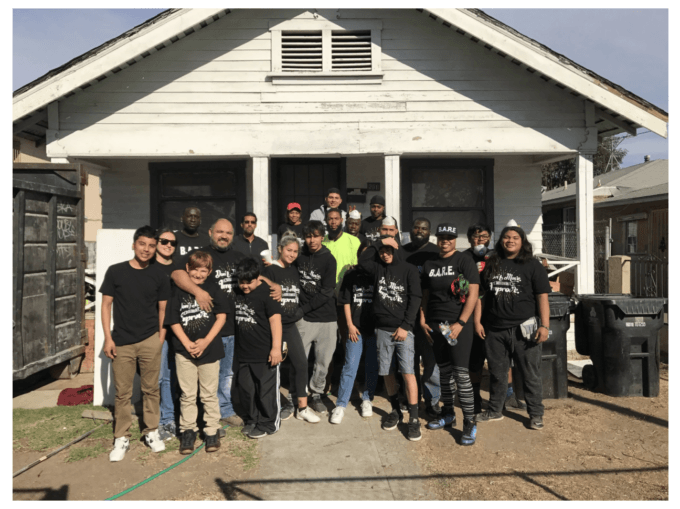
Jorge Nuño and the “Don’t Move, Improve” Beautification Team.
In an interview with candidate Jorge Nuño, we touched on a variety of subjects concerning South Central L.A. The conversation covers: affordable housing, unions, infrastructure, city bureaucracy, employment opportunities, the arts and culture and the preservation of African American culture in South Central Los Angeles. We talked about youth, family, the immigrant community I.C.E and safety.
But most of all, we discussed power at length and the significance of it, how it is exercised and for whom, and how to avoid its persuasive cant.
As we near election day on June 2nd in Los Angeles, flyers have begun to clog the mailboxes. Most all messages and images are similar only combined in different ways. Candidates with the support of deep pockets have filtered campaign money through non-profit organizations buying advertisement ads on the internet, t.v and local media. Those with less resources and extraordinary commitment in shifting the tide must fundraise, and strategically time when to mail out their flyers. The following interview hopes to shed some light on topics and aspirations that fall far away from the controlled discussion that is taking place between candidates and constituents.
Why have you decided to run for Council District 9?
I decided to run because I love South Central Los Angeles, and I believe our community deserves leadership that is deeply rooted here, accountable here, and invested in the people who live here. I was born and raised in South Central. My parents came here from Jalisco with very little, and like many families in this district, we built our lives through hard work, sacrifice, and community.
For too long, many residents have felt invisible. We see it in the illegal dumping, the lack of responsiveness, the housing crisis, and the feeling that City Hall only shows up during election season. I’m running because I believe District 9 deserves a representative who understands both the struggles and the potential of this community firsthand.
I’m not coming from political consulting or lobbying. I come from building businesses, creating jobs, organizing community projects, and opening my own home to the public for nearly two decades. I want to bring a culture of action, accountability, and community investment back into local government.
How long have you been in South Central Los Angeles?
My entire life. I was born and raised in South Central Los Angeles. My parents settled here after immigrating from Jalisco, Mexico. I grew up in the 90011 area, attended local schools, built my businesses here, and raised my family here.
This community shaped me.
What would you say distinguishes you from the rest of the candidates?
What distinguishes me is that my life’s work has already been rooted in community building before politics. I’m a social entrepreneur. I’ve spent over 20 years building businesses in South Central that hire locally, train young people, work with schools, nonprofits, labor unions, and community organizations.
I understand systems because I’ve had to navigate them as a business owner, community organizer, and resident. I know what it means to meet payroll, negotiate contracts, advocate for resources, and solve problems in real time.
I also believe people are tired of transactional politics. They want authenticity. They want someone who actually lives the realities of the district and who has demonstrated commitment long before running for office.
The Big House is one example of that commitment. It became a space where residents, artists, organizers, students, and political leaders could gather, organize, and imagine solutions together.
Share with us what The Big House is and why you decided to make your home into a community center?
The Big House started organically. I purchased my home almost twenty years ago, and over time it became a gathering space for the community. We hosted workshops, organizing meetings, grassroots campaigns, youth programs, fundraisers, political conversations, art events, and holiday toy drives.
I realized there was a lack of accessible spaces in South Central where people could gather safely, creatively, and politically. So instead of seeing my home as only private space, I saw it as an opportunity to invest back into the neighborhood.
For me, it represents a philosophy: community infrastructure matters. Sometimes transformation starts with simply opening the door.
What methodology would you apply as a council member to assist your constituents’ concerns?
My approach would be highly responsive, data-driven, and community-centered.
First, I would restructure the district office to operate more like a service and accountability center than a political office. Residents should know exactly where their requests stand. I want public-facing tracking systems for issues like illegal dumping, street repairs, and housing complaints so people can see timelines and outcomes.
Second, I believe in proactive governance. Instead of waiting for problems to escalate, my office would conduct regular district audits, walk neighborhoods consistently, and maintain direct relationships with neighborhood councils, churches, tenant groups, schools, and local businesses.
Third, collaboration matters. Many of the problems in South Central overlap between city, county, state, and nonprofit systems. I would convene regular coalition meetings so agencies and community stakeholders are coordinating instead of working in silos.
Most importantly, residents must feel heard. The government should not feel distant.
How do you plan to deepen the historical presence of the African American community in South Central?
Deepening the historical presence of the African American community in South Central starts with recognizing that Black families helped build the cultural, political, and spiritual foundation of this community. We cannot allow displacement, neglect, or rising costs to erase that history.
One of the ideas I’m passionate about is creating a preservation and rehabilitation fund specifically to help legacy Black families maintain and improve their homes. Many elders have owned their homes for generations but may not have the financial resources to keep up with repairs, accessibility upgrades, landscaping, painting, roofing, or deferred maintenance. I’ve seen firsthand how quickly longtime residents can feel pressured out when their homes begin deteriorating.
I want to give families a helping hand instead of watching them get pushed aside.
This idea is inspired by the “Don’t Move, Improve” home makeover work I’ve already done in the community. I believe we can scale that model by partnering with trade and labor unions, apprenticeship programs, local contractors, and schools like Los Angeles Trade–Technical College to create pathways where students and union apprentices can gain hands-on experience while helping preserve longtime family homes in South LA.
That’s not just housing policy to me, that’s cultural preservation!
Beyond housing, I want to invest in preserving Black cultural landmarks, supporting Black-owned businesses, expanding arts and music programming, documenting oral histories from elders, and strengthening the Black and Brown relationship that has shaped South Central for generations.
The future of South LA should not come at the expense of the people who carried this community through its hardest decades. It should honor them, invest in them, and ensure they remain part of the story moving forward.
You have shared that your work is unionized. What does unionization mean?
Yes. Our print operations became unionized because I believe workers deserve dignity, protections, fair wages, and pathways toward stability.
Being unionized means workers have collective representation and protections in the workplace. It creates standards around compensation, workplace conditions, and accountability.
I reject the false narrative that labor and business owners must always be in conflict. I believe strong businesses and strong labor can grow together when there is mutual respect and shared investment in people.
What are the feasible realities for South Central when it comes to generating employment opportunities?
South Central sits in one of the most strategically important areas in Los Angeles, but historically many residents have not benefited from the economic activity around them.
I believe the future opportunities include green manufacturing, logistics innovation, creative industries, construction, infrastructure modernization, arts and culture, local tourism, food entrepreneurship, and workforce training connected to emerging industries.
We also need stronger pipelines between schools, community colleges, unions, and local employers so young people can move directly into careers.
I’m especially interested in building local ownership models so wealth circulates inside the community instead of constantly being extracted from it.
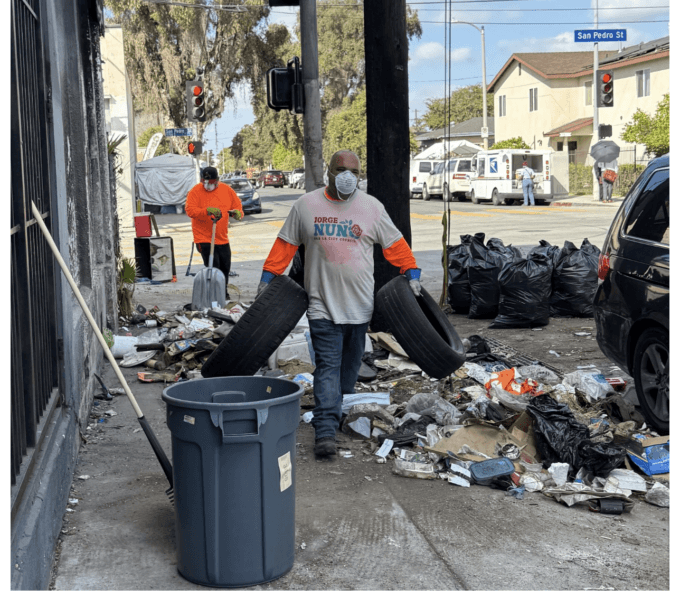
The “Don’t Move, Improve” Beautification Team at work.
One of the main concerns for South Central Los Angeles residents is illegal dumping and housing. What are your short and long-term strategies?
Illegal dumping and housing are connected to something deeper: decades of disinvestment, weak enforcement, lack of economic opportunity, and communities feeling disconnected from ownership and decision-making in their own neighborhoods.
In the short term, we need immediate action and accountability. My office would aggressively coordinate sanitation, public works, parking enforcement, and housing departments to respond faster to illegal dumping, encampments, vacant properties, and neglected spaces. I want a public-facing dashboard so residents can track requests, timelines, and outcomes in real time. We also need consistent neighborhood cleanups, stronger enforcement against repeat offenders, and rapid response teams focused specifically on quality-of-life issues.
But long term, we cannot enforce our way out of these problems. We have to organize our community economically and give residents a real stake in the future of South Central Los Angeles.
That means helping families build wealth, not just survive. I want to use every tool available through the city to support local ownership, cooperative business models, affordable housing development, first-time homeownership programs, community land trusts, and pathways for local residents to participate in development projects happening in our own neighborhoods.
We should be organizing our dollars collectively and recycling wealth back into the community instead of constantly watching money leave South Central. I’m interested in exploring public banking options, local investment initiatives, partnerships with credit unions and community financial institutions, and leveraging city contracts and procurement to support local businesses and workers.
When development happens in District 9, residents should not just watch from the sidelines. They should benefit from it, work in it, invest in it, and eventually own pieces of it.
That’s how we stabilize neighborhoods long term. Clean streets matter. Housing matters. But ultimately, communities become healthier and safer when people feel ownership, dignity, and economic power in the places they call home.
The current Federal administration has launched an assault against the immigrant community. What is your approach to help and protect from ICE raids?
My approach starts with being clear: Los Angeles must stand boldly as a sanctuary city, and immigrant families deserve leadership that will defend them, not abandon them in moments of fear.
I believe the local government has a responsibility to protect constitutional rights and make sure city resources are never used to assist in the targeting of immigrant communities. As council member, I would push to strengthen oversight and ensure LAPD does not cooperate with ICE enforcement activities that undermine trust and create fear in our neighborhoods.
But policy alone is not enough. We need infrastructure to support families in real time.
I plan to help establish a legal defense and emergency support fund for families impacted by ICE raids so residents have access to attorneys, emergency assistance, and rapid response support during moments of crisis.
This work is already personal to me. I’m part of the South LA Rapid Response Network responding to ICE activity in our communities. When raids escalated in early 2025, we used The Big House to print and distribute over 150,000 Know Your Rights red cards across South Los Angeles so families understood their legal protections and how to respond safely during encounters with ICE.
I believe leadership means showing up before the cameras arrive. Immigrant families should know they are not alone, and that their city government will stand with them with courage, resources, and action.
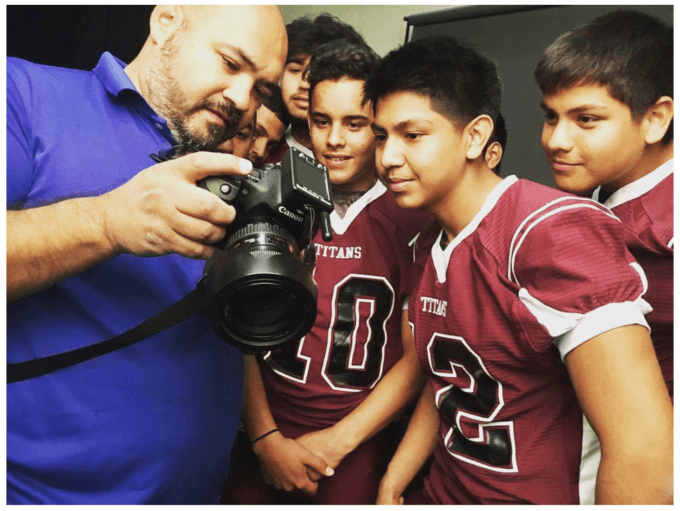
Jorge Nuño mentoring teenagers.
How do you plan to engage the youth?
Youth engagement cannot just happen during election season. Young people need spaces to create, organize, learn, and lead.
When I finally moved into The Big House after years of rehabbing it, I remember looking out of my office window and seeing local youth trying to skateboard on our broken decapitated streets with no safe place to skate. That stayed with me. So that first Christmas, I surprised the neighborhood youth by building a small skatepark at The Big House.
That became the beginning of a much larger effort centered around creating positive spaces and programming for young people in South Central.
Over the years, we organized Guitar Hero nights, weekend teen parties, coding workshops, entrepreneur classes, art gatherings, and block parties powered by the youth themselves. The goal was always to give young people a safe space to express themselves, build confidence, develop skills, and feel ownership in their community.
I believe many young people are not lacking talent or intelligence. They are lacking investment, mentorship, exposure, and opportunity.
As a council member, I want to expand mentorship programs, workforce development opportunities, arts programs, entrepreneurship training, and civic engagement initiatives. I also want youth helping shape conversations around public safety, housing, technology, economic development, and the future of South LA itself.
Sometimes all it takes is one opportunity, one mentor, or one safe space to completely change the direction of a young person’s life.
Do you plan on implementing art and cultural programs as a council member?
Absolutely. Art and culture are not side issues to me. They are central to how we build identity, pride, healing, and economic opportunity in South Los Angeles.
I’m a graphic designer and photographer by trade, so creativity is part of my DNA. Art changed the trajectory of my life. It gave me a career, a voice, and eventually allowed me to build businesses that now employ local residents and work throughout Los Angeles.
At The Big House, we’ve hosted countless arts and cultural events over the years and provided local artists space to showcase their work, connect with the community, and experiment creatively. One powerful example was when Patrisse Cullors showcased her performance thesis at The Big House, attracting hundreds of people from across Los Angeles. That experience reinforced for me how hungry our communities are for spaces centered around creativity, dialogue, and culture.
As a council member, I want to think much bigger about the cultural future of South LA. One of my long-term visions is helping develop a Central Avenue Arts and Cultural Corridor that connects Little Tokyo to Watts through music, food, art, nightlife, entrepreneurship, and cultural preservation.
South LA has one of the richest Black and Brown cultural histories in the country. Jazz history lives here. Activism lives here. Street culture, design, food, fashion, and storytelling live here. Our food culture alone is second to none. The problem is not a lack of culture. The problem is lack of investment and infrastructure around that culture.
I also want to explore repurposing the abandoned half-block building near the South Los Angeles Wetlands Park into a tech and creative campus that could support youth training, digital arts, music production, entrepreneurship, workforce development, and green economy innovation.
I believe the future of South LA should not only be functional. It should be beautiful, creative, culturally alive, and economically empowering for the people who already live here.
Why does art matter?
Art matters because it tells people they exist.
In South Los Angeles, art is everywhere. It lives in our murals, our music, our fashion, our food, our photography, our lowriders, our street vendors, our churches, and the way people express pride in their neighborhoods. Art tells our history. It shares our struggles. It reflects our resilience and our love for community.
For communities that have often been ignored or misrepresented, art becomes a form of storytelling and preservation. It captures identity, memory, pain, joy, and imagination.
As a graphic designer and photographer, creativity changed the trajectory of my life. I’ve seen firsthand how art can transform environments and transform people’s self-worth. Through my work with schools across Los Angeles, I’ve used graphic design, murals, photography, branding, and environmental design to beautify hallways and campuses so students can walk into spaces that inspire them instead of spaces that feel forgotten.
I want art to help communities imagine what’s possible.
Art is powerful because it shapes how people feel about themselves and their surroundings. It can create hope, pride, healing, and connection. I want to use art in all its forms to uplift South LA, preserve our culture, support local artists, and help residents reimagine the future of our community.
Tell us something about your upbringing. You mentioned your father was a gardener. Can you share your experiences?
My father was a gardener, and as a young boy I worked alongside him throughout South Central, Inglewood, and other parts of Los Angeles. I learned work ethic through physical labor. I learned dignity through service.
I saw how caring for a space changes how people feel about themselves and their neighborhood. Cleaning, maintaining, and beautifying spaces may seem simple, but there is something deeply human about it.
Those experiences shaped how I see the community today. They taught me that leadership is not about status. It’s about responsibility.
Coming closer to the end of this interview, we spoke about power at length and how often it is exercised against the needs of a community. How do you plan on addressing power’s persuasive abilities and not become a victim of power?
Power becomes dangerous when people lose their moral compass, isolate themselves from the community, and start believing they are above accountability. I’ve spent my entire adult life being intentional about who I surround myself with. As a business owner and community leader, I keep honest people with integrity around me who are willing to challenge me, tell me the truth, and keep me grounded.
Everything I’ve built has come through hard work, relationships, and reputation. I’ve built partnerships with elected officials, labor unions, schools, nonprofits, and community stakeholders because people know I follow through and operate with integrity. My reputation is everything to me. That’s all you truly have at the end of the day.
I also think we are living in a moment where the public is exhausted by corruption, backroom politics, and elected officials using office for personal gain. We’ve seen the damage that causes trust in the government. I’m not interested in becoming another headline like the current councilmember facing corruption charges or candidates already dealing with ethics violations before even taking office.
For me, public office is not about status or access. It’s about stewardship and responsibility to the people who trusted you with power.
The way I plan to protect myself from the corrosive nature of power is by staying rooted in the same community, relationships, and values that shaped me long before politics. I want residents to always feel they can approach me directly, challenge me, and hold me accountable. The moment a leader stops listening to the community is usually the moment they begin losing themselves.
You’re designated as Social Entrepreneur on your ballot. Tell us more about that ?
To me, being a social entrepreneur means using business, creativity, and innovation to solve community problems while creating economic opportunity for people who have historically been left out.
I’m not a career politician. My background comes from building businesses and community infrastructure in South Los Angeles for over two decades. Through NTS Communications, SCLA Print, and The Big House, I’ve tried to prove that you can build successful enterprises while still investing back into your neighborhood, hiring locally, mentoring youth, supporting artists, partnering with unions, and creating opportunities for working families.
I’ve always believed South LA deserves more than survival. We deserve ownership, investment, beauty, and economic power.
A lot of my work has centered around helping institutions and communities reimagine themselves. As a graphic designer and creative strategist, I’ve worked with schools to transform campuses through storytelling, branding, murals, photography, and beautification because the environment impacts psychology. When students walk into spaces that inspire them, it changes how they feel about themselves and what they believe is possible.
That same philosophy applies to South Central Los Angeles.
I believe the future of revitalizing our community is not waiting for outside forces to save us. It’s about organizing our own talent, businesses, culture, labor, and resources to build from within. We need to create an ecosystem where local entrepreneurs can thrive, where artists and creatives are seen as economic drivers, where young people can build businesses, and where wealth circulates inside the community instead of constantly leaving it.
I want more business owners and entrepreneurs in South LA to understand the impact they can have beyond profit. Businesses can become anchors for community development, mentorship, job creation, and neighborhood pride.
At the same time, we need partnerships. I want to invite the private sector, mission-driven financial institutions, labor, universities, and philanthropy to partner with us in building the future of South LA. There are billions of dollars flowing through Los Angeles every year, yet too little reaches the communities that need investment the most.
I believe South LA can become a national model for community-centered economic development, where culture, entrepreneurship, technology, sustainability, and local ownership work together to uplift working-class families without displacing them.
That’s what being a social entrepreneur means to me. It’s not just about building businesses. It’s about building community power.
Final question: other wealthy districts of Los Angeles have pet parks and spaces and can afford pet care unlike South Central. Not one candidate has tackled this question. Would you be willing to take up this challenge?
South Central residents love their pets, yet many neighborhoods lack safe spaces and affordable resources for pet owners. What is your vision for improving the quality of life for animals and pet owners in District 9?
Last year, I lost my dog Sprinkles after many years together, so this issue is personal to me. Pets are family, but many residents in South LA don’t have safe spaces to walk their dogs because of illegal dumping, encampments, broken sidewalks, poor lighting, and unsafe streets. Part of my vision for a cleaner, safer, and more walkable South LA includes making neighborhoods safer and more welcoming for pet owners too.
I also want to explore partnerships with nonprofits, veterinarians, and animal welfare organizations to bring affordable pet care services like vaccinations, spay and neuter programs, and mobile clinics into underserved neighborhoods. We deserve more dog parks, green spaces, and community areas where families and their pets can feel safe and connected.