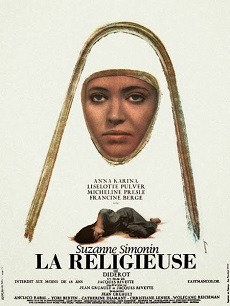
Poster for Jacques Rivette’s Suzanne Simonin, La Religieuse de Diderot.
We think of France as being more liberated culturally and sexually than the US. And perhaps it is, today. But in the 1960s, post-war/pre-Mai ’68 France was still in the grip of the Catholic Church and right-wing Gaullist politicians.
In 1965, France banned the showing of Jacques Rivette’s film of Denis Diderot’s 1792 novel, La Religieuse (The Nun). Not only did they ban the film, they also banned the radio and television press from reporting that they had banned the film.
Although Voltaire and Rousseau grabbed the headlines as philosophers of the Revolution, it was Diderot the Encyclopedist whose “seditious” words put him under constant surveillance, led to the confiscation of his manuscripts and eventually landed him in the dungeons of the king’s prison at Vincennes, where the Marquis de Sade was later locked in a dark cell for seven years. (The last straw for the enforcers of imperial obedience was his heretical “Letter on the Blind,” which not only advocated reason over religious superstition but advanced a theory of natural selection 100 years before Darwin.)
Diderot’s novel, which wasn’t published until a decade after his death, was a scathing assault on the corrupt and incestuous ties between the Church and the Ancient Regime. Rivette’s film, which is remarkably faithful to the novel, targeted the modern reincarnation of that repressive alliance.
Simone is the illegitimate daughter of an aristocratic family in financial ruin. Her severe mother tells her she is a daily reminder of her sin, a child who will never have the status to be married. Against her will, she is placed in a convent. The convent is a prison, a sanctified Bastille, where the nuns are kept in cells, the windows are barred and all interactions with the secular world take place behind curtains or grill-like barriers.
Every act of rebellion is punished with increasing severity: she was placed in isolation, deprived of food and books, whipped and forced to kneel or prostrate herself (stress positions) on stone floors for hours. The basic techniques of torture haven’t changed all that much across the centuries.
Her desire for freedom is viewed as a sign of demonic possession. Suzanne believes that the laws of Enlightenment France will save her from this cruel servitude. She smuggles a letter describing her condition to a lawyer, who eventually pleads her case. But the state and the Church collude to reject Suzanne’s petition. The law offers no recourse in a regime where the government is aligned with the perpetrators. Eventually, Suzanne is transferred to a different convent, where conditions are less harsh, but the cloister is run by a lesbian Mother Superior, who makes sexual advances on Suzanne. Eventually, Suzanne escapes with a Monk, who told her that he, too, had been forced into the thralldom of the church. But the Monk immediately tries to seduce Suzanne and she runs away. Homeless and destitute, she is soon taken in by the madame of a brothel. In despair at her fate, she chooses a final act of freedom and throws herself off the roof of a building.
Rivette’s film is not explicit. It doesn’t show scenes of torture and abuse. There’s no nudity or sex. And yet its message of coercion, subjugation and despotism found its mark. The austerity of the film served to emphasize the extreme brutality it hinted at but chose not to depict.
La Religieuse was a critique of the very forces that sought to suppress it; indeed, the film anticipated its banning and the banning proved its premise.
The media ban was shattered by Jean-Luc Godard, Rivette’s old colleague at Cahiers du Cinema, in an open letter to France’s Minister of Culture, the pompous novelist Andre Malraux. The film starred Godard’s ex-wife, Anna Karina, with whom he remained obsessed for most of his life. The film is one of Karina’s greatest performances.
By then Godard himself had had two of his first five feature films banned or censored: Le Petit Soldat, for its depictions of torture during the Algerian war and A Married Woman for “images contrary to good morals” and “its allusions to concentration camp inmates” which Godard used to made clear the history of France during WWII wasn’t merely a heroic saga of the resistance but also widespread complicity with the Nazis and in the Holocaust.
The politician who led the assault on Le Petit Soldat was none other than Marine LePen’s father, Jean-Marie LePen, leader of the Neo-fascist, anti-immigrant Front National. (Ironically, three years later, his film Contempt was going to be withdrawn from distribution by its own US-Italian producers for the opposite reason: he didn’t include enough nude scenes of Bardot, prompting Godard to shoot the famous opening sequence of Bardot’s naked ass shot in the flashing colors of the French flag.)
Godard’s letter to Malraux appeared on the front page of Le Nouvel Observateur, where he compared the Minister/Novelist to a cultural Vichyist, a collaborator with fascists:
Since you are the only Gaullist I know, my anger will have to fall on upon you. I am sure now, dear André Malraux, that you will understand absolutely nothing of this letter, which submerged in hatred, I address you for the last time. Nor will you understand why, from now on, I will refuse to shake your hand, even in silence. It’s not surprising that you will not recognize my voice when I speak of Suzanne Simonin, Diderot’s Nun, as an assassination. No. There’s nothing surprising in your deep cowardice. You are putting your head in the sand to avoid your interior memories. How could you hear me, Andre Malraux, since I am calling you from the exterior, from a distant country, from a free France?
The rebuke included a Postscript from one of his old running mates: “Read and approved by Françoise Truffaut, obliged to shoot in London, far from Paris, Fahrenheit 451, the temperature at which books burn.”
The missive found its mark and the humiliated Malraux gave Rivette’s film permission to be shown at Cannes, where it was runner-up for the Palm d’Or.
As Trump’s new right congeals with reactionary religious sects, France’s past may well become America’s future.
Sources: Everything is Cinema: The Working Life of Jean-Luc Godard by Richard Brody. (Holt)
The New Wave: Truffaut, Godard, Chabrol, Rohmer, Rivette by James Monaco. (Oxford)
Jacques Rivette by Mary Wiles (Illinois)