
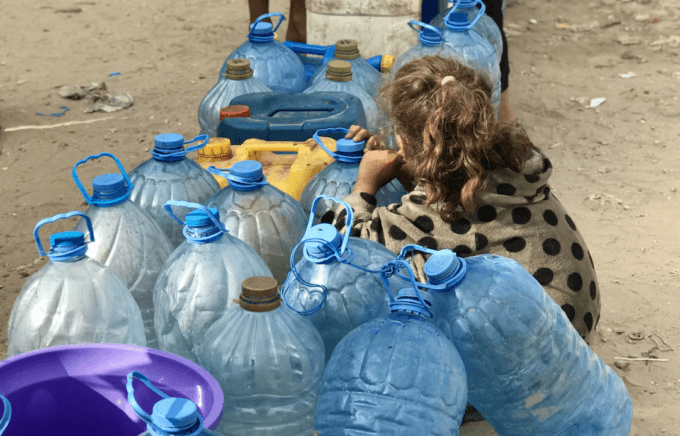
Photo by Emad El Byed
Her grandparents never began with the leaving. They began with the house.
When her grandparents spoke, they spoke of the house—a stone house. They always said stone house slowly, as if the word itself could still hold something, as if it might remain if spoken carefully enough. They spoke of a door that was never locked, of a courtyard where the light lingered longer in the afternoon, of water that did not have to be measured.
They said they had had everything.
They never explained what that meant.
Sometimes they stopped there. Her grandfather would lower his gaze, and her grandmother would wipe her hands on her apron, though there was nothing on them.
The girl learned not to ask. She understood only that there was a point in every story where the voice changed and could not go further.
She is thirty-five now, not old and not young, and she knows where that point is.
Her house is gone.
Not the one they spoke of. Another one, smaller, temporary in ways no one said out loud, but still a place where things had their place.
They said it was over.
After that, it disappeared.
She does not remember the sound, only what followed—how the air shifted, as if something invisible had been removed, as if everything that had a place no longer did.
There is nothing to return to. Not her ID, not the clothes she folded the night before, not the small things she never thought to name.
Her daughter had something once, something soft. She tries to remember its color, but cannot.
They do not say everything. They do not need to.
Each day, something disappears—not the kind that is counted, not the kind that appears on maps.
Smaller things: a spoon worn thin from use, a cup that lasted longer than expected, a piece of cloth that once belonged to something else.
Things that remain until they don’t.
They sit close now, not out of tenderness but because distance has become uncertain, something that can open too quickly.
The child holds the cloth.
Blue.
She rubs it between her fingers, slowly, as if something might still be inside it, as if it could remember for her.
In the morning, the woman untangles the child’s hair with her hands. There is no brush. She wets her fingers first, carefully, just enough. The child sits still.
Sometimes the child searches her pockets, one by one, as if something should be there. Her hand comes out empty. She looks at it for a moment, then tries again.
At night, they lie beside each other. The child takes her mother’s hand and places it against her face, as if returning it to where it belongs. The woman lets it remain.
These are small things. No one writes them.
One evening, the child does not reach for her hand. It does not happen suddenly—only that the hand remains on the blanket, still, instead of searching. The woman does not move.
In the morning, the child asks for nothing.
The woman thinks of her grandparents and the way their stories ended—not only because they could not continue, but because there was a point beyond which questions no longer made sense.
The child sits with the cloth and folds it carefully, once, then again. The woman recognizes the movement before she understands why.
She remembers her grandmother’s hands, how they folded what remained, as if order could hold something else in place.
The child gives her the cloth. The woman folds it once more, more precisely this time, and they place it between them. For a while, it rests there.
Later, the child puts it in her pocket. This time, it stays.
The pocket is no longer empty.
It took a moment to lose everything. It has taken the years since to understand what that meant.
Each day, something disappears. Each day, something else—almost nothing—is kept. Until it isn’t.


