
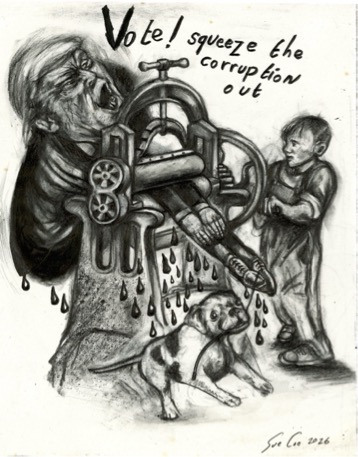
Sue Coe, Vote! 2026. Courtesy the artist.
The author and JFK
When I was a little boy, my parents, older sister and brother often watched The Jack Paar Tonight Show on our small, black-and-white Admiral television set. Sometimes I’d be awakened by it — not the program, but the sound of laughter. Paar had a good team of gag writers, including Dick Cavett, and a deadpan delivery that worked for Bert and Grace, my two siblings, Joan and Paul, and millions of others.
Not wanting to be left out, I’d trundle down the short hallway from the bedroom to the living room and ask if I could join them. The answer from my parents was always the same: “Ok, just five minutes,” which usually stretched to ten or fifteen. A quarter of an hour is a long time late at night when you are four years old.
The first time I saw John Kennedy was on Paar’s show, June 16, 1960. You can watch part of the interview on YouTube. Paar was embarrassingly deferential – even reverential – and Kennedy nervous and over earnest. The candidate’s apparent goal, a month before the convention, was to project strength and assure viewers he was better prepared to stand up to Russian and Chinese communism than Lyndon Johnson or the red-baiting, Republican nominee, Vice President Richard Nixon.
We need a president with “vigor,” the 43-year-old senator said, and America was “the only guardian against the communists’ advance.” The interview is a reminder of how blinkered the country was back then by the supposed communist menace. (Trump is trying, without much success, to revive the fear.) None of this, of course, was apparent to me back then – I just liked staying up and laughing with everybody else.
Seven months later, on Jan. 20, 1961, I watched Kennedy’s inaugural address on T.V. I quickly committed to memory its most famous lines:
And so, my fellow Americans: ask not what your country can do for you–ask what you can do for your country.
My fellow citizens of the world: ask not what America will do for you, but what together we can do for the freedom of man.
For the next three years, until the assassination, I’d repeat the words, imitating the president’s Boston Brahmin accent, playing it for laughs. This was the great age of American comic impressionists like Frank Gorshin and Vaughn Meader who made a brilliant, albeit short-circuited career impersonating Kennedy. I can still do my JFK schtick.
I kid you not
I recount all this just to say how far back goes my engagement with American politics – not quite to the womb, but close. It was mother’s milk to me, but better since I was fed formula like most other American children of the day. But however long I’ve been looking at, reading about and studying American politics, I’ve rarely succeeded in predicting the results of an election. Hopes and fears nearly always triumph over judgement. As an 8-year-old, I was sure Goldwater would beat Johnson and plunge the world into atomic war. I spent much of October 1964, practicing duck and cover. That year, Johnson won in the greatest landslide in American presidential history.
Four years later, aged 12, I was deeply upset by the assassination of Robert Kennedy, but certain that Hubert Humphry, who in September finally came out in opposition to the Vietnam War, would beat Nixon.
Then in 1972, I was equally sure Nixon would be defeated by the hapless George McGovern, regardless of the polls that universally predicted the opposite. How could people vote against so decent a man as McGovern, who was vehemently opposed to the war and had been since ‘65. I knew, of course, that he’d made a catastrophic blunder in initially choosing as his running mate Thomas Eagelton who had three times been hospitalized for depression and subjected to electroshock therapy. His replacement, Sargent Shriver, was an excellent choice: Former Ambassador to France and founding director of the Peace Corps, he was married to Eunice Kennedy, John, Ted and Bobby’s sister. Surely that was electoral gold! Besides, Nixon was obviously a racist, antisemite and crook. McGovern suffered an even bigger landslide than Johnson, losing 49 out of 50 states, taking only Massachusetts.
With maturity came self-knowledge. Knowing my poor record of picking winners, I was certain in 2008 – because my heart counseled the opposite — that Obama must lose to Bush. I was especially upset by the prospect of defeat because it was I who convinced Barack to run for president in the first place! Don’t believe me? As Paar would say, “I kid you not.”
In 2004, when Obama was running for the U.S. Senate from Illinois, my liberal next-door neighbors in suburban Highland Park threw a small fundraiser for him. Standing in the circular driveway of their large, modern house, Obama gave a fifteen-minute campaign speech of considerable eloquence. He promised to end the war in Iraq, extend medical coverage to currently uninsured Americans, and raise taxes on the wealthy (Bush had recently cut them). These were big promises from a candidate for Senate!
Obama seemed smart, poised and progressive – like Kennedy, only better because he wasn’t fixated on communists. After his speech, I went up to him with my 13-year-old daughter, Sarah in tow. She gazed up at him with awe; I didn’t want to admit it was probably desire. I introduced her to him. Obama looked down at her kindly and said, “Sarah, you look like my daughter Malia, though she’s younger than you.” Sarah’s eyes glazed and her only reply was flushed cheeks and a short nod. I interrupted the love scene with verbal genuflection: “Great speech, Barack,” I said. (Giving a candidate money establishes familiarity.) “You ought to consider running for president!” Obama smiled and replied: “Thanks, that’s very kind – but one step at a time!” So, you see, it was I who gave him the idea! But don’t blame me for his many failures as president. He never came back to me for advice, so it’s all on him. In any case, Obama won easily and my record of inaccurate electoral prediction was secure – and so it remains to this day.
My prediction for tomorrow
Given my history of forecast failure, it pains me to predict an overwhelming Democratic victory tomorrow — a blue-wave, perhaps even a tsunami. Here’s five reasons why:
1) Trump is a fascist. Sue Coe and I wrote a whole book about that in 2024, and who today could disagree? He engendered a cult of personality – lately weakening; and he created an army of storm-troopers (ICE) to terrorize immigrants, anybody who looks like an immigrant, and anybody who tries to defend someone who look like an immigrant. Trump heads a death cult; he wants to fry the planet, while offering an escape hatch to AI billionaires planning flight to Mars.
2) The U.S. economy is weak – inflation is up, growth is sluggish, and the gap between rich and poor is greater than during the gilded age. Gas costs five bucks a gallon; a fast hamburger ten dollars, even my preferred veggie burgers.
3) The Republicans are now the party of war. They have enabled a genocide in Gaza (admittedly, Biden started the policy, but he got booted off the ticket partly because of it) and supported a war of aggression against Iran. Trump is now stuck in a quagmire with no plans for escape.
4) It’s true that Republicans, in the end, almost always come out to vote in large numbers for other Republicans. But (my heart says), there’s no reason to believe that will be true again this time.
5) Democrats and independents, including poor and disaffected voters, libertarians, socialists, and others on the left will recognize what’s at stake and decide to vote strategically.
No laughing matter
I’ve watched the few surviving tapes of Jack Paar’s broadcasts and most of the stuff is puerile – gags about celebrities, TV commercials, pretty girls and fat people. But he wore his two-button jackets well and exuded a cool confidence. He was quick on his feet and comfortable with all sorts of guests. And he had some surprising ones, including Fidel Castro in 1959 (recorded in Havana), Dick Gregory in 1961, and Muhammad Ali (then Cassius Clay) in 1963, before he knocked out Sonny Liston for the title. Parr unfortunately called him a “very nice boy.”
The Tonight Show was “not a political show,” Paar liked to say, though he had Bobby Kennedy as well at JFK on, and Nixon three times. In 1966, he hosted a special called “A Funny Thing Happened on the Way to the White House” filled with powder-puff jokes about President Johnson, Vice President Hubert Humphrey, Nixon, and many other politicians. The word Vietnam wasn’t uttered once. Parr set the tone at the start of the show when he told his best-known joke:
“I’ve never been involved in any partisan politics – one side or the other. As a matter of fact, I feel like the little old lady in Maine who said: “I never vote; it only encourages them.”
In contrast to the invented “little old lady,” I’ve voted in every election – federal, state and local – since 1974. After moving from Florida to Norwich, England in 2024, I voted absentee and did again this year. Unless my prediction this time is right (for a change), I may never have the chance to vote again.


