
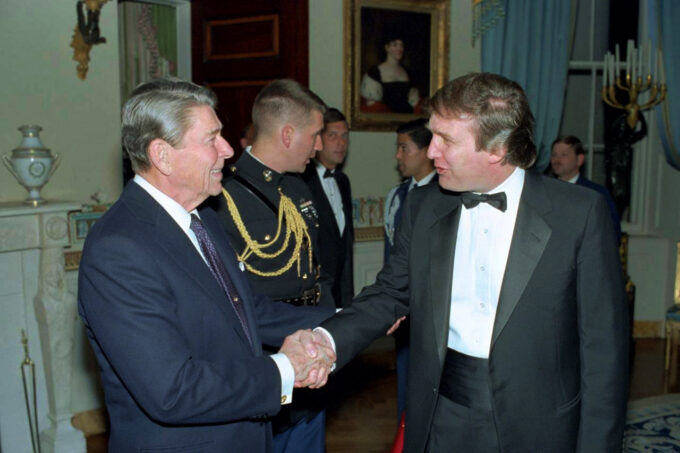
Photograph Source: White House photographer – Public Domain
Many observers have posed the question, “How did the US end up with a psychotic president who displays no regard for truth?” A critical and historical understanding of the political economy of politics helps to explain the self-aggrandizing transactional presidency and make sense of the seemingly nonsensical.
In the late 1970s and early 1980s, both the US and UK led the radical transformation of the international political economy toward a fundamentalist neoliberal regime. What this meant is that the public sphere would be systematically eroded in favor of an all-out, untethered private sphere as the moral ideal. The arbiter of rationality would shift away from the leadership of public-minded individuals to those eager to run the state along strictly market principles.
Margaret Thatcher famously uttered the credo of the neoliberal state: “There is no alternative,” meaning that corporate capitalism is the only game in town. Her goal was to smash labor unions and socialist politics. Her partner in crime Ronald Reagan, elected a year later, acted as her pas de deux. One of Thatcher’s targets was the National Union of Mineworkers, while Reagan aimed at the air traffic controllers union, PATCO, which he reduced to rubble.
The duo were able to spread their shared individualist-oriented ideology by hiring the talents of PR specialists drawn from the private commercial sector. “Spin masters,” as they were called, came from the fields of marketing, sales, advertising, publicity, public relations, public opinion management, and related communication professions. Thatcher hired the giant advertising firm Saatchi & Saatchi to help run her campaign, while Reagan broke away from the tradition of limited use of campaign specialists to the wholesale employment of propaganda professionals and consultants taking leave from the major Madison Avenue agencies, BBDO, Ogilvy & Mather, Young & Rubicam, and others.
Reagan was enthralled with how his own Hollywood career had influenced American culture. Why couldn’t he, a grade “C” actor, accomplish the same in the political sphere with such banal phrases as “the shining city on the hill,” i.e., America as a unique and universally revered state, and his studied observation that: “Trees cause more pollution than automobiles”? Reagan’s ad/PR team turned White House communication into a “permanent campaign,” with continuous polling, giving his advisers immense power to mold and manipulate popular political discourse and fashioning the Reagan persona as an almost cult-like figure.
The presidential image-making industry did not simply arise from the brilliance of Reagan’s senior media advisers James Baker, Edwin Meese, and Michael Deaver. The cultural brokering of the mass media industries had already been established with the propaganda uses of Roosevelt’s radio “fireside chats” and Eisenhower’s television campaigning (“Eisenhower Answers America” and the upbeat “I like Ike” jingle).
What was unique about Reagan’s tenure was that his communication team ran a non-stop media/PR diffusion of White House spin throughout his eight years in office, creating what became known as the “public relations presidency.” No other president since, up until media-obsessive Trump, was able to able to exercise as much control over the mainstream media (MSM).
Trump has taken the highest public office and the media to monarchic and ultra-narcissistic levels, constantly roping in the scandal-hungry MSM to make himself, not public policy or the public interest, the news. The monopoly capitalist control of the mainstream media and the breakdown of liberal democratic journalistic standards make both natural allies of Trump and work symbiotically with his combative style.
Three other earlier developments paved the way for Trumpism. In the 1976 Buckley v. Valeo Supreme Court decision, the majority ruled that setting limits on campaign spending by groups or individuals represented a constraint on free speech, thereby establishing the principle that “money equals speech.” It opened the floodgates of corruption and oligarchical domination of electoral campaigns and corrosive political speech and behavior.
Spending on the presidential election alone in 1972 was $138 million; in 2020, it reached $6.37 billion; combined with congressional races, it reached almost $16 billion. The largest share went to television advertising, a major beneficiary of the best electoral system that money can buy. The advertising windfall binds the corporate capitalist media to the political parties, the electioneering industry, and the broader ruling class, all in the service and maintenance of state legitimacy.
The elimination of the Federal Communications Commission’s Fairness Doctrine in 1987, which since 1949 had required broadcasting stations to air contrasting responses on controversial political subjects, brought a new wave of extremely partisan and shock jock political talk show commentary, especially on radio and Fox News. In the neoliberal age, even the limited constraints on time-honored protocols in political speech were lifted, enabling the political right as well as liberals to go on the warpath against their opponents. Russiagate was one such carnival of political warfare spun by the liberals to wreck Trump’s first term in office. He has since retaliated.
Third, America’s deindustrialization, starting in the 1980s and 1990s under both parties, went hand in hand with neoliberalism, replacing a producer economy with a selling (i.e., marketing, PR, advertising) economy. Americans now spend an inordinate amount of their lives as audiences – from doctor visit ratings to online podcast “likes.” The form of political communication displayed so grotesquely by Trump, drawn from the outrageous character he played on his TV “reality” show, can thus be traced to the onset of neoliberal capitalism, the deregulation of spending rules, the emergence of the dominant political marketing culture, the breakdown of political communication, and the demise of the fragile public sphere in America.
In foreign policy, his predecessor Joe Biden resumed the Cold War and, to that point, brought political speech to a new low, referring to the Russian president as a “thug,” a “killer,” a “crazy SOB,” and a “murderous dictator.” Democratic presidential candidate and former secretary of state Hilary Clinton abandoned all manner of diplomatic protocol in calling Putin a “white supremacist” and comparing him to Hitler. In neoliberal discourse, the only thing that matters is whether it sells.
Will there be a return to discursive normalcy after Trump? Are happy days here again? Hardly likely, inasmuch as the inner circles of policymaking and the oligarchs will continue to run the country and rule the commanding heights as much as they did before, probably even more so. In realpolitik, what Trump has done is actually not beyond the pale of postwar American politics but rather represents a more transparent effort to turbocharge the country’s expansionist and imperialist market political economy and reassert its global hegemony.
In 2026, he bluntly stated that he invaded Venezuela in 2026 and kidnapped its president and first lady to “take the oil.” This was nothing more than the logical conclusion of an aggressive regime with a singular unipolar orientation, differing from his neoliberal Democratic predecessors more in style than in substance.


