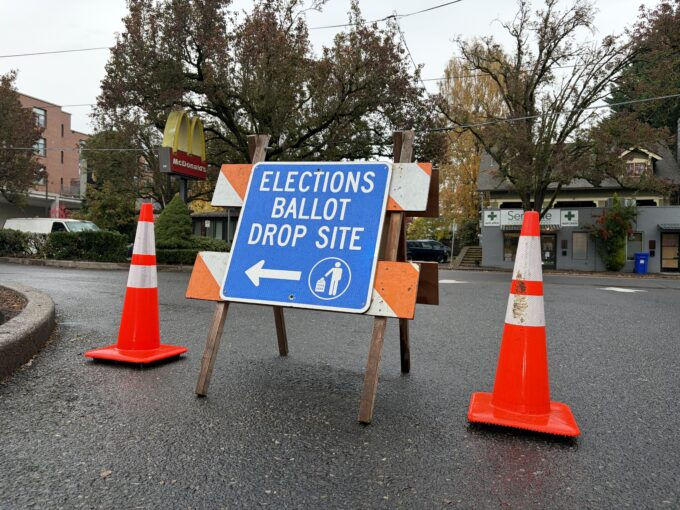
Photograph by Nathaniel St. Clair
Two words defined the 2026 elections: Trump and affordability.
In 2015, as Donald Trump began his first presidential campaign, he tweeted: “Sadly, the American dream is dead.” He then added, “But if I get elected president, I will bring it back bigger and better and stronger than ever before, and we will make America great again.”
And so, Trump was elected and Make America Great Again (MAGA) was born. Now 11 years later, America is worse off than it was in 2015 – the dream really seems dead.
The Wall Street Journal reported last year, “Nearly 70% of people said they believe the American dream no longer holds true or never did, the highest level in nearly 15 years of surveys.”
Patrick Harker, former president of the Federal Reserve Bank of Philadelphia, recently acknowledged this, writing, “… the economic ladder doesn’t just fall short, it seems entirely out of place. Instead of a ladder, these workers and their families find themselves on something more akin to a treadmill. They continue to put one foot in front of the other, yet they feel as if they’re stuck in place.”
The big squeeze in underway.
+++
A hundred years ago, the robber barons of old ruled during what is known as the first Gilded Age and were driven by the arrogance of a new economic order, one based on the opportunities of industrialization and the vast wealth to be garnered. It spawned a new buccaneer class of capitalists like none other that preceded it. While warnings were raised by muckrakers like Ida Tarbell and Lincoln Steffens, the robber barons of the first Gilded Age could claim ignorance as to the consequences of their arrogance, their personal greed and political connivance.
Today, Vanderbilt’s and Rockefeller’s corporate descendants include SpaceX’s Elon Musk, Amazon’s Jeff Bezos and Meta’s Mark Zuckerberg, among others. They rule during what can best be called the “Second Gilded Age.”
Today’s “Big Tech” companies are giant, global conglomerates that include Alphabet (Google), Amazon, Apple, Meta (Facebook) and Microsoft. But there is also Big Pharma — i.e., Johnson & Johnson, Roche Holding, Pfizer, Novo Nordisk and Eli Lilly; Big Oil — i.e., Shell, ExxonMobil, BP, Chevron, and ConocoPhillips; Big Tobacco — i.e., Altria, Philip Morris International and British American Tobacco; and Big Telecom — i.e., AT&T, Verizon and Comcast. Collectively, they have transformed the U.S. economy into a cartel nation.
The new new robber barons are driven by a combination of greed and political cunning that enables them to have considerable influence, if not control, over the federal and state governments throughout the country. Like the robber barons of old, today’s barons engage in ruthless business and political practices and are masked, like the flesh of a fan dancer, by their support for major bourgeois media and cultural institutions.
***
The Big Squeeze is simple: the rich are getting richer while the rest of us are getting screwed.
American Progress puts the squeeze in simplest terms: “The wealthiest 0.1 percent of households have gained more than 8,000 times as much wealth per household as the bottom 50 percent since the end of 2024.”
Pew Research finds in 2026 that “About six-in-ten Americans (61%) say there is too much economic inequality in the United States, a view that is far more common among Democrats and Democratic leaners than Republicans and GOP leaners (78% vs. 42%).”
The economist Markus Schneider reports that the share of the nation’s wealth of the top 1 percent was 32.5 percent during the second quarter of 2026, (i.e., over $8.5 trillion), up from 30.9 percent in the last quarter of 2024 – and from 27.4 percent in 1999. Going further, he notes “the ultra-wealthy, those in the top 0.1%, are pulling away even from the rest of the rich, the data shows.”
Schneider adds, “This tiny elite owns 15% of all wealth – almost half of all the wealth of the top 1%. Both the top 0.1% and the next 0.9% saw their share of wealth increase, but the top 0.1% captured two-thirds of the gains between the first and second quarters of 2026.”
And the middle class? Schneider points out, “the 40% between the bottom half and the top 10% – who hold only 28.8% of all wealth despite being a group that’s 40 times larger than the top 1%. And the middle’s share is shrinking, down from 32.9% in 1999 and 30.2% at the end of 2024 …”
In their new book, The Everywhere Millionaire: Who Is Really Rich in America and How They Got There(2026), Owen Zidar and Eric Zwick report, “The chance of making it to the top as a poor kid in the twenty-first century is about half of what it was at the beginning of the twentieth.” Reviewing the book in The New Yorker, John Lanchester wrote, “it means that if you were born in that bottom fifth, you could be 92.5 per cent sure that you wouldn’t get to the top fifth.” And adds, “That means that the richest and most powerful country in the world has seen a dramatic and dispiriting decline in opportunity for the less well-off.”
***
A century ago, Teddy Roosevelt and the Progressives waged war against growing inequality and the rise of trusts and cartels. They battled the shameless practices of the old robber barons. Sadly, there is no Roosevelt taking up the challenge today.