Image by Yucel M.
There is much talk of U.S. midterm elections. Such a relentless white noise, so calculated that all other conversation, like stopping the slaughter of Palestinians, seems like an inconvenient distraction rather than the actual topic at hand. Little discussion, if any, focuses on how this electoral spectacle systematically shortens our attention spans and blunts our critical faculties to think past two-year cycles. The TikTok-brained, quick-cut ads, hollow slogan-peddling, and endless stream of news commentary rot our political imagination. The promises of campaign season evaporate as soon as oaths are sworn. What remains is an intense, manufactured urgency of the “now,” severing us from any deeper historical perspective or coherent vision for the future.
Our world is filled with crises, from climate chaos to endless wars. And yet voting for this or that candidate seems like a deceptively easy way out of confronting these problems, especially since both parties bear responsibility for the current conflagration. The burden of changing this reality weighs heavily on this living generation, and even more so for those who come after, whose lives are being traded away for partisan theater and short-term profiteering.
As a young person nearing voting age, the prospect of casting a ballot brought pure existential dread. Even the hyper-patriotic curriculum of my rural public school bored into our heads the sanctity of voting as a civic sacrament. At the time, I stumbled upon Thoreau’s 1849 essay “Civil Disobedience” and realized an obvious truth: you cannot simply “vote harder” to end empire; more had to be done. High school political debates frequently revolved around the ghoulish excesses of the U.S. War on Terror. The frantic jingoism of those times had infected its hosts like a literal brain worm, where every facet of daily life was enlisted for a national purpose. Rural South Dakota schools were no exception, and no one was immune from performing their patriotic duty.
I found myself staging petty mutinies—refusing to stand for the Pledge of Allegiance crackling over the school intercom every morning. This was as much a symbolic rejection as a political statement—a line drawn in the sand, I explained to peers and teachers. I naturally gravitated toward strange company with the handful of Jehovah’s Witnesses. While their religious refusal to salute the flag was ostensibly tolerated, my deliberate decision to sit rankled the patriotically devout. Classmates hurled homophobic slurs and anti-Native invectives because of my silent protest. One girl was so offended by my sitting that she covered her eyes, broke into tears and loud sobs, and stormed out of the classroom to regain her composure in the privacy of the hallway.
It was at this moment that I understood that facts and logic alone could never penetrate these deeply held emotional and psychological attachments. My mini-protest, emphatic explanations, and in-class essays were insufficient to the task.
As the jeers echoed around me and my social circle shrank, I retreated into a meditative practice. I read the newspaper obsessively, following antiwar protests and trying to tally the sheer scale of destruction U.S. war-making had brought to places most of my classmates could not locate on a map. In the early months of the U.S. invasion of Iraq, the body counts quickly surpassed the entire population of my 2,100-person hometown. The thought of an entire town’s worth of people wiped out—with more queued up for killing—sank me into darkness. (Later, the deaths far surpassed the entire population of South Dakota.) If I couldn’t even fathom everyone in my tiny town, how was I supposed to digest death on an industrial scale?
I resolved to ask myself a simple political question thereafter: Who do you vote for if you’re against war?
The idealism inherent in that question has led me to modify the premise: Who do you vote for if you’re against empire and for a livable planet?
If the right to vote is such a sacred principle, then how do we not squander it on those who don’t deserve it?
I think of my youthful arrogance and naïveté, and the silent protest I staged. I had to be against something to be for something. But how did my protest change the minds of those beyond my immediate friend group? Probably very little, if at all. A great rupture or disruption to their lives was necessary, something the act of sitting during flag worship did little to effect. And as our generation has witnessed the War on Terror devolve into a twenty-first-century genocide against Palestinians, which has both Democratic and Republican origins, we have yet to fully grasp our historic task, beyond trying to survive the very system that set the world on fire.
The pundits would have us believe this election, just like the last election (in case you forgot), is “the most consequential election of our lifetimes.” The addiction to the spectacle of political theater, which could be described as a cycle of abuse, comes at the expense of the future and the reality of those on the receiving end of American empire.
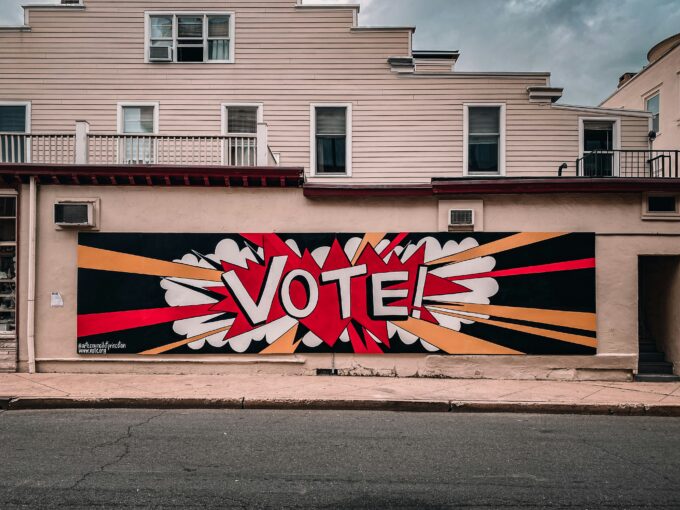
Look around my own neighborhood: for weeks, well-meaning liberals have been standing at intersections holding hand-painted placards urging passersby to “VOTE.” The implied message is clear enough—these are the exact same people showing up with signs comparing Trump to Putin at the “No Kings” rallies across the river in St. Paul, seemingly detached from the reality that these authoritarian impulses are entirely homegrown, nurtured on local soil. Their signs condemn ICE while steadfastly supporting Minnesota Democrats, many of whom hesitate to call for the abolition of the very institution that enforced such violent raids here last winter during Operation Metro Surge. Even following the fatal shooting of two anti-ICE activists in the streets of Minneapolis—just a short distance from where George Floyd was lynched—and the violent raids targeting Latinx communities and disrupting family lives, party insiders still treat calling to “Abolish ICE” as an uncomfortable topic best avoided.
Pundits and scholars have also frequently invoked the Civil War as a quick shorthand for our current political divide. But such comparisons tend to miss a deeper truth: history isn’t a crystal ball, and the core issue isn’t merely partisan polarization—it’s what’s baked into the American cake. The fascism of our times is historically situated. If fascism and authoritarianism are treated merely as a result of Trumpism and MAGA, then what do we make of the centuries of Indigenous genocide, African slavery, and settler colonialism and our current forever wars?
Voting can’t un-bake that cake.
This piece first appeared on Nick’s Substack.