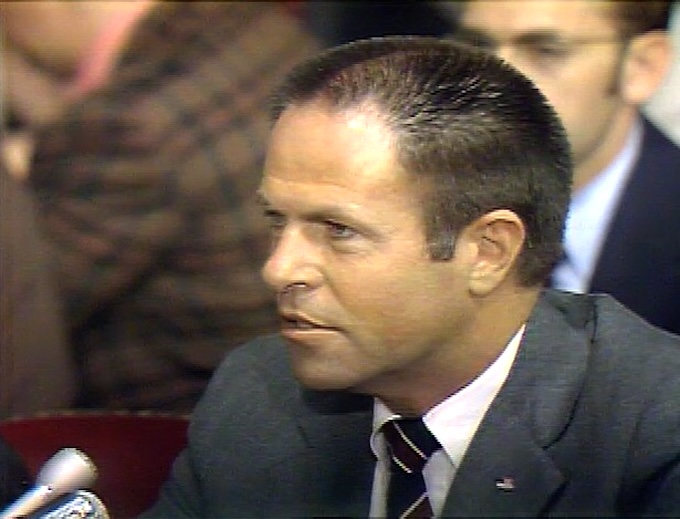
Nixon’s chief of staff, H.R. “Bob” Haldeman, was convicted of perjury over the Watergate cover-up. Public Domain.
I come from a family of lawyers and law professors, so I’ve actually attended quite a few conferences of legal scholars. I remember once, years ago, hearing a paper at one of these conferences on how the emphasis in law had shifted at some point in the sixteenth century from oaths to evidence. Actually, I don’t remember whether that was the main point of the paper, or simply a point made in passing. What I do remember quite vividly was that the speaker said he was uncertain of the reason for the shift.
I should probably point out, to those unfamiliar with the profession of legal scholarship, that most legal scholars (i.e., law professors) are not really scholars at all, not in the same sense that most people with Ph.D.s are scholars. That is, they generally have no scholarly training. They go right from getting their bachelor’s degree into the three years of technical training that is law school. Nothing beyond a J.D. is generally required of a law professor, so they don’t necessarily know much history, or appreciate the importance of such knowledge.
So anyway, I’m sitting there, listening to this guy’s admission that it is unclear to him why the emphasis in law shifted at some point in the sixteenth century from the swearing of oaths to the production of actual empirical evidence that would support particular claims, and I think to myself, is it actually possible that this legal “scholar” is unaware of the fact of the Protestant Reformation? Does he not know that Protestants and Catholics distrusted one another’s oaths? When nearly all the “Christian” world was Roman Catholic, jurists could count, to a certain extent anyway, on a witness’s fear of eternal damnation if he or she lied under oath. Few things would have inspired as much fear as what many believed was the absolute certainty of eternal damnation that accompanied a lie made under oath. “Do you swear to tell the truth, the whole truth, and nothing but the truth — so help you God!” That rider, “—so help you God!” was in the minds of many a far greater threat than of life in prison, and possibly even of death. I don’t mean to suggest that people never lied under oath in those days, but only that it was a far more serious crime in the minds of most people than it is today.
That changed after the Protestant Reformation. Catholics believed that Protestants had literally abandoned God — that they had gone over to the devil and hence that one could not trust their oaths. Protestants, for their part, thought that Catholics did not really worship God at all, but only the Pope, and hence that they thrown in their lot with the devil, which meant that one could not trust their oaths. So Protestants didn’t trust Catholics’ oaths and Catholics didn’t trust Protestants’ oaths and hence both sides began to want more to support a claim than that it had been made under oath.
Fast forward to secular humanism. First there was Deism, or the view that there was a creator God, but that he did’t really involve himself in human affairs, so people really needed to see to the maintenance of their moral fiber all by themselves, and that that was a very serious business. God made us, it was believed, inherently capable of distinguishing right from wrong, and of the importance of hewing to the former. This imbued us with a certain dignity, according to the Deists, that needed to be respected and cultivated.
Deism gradually evolved, as theists feared it would, into secular humanism, or the view that there is no God. Secular humanists still believed, however, that there was something special about human beings, that they, in contrast to the “lower” animals, could tell right from wrong and that hence they were subject to moral obligation.
That’s the way I was raised. Neither of my parents was religious, but both subscribed to the view that human beings were elevated above other animals because of their inherent ability to tell right from wrong, and since they believed there was no God to forgive people for their moral failures, they had incredibly high and inflexible moral standards. They understood the desire to wound when one had been wounded oneself, and that it took time for children to acquire the level of self control that would enable them to resist that impulse. Lying, on the other hand, was something else. It was absolutely, completely, and universally unacceptable.
My parents sowed in me an appreciation of how essential to the maintenance of civilization is view that there is an inherent dignity to human beings that brings with it a sense of moral obligation. They made me understand that all human beings must be respected as ends in themselves (though they didn’t put it that way because I don’t believe either of them had read Kant) and treated as such. They made me understand that if we abandoned our duty to be truthful with one another, none of our institutions would be able to function properly, none of our communities would be harmonious. All of civilization, as Hobbes so forcefully pointed out, rests on a foundation of mutual obligation. Without that, we have a bellum omnium contra omnes, or “a war of all against all.”
My older sister was a law professor. She tried for a time to persuade me to go into law. I could never be an attorney, though, let alone a judge, because I find the spectacle of people lying under oath deeply disturbing. If it were only occasionally a problem, I believe I could stand it. It isn’t only occasionally a problem, though, I have learned from helping my husband with his practice. It’s endemic. It is more the rule than the exception. People swear to tell the truth, when they are having their depositions taken, with the same level of gravity they exhibit if they are asked the time.
The situation is even worse when politicians are sworn into office, or when witnesses are sworn in in an actual trial. There, they ring out “I will!” or “I do!” or whatever, when they are asked if they swear to tell the truth, the whole truth, etc., with an enthusiasm explicable only as an expression of their confidence that by having sworn an oath, they will give the lies they subsequently tell the imprimatur of credibility.
“Yes,” one can almost hear them saying to themselves, “now people will have to believe me!”
And then they proceed to lie.
Rates of depression are apparently high among people in healthcare professions. That makes sense because it has got to be depressing to be presented constantly with the spectacle of human suffering. Rates of depression are also high among attorneys. That makes sense as well because moral turpitude is also a pretty depressing spectacle. I couldn’t take it. I couldn’t survive in a profession where I was confronted with it daily, even hourly.
One doesn’t have to be religious, or even an old-fashioned secular humanist, to appreciate that human beings have an innate sense of moral obligation. Evolutionary psychologists will tell you that it is part of our mammalian nature. Human beings are mammals, and mammals are social animals. They are naturally caring and nurturing. I’m not a big fan of evolutionary psychology, but that assumption seems to me to be correct. Individuals who can count on one another for support are going to have a higher survival rate than those who can’t, hence that trait, the sense of mutual respect and concomitant obligation, is going to be selected for. That means, of course, that people don’t generally wantto lie, so why has lying become so pervasive?
The problem, I believe, is that we’re increasingly allowing our civilization to devolve into a war of all against all. Our institutions increasingly fail to serve the purposes they were originally designed to serve, fail to protect those they were originally designed to protect. We are more and more left to feel that our survival is entirely up to ourselves alone. And the more we feel this, the more eroded is the esteem in which we hold others who appear to evince no concern for us. And as our esteem for others is eroded, so is our sense of obligation toward them. The instinct for self-preservation is deeper in human nature, as it is in the natures of other animals, than is the social instinct. So when people feel that their very survival is threatened, that they are justified in doing whatever they need to do to ensure it — including lie.
Everyone knows the practice of swearing oaths is a holdover from the days when people believed there was an inherent dignity to human beings, that they were deserving of respect and that we had certain obligations, including a duty of honesty, toward them. It appears, however, that we no longer believe this. Ours is increasingly an “every man for himself” society. So can with dispense with the sorry spectacle of people swearing oaths?
Or is even that degree of honesty now beyond us?