
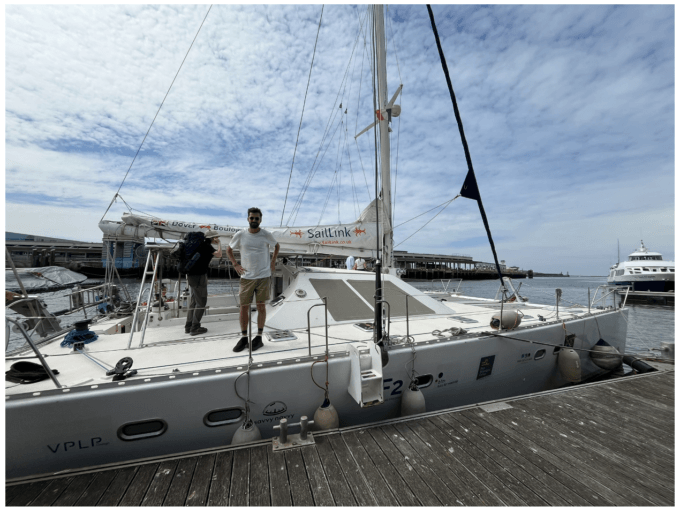
Charles Stevenson, who is getting his PhD in environmental economics, on board SailLink’s Echoes, which, under sail, makes a daily ferry crossing in summer between France and England. And it is open to all and cheaper than flying or Eurostar. Photo: Matthew Stevenson.
If you are an American heading to Europe, your plans might well include a stop in either London or Paris, if not a journey between Great Britain and France.
In all, about 10 million travelers move between the two cities each year, and many of them dread the experience. (Flying easyJet from London to Paris ought to be defined as capital punishment, and Eurostar’s waiting rooms have the feel of a minimum-security prison.)
+++
Until about 1820, sails were needed to cross the English Channel, usually between Calais and Dover. Then came steamships of the kind Mr. Phileas Fogg took in 1872 as he set out to go around the world in 80 days from the Reform Club.
The packet mail ship owned the Channel service until 1919, when the first commercial flight flew from London to Paris (with one passenger on board and a bevy of journalists).
In 1936, the railways struck back by launching a “night ferry” train service from London to Paris, during which the sleeping cars were loaded on and off a specially configured boat—allowing passengers a full night’s sleep.
After World War II, commercial aviation took a big slice of the cross-Channel business, especially with the advent of discount airlines that brought the price of a one-way journey down to about $50, if booked ahead.
+++
Aviation ascendancy held until 1994, when the Channel Tunnel was completed, and Eurostar began running its express trains from London to Paris and Amsterdam.
Suddenly, Paris was less than three hours from St. Pancras International in London.
Eurostar is a lot more expensive than a flight on a discount airline, but after a while, the cross-Channel traveling public figured out both that planes are destroying the ozone layer and that, door-to-door, a flight from London to Paris takes about six hours (when you add in security lines and schleps to the airport).
Nor does Eurostar get much competition from old-time cross-Channel ferry companies (P&O, DFDS, etc.) as many routes now make no allowance for foot passengers: to cross from Dover, say, to Calais, you need a truck, bus, car, or bicycle under you. So much for the public in public transportation.
+++
Into this chaotic market now comes SailLink, the first commercial ferry in more than a hundred years that connects France to England with a sailboat.
For several years, I have been reading about the prospect—that of a catamaran that would take up to twelve passengers each day between Boulogne-sur-Mer and Dover.
Its initial target market was cyclists and walkers, but really, it’s for anyone who hates polluting the atmosphere on easyJet or Eurostar (or is tired of all those security lines with sniffer dogs and gate agents measuring the size of your briefcase, in order to charge you more money).
In April 2025, SailLink launched its maiden voyage and during that first summer season carried 465 passengers across the Channel, usually (yes, it depends on the winds) in about four to five hours. On a broad reach, Boulogne is 31 miles from Dover.
+++
I missed the news of the launch in 2025, but a few weeks ago—planning a short trip from Switzerland to London—I stumbled across the SailLink website (https://www.saillink.co.uk/), complete with a schedule (a lot depends on currents and weather) and booking instructions.
A few minutes later, I had reserved passage for myself and my younger son, Charles, on the August 17 crossing, departing Boulogne-sur-Mer at 14:00.
For those weak on French geography, Boulogne is a two-hour plus train ride north from Gare du Nord in Paris. And as a small French city and port, it’s a winner—with a medieval old town, small seafood restaurants, and stunning beaches.
+++
Boulogne has a superb house museum dedicated to the South American liberator General José de San Martín, whose campaigns brought independence to Argentina, Chile, and Peru (as Simón Bolívar was bringing independence to Venezuela, Colombia, Bolivia, Ecuador, Panama, and Venezuela).
San Martín lived his last years (1848-50) in Boulogne when the countries he helped to create had no interest in taking him in.
Boulogne also has a huge Napoleonic plinth (he’s on top with his bicorne hat, with his back to the Channel), in theory to recall his successful 1805 cross-Channel invasion of England.
Except that Napoleon gave up on the invasion in August 1805 and, instead, marched his forces to what is now the Czech Republic, to crush the Austrians and Russians at Austerlitz.
But you need not know any of this to board Echoes, a 53-foot catamaran, to sail to England; you just need an open mind.
+++
SailLink asks passengers to arrive an hour before departure, to complete border formalities, although they should be called “informalities,” as two French border police simply scanned our passports.
Then for the hour before sailing, all of the passengers introduced themselves to each other (not something that often happens on British Airways or Eurostar).
On our crossing was a French father from Alsace and his 15-year-old daughter, several cyclists on grand tours, and a few backpackers. All were in the midst of offbeat but fascinating travels.
We cast off just after 14:00 and motored out through the inner and outer harbors, before hoisting the sails to pick our way through the Channel shipping lanes (commercial ships of the line on runs between the North Sea and the Atlantic Ocean).
+++
When we finally cut the engines, everyone on board felt the exhilaration (and quiet) of sailing on the Channel, and Andrew Simons (the founder, owner, and skipper of Echoes) encouraged all of us to help hoist and trim the sails.
It’s impossible not to like and admire Andrew, who gets around Europe (as I do) with an Interrail pass and a folding bike. He’s British, learned to sail off Scarborough (in North Yorkshire), and now lives on the boat and in central Europe. He’s tempted to open a second SailLink service from the south of England to Normandy. He graciously greets every passenger.
Andrew loves sailing, cares about the environment, never flies, and wants his passengers to step away from the grind of their lives for their four hours under sail (as if, with the tiller, he is writing Zen and the Art of Cross-Channel Sailing).
Underway, most of us passed the time chatting with the other passengers, on watch for Channel traffic (although Echoes has the full panoply of radar and navigational equipment), scanning for seals, or reading.
My son Charles was reading volume 13 of the delightful Aubrey-Maturin series by Patrick O’Brien, on the off-chance, I suppose, that Echoes might have a letter of marque and go off in search of prizes.
+++
I asked the crew if they saw many refugee crafts in the Channel, and the answer was “surprisingly few.” But I also saw a menacing French warship on patrol off Cap Gris-Nez.
If the crew does see refugees in distress, their instructions are to call the coast guard; otherwise, the Channel is laissez-faire, and the French police have no jurisdiction once a refugee is “in the water” and off the beaches.
This trip was the first time I had ever sailed (close to the water) across the English Channel, and I have to say (mind you, I love messing around in boats and sailing) I found it thrilling.
What’s also dramatic about the Channel is that the current is serious business (at least for a small catamaran), and I loved watching container ships and tramp steamers in their dedicated shipping lanes. (It’s a big box world.)
We gave them a wide berth, but they could see our speed and position via APIC, a navigational system not unlike air-traffic control. And the Channel has its own controllers who keep up a lively dialogue with many ships—just to be sure that the traffic remains separated.
About halfway across the Channel, as we were entering the shipping lanes, we lost our wind. Yes, it was yet another heatwave day in climate-changed Europe, and Andrew had no choice but to turn on the engine. He said plaintively: “Whenever we take down the sails… I hate it…”
It’s not what any of us wanted, to be sure, but the Channel is not a place where you want to be adrift. Once under power, I was given a watch at the wheel (easyJet rarely lets me fly any of its planes!).
For about two hours, with a crew member at my elbow, I had the helm, which was an unexpected pleasure, especially as the White Cliffs emerged from the summer mists.
We entered Dover Harbor a little after 19:00 (I wasn’t on the wheel for that), and followed the harbormaster’s docking instructions, which were complicated but also dramatic, given the ferry, freight, and cruise-ship traffic that converges on Dover, where the medieval hilltop castle and its Great Tower brood over everything.
At 19:15 we were all hugging each other goodbye and posing for pictures with Andrew and his mates. Bet you don’t take a selfie with your Eurostar engineer.
+++
Given that we had crossed from Boulogne in a relatively small sailboat (although a-53-foot boat is safe and comfortable), I expected the U.K. Border Force to be on hand to check our bags and passports. But the immigration booth was unmanned, and we walked off the dock and headed to the railway station. Don’t tell Nigel Farage.
The fare for a one-way crossing is £85, and it costs another £10 to bring along a bicycle, but in exchange you give the ozone a break, see the English Channel from the gunwales, make a few friends, and approach England, as it should be approached, in the lee of the White Cliffs.
Plus you’re crossing the English Channel on a lovely catamaran (it used to be an ocean racer) and under the guidance of a highly professional crew. At all times, you wear a lifejacket and have to “clip on” if you wander around the deck. But with luck, you will see seals and dolphins, brood a lot on the courage it takes to be a seaborne refugee, and do something that Napoleon never managed to do from Boulogne—that is, to cross over to England in style.


