
Photo by Frames For Your Heart
Were the acts undertaken by the US in recent years to be listed without national or political party affiliation they would appear to have been drawn from the geopolitical catastrophes of the twentieth century. Ethnic genocide for resources and territory? Check. Bloody wars of attrition where millions die as pawns in proxy conflicts? Check. Raw imperialist regime change operations to seize the resources of foreign nations? Check. The creation of a global gulag system with which to contain inconvenient humans? Check.
While the Treaty of Versailles explains a lot in terms of the causes of WWII, so does the Great Depression. Is it accidental that the global move to the political right accelerated with the Great Recession? It was obvious in the early days of the Great Recession that fascism would be the choice. The US followed the Weimar playbook to perfection: deny culpability on the part of capital, rebuild a purer form of the extractive finance that created the crisis, and use national resources to revive the economic fortunes of the rich while leaving the 99% to rot.
By the time of the GFC (Global Financial Crisis), the US had been through four decades of policies seemingly intended to destroy the nation. For better or worse, the US was built on industry. Its prior dalliance with finance capitalism resulted in the Great Depression. This was why I (and many others) claimed that reviving Wall Street was a wrong turn. Wall Street had proven itself to be the problem, not the solution. But America chose the Weimar resolution anyway, forgetting that it had launched amongst the most tragic histories known to humans.
Scapegoats of convenience were identified. One party blamed never-explained ‘elites’ and immigrants while the other blamed foreign nations and the Americans who didn’t accept their explanation of the world. Grievance economics became a thing. Donald Trump’s petulant child like explanations of ‘bad people’ and ‘losers’ personalized the impact of political decisions made decades earlier. Through the regularly occurring disasters of finance capitalism, room was opened up for Trump’s crackpot economic theories.
The US is now in the process of winding down as a nation. The question of the next decade is will the denouement be fast and ugly or long, drawn out, and ugly? It doesn’t have to be ugly at all. Rational solutions are both possible and workable. So why are only the stupid and unworkable ideas floating to the surface? Because these are the policies favored by the oligarchs. AI is making possibly one hundred insiders wealthy beyond the dreams of avarice. But guess who gets to clean up the mess when the effort implodes?
US plans for global military dominance made by agencies of the Federal government at the end of WWII are being undone by deindustrialization and financialization. Despite having the largest military budget in the world by several orders of magnitude, the US is reportedly out of offensive and defensive missiles with which to continue its vanity war against Iran. This currently has Donald Trump threatening the use of nuclear weapons for the benefit of Israel. That Russia, an ally of Iran, and China, also an ally of Iran, also have nuclear weapons is apparently unknown to Mr. Trump. Perhaps Testosterone Barbie (Pete Hegseth) could explain this to him.
The sleight-of-hand now being put forward is that China is America’s economic enemy. But China had nothing to do with the passage and implementation of NAFTA, the shift of the US economy from making things to financial gamesmanship, or the decision made by self-described geniuses to roll our collective dice on AI. AI is currently looking more like a planet-sized wrong turn than the path forward. Unfortunately for the US, AI is all that there is.
In spite of bitter disputes on both the American Right and Left over US foreign policy, the policies being implemented today were chosen by unelected officials at the end of WWII and again in the 1990s. Here is retired US General Wesley Clark stating in 2001 that the US plan was to ‘attack seven countries in five years.’ These seven countries (Iraq, Syria, Lebanon, Libya, Somalia, Sudan and Iran) were subsequently either destroyed by the US or are currently in the process of being destroyed by the US.
Author Stephen Wertheim wrote Tomorrow, the World: The Birth of U.S. Global Supremacy in 2020, providing documents from the 1940s suggesting that the US exited WWII with a plan for global military dominance. On the one hand, American leaders perceived a role for the US as a benevolent hegemon. On the other hand, World Wars I and II were imperialist wars to control economic resources. The Americans, Brits and French even had Expeditionary Forces in the USSR in an effort to reverse the Bolshevik Revolution.
The point is that enthusiastic back-and-forth over US foreign policy in the present requires explanations that transcend current politics. The problem is the temporal logic. If current wars are the product of recent provocations, why were plans in place for these very same conflicts before the current rationales for them were conceived? Are Americans actually arguing that history doesn’t matter? If so, how does that differ from the Right’s Great Man theory of history?
What to make of this temporal paradox? If the CIA is arming and training foreign militaries, how does this not fit Wertheim’s and Clark’s theses? Were China arming and training the Mexican military to attack the US, the US would absolutely not see the arrangement as benign. What is the evidence? The US is so not-okay-with China’s Belt and Road initiative that it is destroying its infrastructure in West Asia.
To the Americans looking for someone to blame for the economic evisceration of the US, who benefits from the fingers being pointed abroad? Neither China nor Iran nor Russia put a gun to America’s head and forced NAFTA on us. Imagine how pathetic these nations would seem if they blamed the US for their internal failures? So, the political enemy, if one is to be claimed, isn’t other countries. It is the Americans who made economic decisions for their own benefit no matter the social costs to the rest of us.
The formal political architecture of the US— the Constitution, the institutions of representative democracy, and the electoral system are all premised on shared input into political decision making. This is the political version of ‘trickle-down’ economics where theory has it that making the rich richer ‘benefits us all’ because some tiny fraction of it will land in our pockets. In contrast, the defining characteristic of the neoliberal era has been that it all lands in someone else’s pocket. Empowering the few disempowers the rest of us.
Another way to phrase this is that the premise of social equality hides the true levers of social power, which are economic. This makes the American illusion of democracy a weapon wielded against us. It is political misdirection. The Supreme Court implied this with over a century of jurisprudence culminating in the Citizens United ruling that money is protected political speech. Citizens United was a culmination, not a cause. It represents the end of a power-sharing agreement that never was. Political economy has always decided the politics.
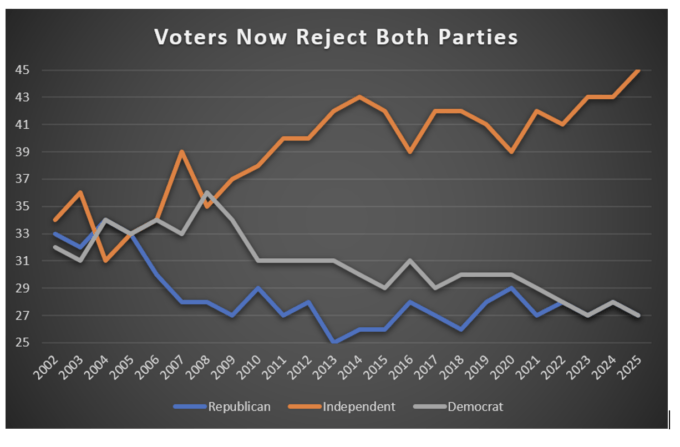
Graph: voters began fleeing the Republicans when George W. Bush’s war against Iraq headed south around 2004. And they fled the Democrats when Barack Obama bailed out Wall Street as the Great Recession consumed the US. To the issue of racism, see the surge above around 2008 as the ranks of Democrats swelled to elect Mr. Obama. Then notice that the voters fleeing the Democrats didn’t switch to being Republicans. They became Independents. This destroys the DC insider rhetoric that voters prefer to move back and forth between the parties. Source: gallup.com.
The tension at present is between the well-sold myth of widespread public participation in political decision making versus the facts of oligarch and corporate control over the American political system. Words from most Americans have no public consequence while words from those with the economic power are scattered across the globe. The claim that this broad distribution is the result of fair competition in the marketplace of ideas misses that most of the American media is owned by oligarchs.
The signature effect of this ‘oligarchy with rights for the rest of us’ has been that the rights for the rest of us are owned by someone else. ‘We’ have freedom of speech, but the enclosure of the informational commons means that what we say isn’t heard. We have the right to choose our occupations, but the choices have been so constrained that few among us freely choose. The pretense of social equality misses that some amongst us were born billionaires but most of the rest of us were born to serve the billionaire class.
The social and political tension being articulated is between the political fantasy of broad and active participation in social decision making versus the contemporary fact of corporate and oligarch control over the US economy, politics and increasingly, our daily lives. When rising suffrage (right to vote) threatened oligarch interests, the Supreme Court decided that money used politically— owned and / or controlled by the rich, is an expression of political will akin to voting. Okay. Where is money = speech found in the Constitution? It isn’t.
In contrast, the Voting Rights Act (1965) was proposed by former US President Lyndon Johnson and ratified by the US Congress. In other words, Citizens United was / is the very same ‘legislating from the bench’ long opposed by the people intended to benefit from the ruling (and a century of related law). LBJ used the legislative process outlined in the Constitution while the Supreme Court did a legally dubious solid for the already rich. Americans need to consider precisely when the Constitution was abandoned and why? 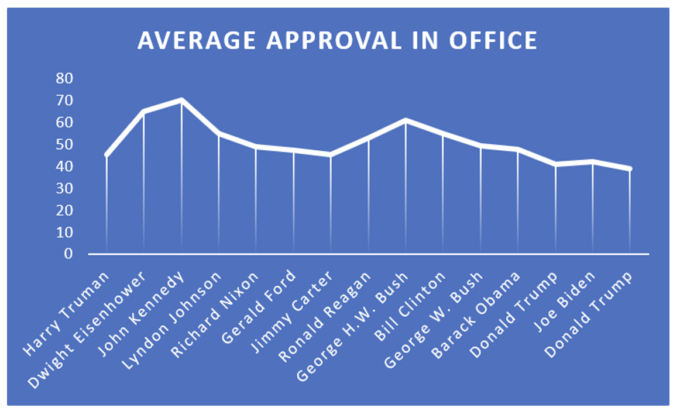
Graph: illustrated above is the persistence of both high and low presidential approval ratings that better illustrate approval for the institution of the presidency than the individual performance of presidents. LBJ – Jimmy Carter represented the Vietnam War and its immediate aftermath. Clinton – Trump2 represent the neoliberal pure-play. While it is tempting to claim that Trump2 revived US imperialism, from Obama’s support for the TPP (Trans-Pacific Partnership) to Biden’s scuttling of Nord Stream 2, the revival of naked imperialism has been bi-partisan. Source: Gallup.com.
While the data has been made much harder to find recently, Donald Trump and his immediate predecessor (Joe Biden) have had remarkably similar approval / disapproval rates in public opinion polls over similar time in office (graph above). They are both outliers in terms of public rebuke. The choice for readers in considering the data is to either blame the humans so elected or the broader historical circumstances that brought them to power. The focus here is on the historical circumstances, leaving the question of personalities to mental health professionals.
While partisans for American empire are convinced that personalities determine the politics, both men (Trump, Biden) entered office in the still smoldering ashes of the Great Recession with the US in political and economic decline internationally and in the midst of CIA-instigated wars that committed the US to a limited range of foreign policy options. As convinced as party loyalists are that the other man / party is the devil, the polling data suggests that the feelings are mutual. A large and growing group rejects both parties.
“Those who make peaceful revolution impossible will make violent revolution inevitable.” JFK.
While the view here that the current state and trajectory of the US represents a political emergency, the US electoral system is profoundly unsuited to rectify it. This isn’t an argument against voting. For the last year I have suggested a split party strategy for the midterms. Vote for Democrats in the hope that doing so will prevent Donald Trump’s wrecking crew from dismantling what remains of the US. Beyond the midterms, either more lasting solutions will be found or non-electoral politics will represent the only path forward.
(I voted for Jill Stein (with no regrets) in 2016 and supported Bernie Sanders in 2020 and Stein again in 2024. To party partisans, look at the top graph above. No one wants what you are selling).
Political scientist Thomas Ferguson and economist Servaas Storm recently released a paper explaining post-Great Recession politics in the US in economic terms. In it they provide an economic explanation for the collapse of the political ‘center’ in the US.
“The paper then extends the analysis backward, showing that during the Neoliberal era key macroeconomic trends spiraled steadily downward for most American households and workers regardless of which party occupied the White House.” Ferguson, Storm et al.
For those who may have missed it, the ‘financial crisis’ genre of films that lasted roughly 2009 – 2014 featured mostly the same people who created the GFC rushing to-and-fro to solve it. Surprise! They solved it to their own benefit. Ferguson and Storm show us where the bodies are buried.
What Ferguson and Storm confirm is that the theoretical economics of the big-name American economists don’t fit the facts. In high-bourgeois circles, reciting one’s resume serves as introduction. What doing so doesn’t elucidate is what one has actually done with the resume. Listing the marketing names of a politician’s policies plays a similar role. It conveys an ideological direction without providing information as to whether or not the policies were effective. Ferguson and Storm confirm that there is little difference in economic outcomes between the parties.
This suggests that there are factors larger than election cycles that drive the outcomes that election cycles in theory decide. There are important decisions for the nation currently being made by fifty-year-old frat boys who slept through every history class they bothered to attend. This was preceded by A students whose minds were poisoned by DC politics and Game Theory. While Trump is worse at the top, there are no functioning governments on the horizon. No one is going to save the US. We, the people, either do it or it won’t get done.
An envelope for popular discontent has been the neoliberal era. While in theory this runs from the election of Ronald Reagan to Trump, the party framing is not constructive. NAFTA, passed in 1994 and implemented in 1995, was followed fifteen years later by the China Shock. While these aren’t directly related as policies, they both exist on a trajectory from the neoliberal turn of the early 1970s to today. They both contributed to the view of American labor as unnecessary. AI is the ultimate expression of this view.
With all of the American economic eggs now in the AI basket, the most likely scenario is a Great Recession type unwind preceded by severe financial market unpleasantness and followed by a decade or more of insufficient employment. The US should get a clearer picture soon enough. If Anthropic and OpenAI can pull off three trillion dollars in IPO funding, that would resolve near term funding concerns. If they can’t, expect extreme market unpleasantness to strike between the fourth quarter of 2026 (now) and the funding / refunding cliffs in 2027.
The larger issue is what Americans will do for a living going forward. If AI crashes out and subsequently destroys financial markets, the economic catastrophe of squandered and misallocated resources with no Plan B may well destroy what is left of the US. What will stun Americans should an unwind occur is how far AI has already been integrated into our lives. If the sense is growing that nothing digital works anymore, thank AI. Anthropic just released a paperexplaining that self-replicating AI agents will soon inhabit your ‘smart’ devices. Hint: they already do.
For those imagining that Elon Musk’s universal basic income will save us, I paid into Social Security since I was fourteen years old. My promised benefits are scheduled to be cut by 30% in a few years. That wasn’t the deal that I paid into for all of my life. NAFTA was passed under the theory that the ‘winners’ would compensate the ‘losers’ (American labor) for what they were giving up. This did not happen. Humanitarian intellectuals like Donald Trump, typical of his class, doesn’t think that ‘losers’ deserve to be compensated. Neither did Bill Clinton.
The point is that while there is always hope, hope isn’t a strategy. Strategy is a strategy. The main source of fungible oligarch wealth is financial markets. A company is only worth a billion dollars if someone will pay a billion dollars for it. Financial markets provide proxy valuations for companies. And they provide liquidity so that companies can transact. Public banks could fill this banking role without the social destruction caused by manias and crashes.
The top graph (above) illustrates this point. Democratic voters flooded in to vote in 2008 and then fled the party for the next decade. While I wouldn’t claim that the Democrats fleeing did so because they were racist, this was the Democrat’s explanation of why the party was eviscerated. The more likely explanation is that after channeling billions of dollars to Wall Street. Mr. Obama pivoted to cutting Social Security and Medicare. This isn’t criticism of Obama. It is fact.
With neither workers nor consumers lined up to feed Western capitalism going forward, the oligarchs apparently haven’t yet figured out that they can’t eat money. Why does Donald Trump’s alleged effort to revive the US economy look so implausible that his only idea still standing is to goose stock market prices? He isn’t doing so for the rest of us because we don’t own enough stock to matter. This is the end game for the oligarchs.
A limit on the post-WWII plan for global military dominance is that it cannot accommodate changed circumstances. Question: what are the 800+ US military bases abroad intended to accomplish? Military commenters suggest that the American MIC could have quickly ramped up production until about 2008. That would be from the start of the Great Recession forward. Well, that is the period in which private equity bought the rest of the MIC that it didn’t already own.
Should the expected economic unwind outlined here come to fruition, the contours of the Great Recession will likely be a guide. As millions of workers faced an impossible job market (seven unemployed for every available job), the full resources of the Federal government were being applied to making sure that bankers didn’t miss a single three-hour lunch. ‘Saving the system’ was code for saving the rich. By 2010 with the bodies piling up, the US ‘pivoted’ to cutting Social Security and Medicare.
The US really is in a political emergency. AI is in the process of destroying the domestic economy while the CIA and Pentagon are in the process of ending the world. As theory predicted, capitalism has consumed / destroyed the world. Over 5,000 AI data centers have already been built, approved or licensed in the US. The AI industry is predicting a 10% increase in greenhouse gas emissions from AI that the environment can ill afford. We are headed in the wrong direction.
The coming financial crash will provide an opportunity to forge a better path forward. If there exists a Left in the US, this will be the time to make its program known. People will be looking for answers and the chaos will make them amenable to listening to people they wouldn’t previously have listened to. None of this is intended to deceive. That is the purview of capital and its agents. Here’s the deal: it is guaranteed that the Right has a program ready to go. But ‘beating’ the right is the wrong target. Lifting up the people and restoring human-centric policies will win for the Left. Mirroring the tactics of the Right won’t.