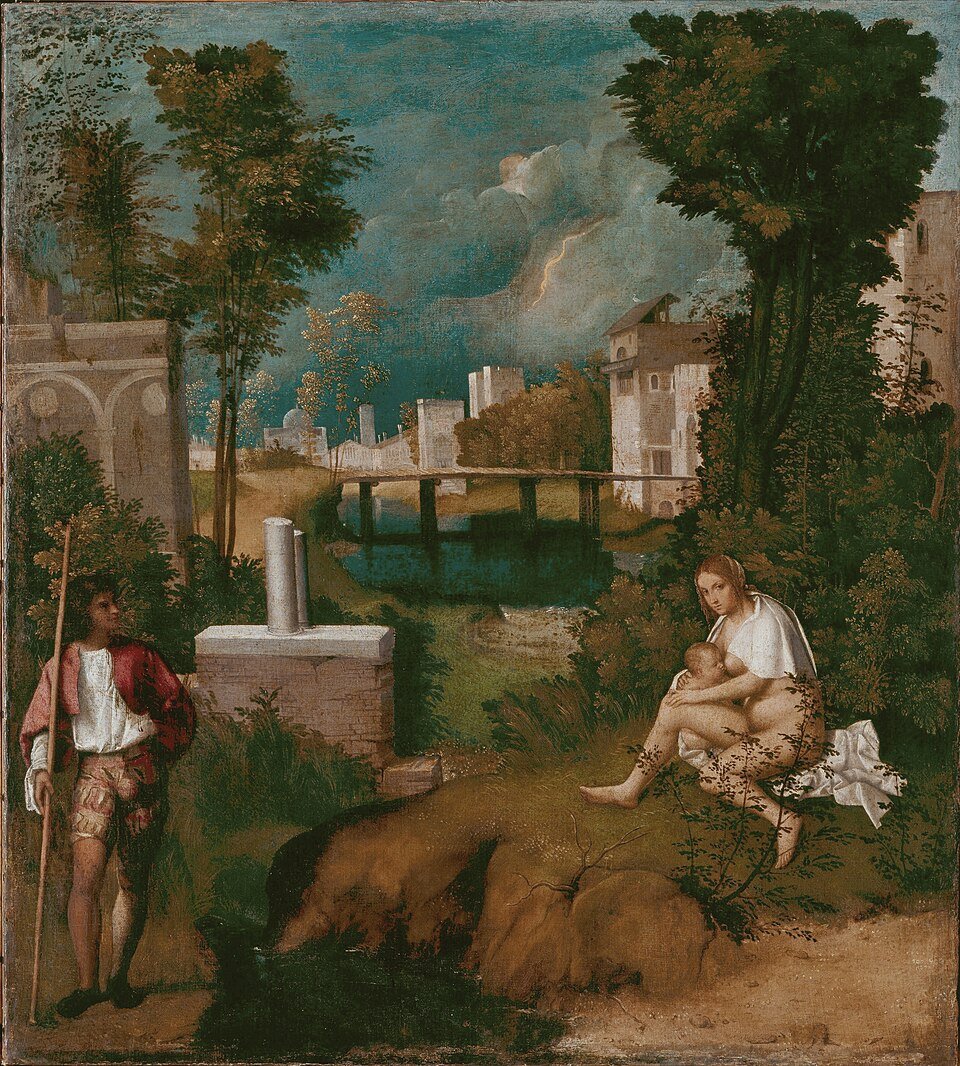
In the studio, the visual artist may bring to the activity of picture making some awareness of the larger space outside the studio. Since Venice is a singular site, with its vehicular traffic and pedestrian travel on canals, its visual art can have unusual structures. Almost every history of Venetian painting remarks that the waters of the lagoon influenced the visual art. Because frescoes were short-lived in this humid climate, the tradition of Venetian art using oil painting got off to a slow start, late in the fifteenth century. And as such diverse commentators as John Ruskin. Paul Hills and Daniel Savoy have noted, the everyday experience of the distinctive lighting of Venice played an important role in its painting. Most Venetian Renaissance pictures, it’s true. don’t present images of the city, in the way that Impressionist paintings show Paris, But what we find, sometimes, is a response to this setting in the way that artworks are put together. This point will be clearer if we consider one such example, Giorgione’s Tempest (1508), and contrast a contemporary work from landlocked Florence
As many commentators have noted, from Mondrian through to the minimalists and, in some early paintings of Sean Scully, the urban modernist grids are imported into the visual artworks. The grid is the basic structure of a great deal of this art. And, now, thanks to an essay by Jean-Paul Sartre, there’s a productive suggestion about how we might understand in new ways painting in Venice. Sartre describes looking and travel in Venice in intuitive terms, familiar to every tourist. When you look out of your window, you see the canals, which govern your travels. My goal, then, is to link that analysis to the spatial structures of Venetian paintings. Sartre’s essay on the Venetian painter Tintoretto is well known. My present concern, however, is with another Sartrean essay, which has been little discussed as yet.
Accounts of the site of Venetian painting usually refer to its proximity to the regular, ever-changing reflections of the moving waters. ,Here, however, I consider a different issue, the way that the canals influence our everyday movements in the city. In our art world, for example, when I am at the Frick in New York, just off of Fifth Avenue, to get to the Metropolitan, I just need to walk or drive uptown thirteen blocks on Fifth Avenue. A short, straight-line walk, which takes us directly uptown. In Venice, travel is usually more complicated. Lord Byron loved to swim in the Grand Canal, but nowadays if I want to travel around the city, you need to walk to one of the bridges, or go to the stop of a water taxi or hire a gondola. In a normal city like New York, I can look out my window to see where I want to go. But in Venice, as Sartre points out, travel is a little more complex. If, for example, my destination is on the other side of that waterway, then I might hop onto a #1 vaporetto, which makes stops on both sides of that Canal, and finish the journey after I get off by walking. In Venice, unlike New York, what appears close physically is not necessarily close for a traveler. Two places which are close together as the seagull flies may be far apart as the tourist travels. Unless, of course, unlike Ruskin with his private gondola or some privileged modern visitor with his own boat, you can travel on the waters.
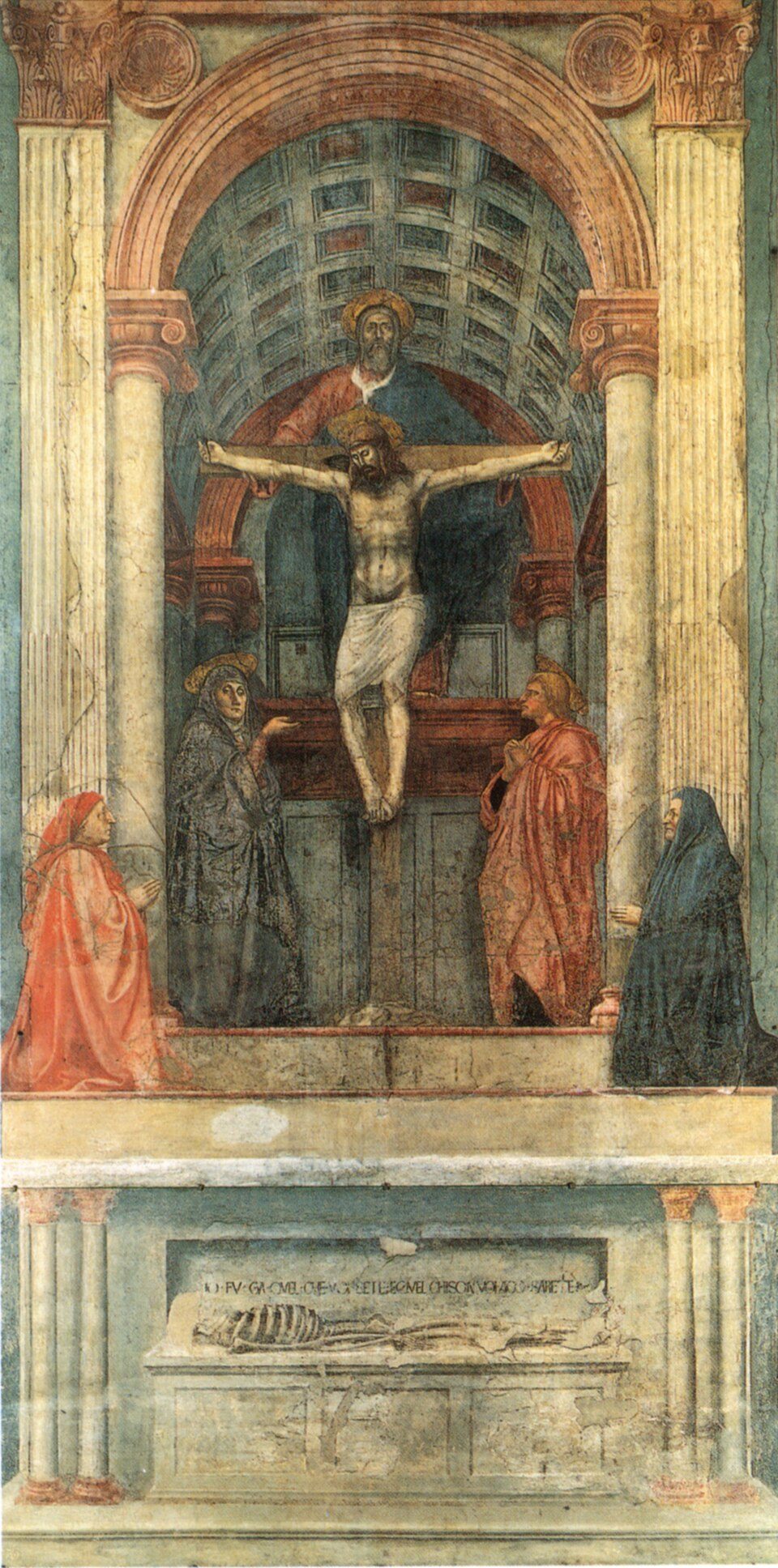
One way to identify the importance of this distinctive geography of Venice is to contrast the famous works by two short-lived Renaissance painters, Masaccio, The Holy Trinity (1424-7), in Santa Maria Novella, Florence, and Giorgione’s The Tempest 1408), made for a Venetian collector and now displayed in the Venetian museum, the Academia. As the many commentators note, Masaccio’s picture is an exercise in the newly developed linear perspective. It’s possible to readily construct a reliable three-dimensional model of the various picture elements: God, Christ, the holy figures, and, on either side of them, shown in profile, the two spectators. By contrast, as Tom Nichola nicely indicates in clear detail, the Tempest is an exercise in ambiguity. Who are the three figures, and where are they standing in the pictorial space? Many accounts have been proposed. Maybe they are actors from Scripture, but perhaps they are contemporaries of the artist. One scholarly book assembles 38 interpretations, and since then more accounts have been proposed. How surprising that a relatively simple picture, with the standing man, the female nude and landscape, with the flash of lighting, has proven so difficult to interpret. What is the relationship between the man and woman? That’s part of the ambiguity.
These, to be sure, are two unusual paintings. Part of the reason the Tempest is so famous is that many commentators, Adrian Stokes is one, consider it the Venetian painting. Of course, it is true that as comparing these paintings by Masaccio and Giorgione we are considering different sorts of works. The Trinity was painted for a public setting, while the Tempest was originally for a private collector. Only now, then, are both these works presented as if in museum settings. But I don’t see that this distinction affects my argument. Masaccio’s perspective is a development of landlocked Florence, where you can grasp mathematically the ways in which the urban structure is put together. Masaccio’s composition builds upon that calculation. Perspective shows the settled state of the visible world. By contrast, I am suggesting, Giorgione’s visual ambiguities reflect the structures of Venice’s lagoons, in which spatial relations are often more elusive. What appears nearby may be distant. And that’s why it’s appropriate to treat this picture as a symbol for the city of Venice.
In his recent book, The Trouble of Space in Paintings: A Critical History (2026), which I helped publish, James Hyde argues that it’s inappropriate to speak of space in pre-modern paintings. If my present analysis is correct, it may support (or complicate) Hyde’s far-reaching analysis. There is more relevant material for discussion of Venetian’s painting in Sartre’s short essay. And so there is more to be said.
Note:
Sartre’s essay appears in his Venice and Rome (2021). This account of the Tempest derives from Tom Nichols, Giorgione’s Ambiguity (2020). See also Salvatore Settis, Giorgione’s Tempest: Interpreting the Hidden Subject (1990).