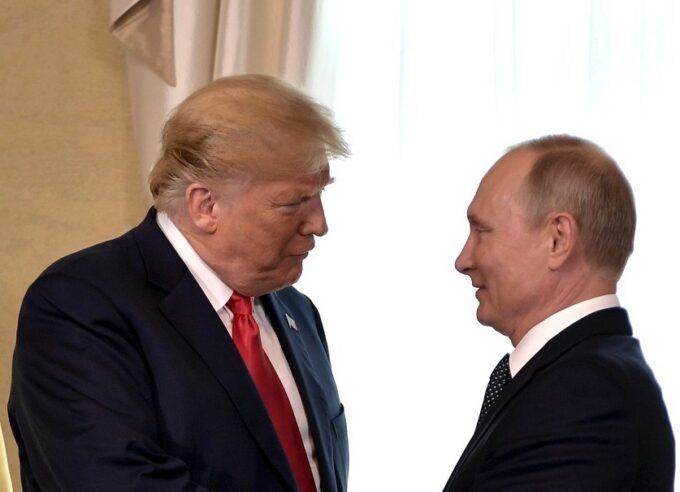
Photograph Source: Russian Presidential Executive Office – CC BY 4.0
As I travelled on the London Tube to meet CounterPunch writer and esteemed art historian Stephen Eisenham, I read journalist Owen Matthews suggesting Putin “lives in a parallel reality, a sealed bubble of disinformation where all the data he receives confirms the wisdom of his choices.”
It got me wondering what else on leaders and protected bubbles was out there. Did it include Donald Trump? It’s called echo chambers, information cocooning, courtier syndrome. Some political scientists call it the ‘dictator’s dilemma’: rulers depending on information from below, while their own power discourages uncomfortable truths.
It seems the more powerful someone, the less likely they hear unwelcome news. It is the pointless armour of the super elite. The useless algorithm of power. Matthews’ description is shared by other Russia specialists. Not that they can peer into Putin’s mind. Even Jude Law playing the Russian leader in Olivier Assayas’ The Wizard of the Kremlin is impenetrable.
Putin during COVID isolated himself even more. This extended to receiving senior officials across absurdly long tables. Footage of this not only bore a quirky resemblance to the warped perspective of Alice in Wonderland, it recalled Kubrick’s Dr. Strangelove: another sealed command centre where reality struggled to cut through all the layers of protocol and deference.
And did the former KGB man believe his own state propaganda over Ukraine too much?
We know some of the invading troops expected a warm welcome. Also that the Ukrainian government would be toppled quickly. Making sense of this is difficult to understand otherwise.
The phenomenon is hardly unique to Russia. It has recurred throughout history. Most over-centralised political systems are victims of this. Joseph ‘Bossy McSteel’ Stalin was a case in point. Presumably because failing meant death or the gulag, Soviet officials famously made up their agricultural figures. As the late Martin Amis wrote in Koba the Dread: “He tortured, not to force you to reveal a fact, but to force you to collude in a fiction.”
Towards the end of the Second World War, it was Hitler who relied on an information-free shrinking sycophancy. Generals were too frightened to contradict their blessed Fuhrer’s increasingly rabid belief that the Wehrmacht could still achieve victory through a sheer offensive spirit. Historians see the Nazi defeat at Stalingrad as the fault of unchallenged assumptions. Hitler’s refusal to allow a retreat was a major cause of the disaster. “Kapitulation ist verboten,” spat the Austrian. Surrender is forbidden. The same refusal to accept reality also shaped the Ardennes Offensive.
In China, during the Great Leap Forward, local party members exaggerated the harvests to keep Mao happy. Their figures rose upwards through layer after layer of bureaucracy. Hence policies based on a kind of fictitious abundance led to famine on a catastrophic scale.
Across the Himalayas, all the way to the Zagros, Saddam Hussein entered the 2003 Iraq War believing his military more capable than it was.
Until the moment his squalid regime collapsed in 1989, Nicolae Ceaușescu was convinced the Romanian people adored him—so insulated was he by his protective entourage.
Such isolation is even more complicated when it comes to democracies. Democratic leaders live inside vast information bubbles, even if they are weaker and more poppable. Why? Because they face a hostile media, opposition parties, elections, so-called independent courts, opinion polls, and lots of internal party dissent. Look at the rapid turnover of recent UK prime ministers. A democratic leader can ignore criticism, but never eliminate it.
Yet there’s another kind of bubble emerging among the super-rich. The Guardian recently noted that, in the run-up to SpaceX’s initial public offering, Elon Musk posted about race and immigration in Britain on X roughly twice as often as he posted about SpaceX itself. Whatever one makes of Mars Man’s views, the contrast is pretty striking. Here is the owner of one of the world’s most important aerospace and AI companies devoting more time to Britain’s culture wars than to the business that is actually creating his fortune.
So does a bubble apply to the Trumpinator? Many political scientists, including conservatives who have served with Trump, argue that he shows classic signs of an information bubble.
Examples include an unsurprising liking for advisers who show blind faith. A mocking scepticism towards intelligence agencies. An over-reliance on media outlets whose personal networks reinforce certain types of perspective. Or an easy shooing away of prickly information dismissed as politically motivated.
While I thought I’d finished this article, Trump provided an almost comic illustration of the point. By demanding that a one-match suspension for America’s top footballer be overturned, he appeared to assume that even the laws of football should bend to presidential will. It was a tiny incident beside wars and constitutions, but psychologically revealing. Football’s authority rests on the sanctity of its rules. To treat them as optional is the reflex of someone so enclosed by power that even an independent sporting code looks like something he thinks he can negotiate.
At the same time, there are important differences here from Putin. Whatever we say, Trump does in theory still have to operate within a constitutional system of independent courts, however blunted. There is Congress, state governments, a free press, elections, and there have been Republican figures like Liz Cheney, Mitt Romney and Mike Pence who have publicly challenged him.
There is something of Being There about elite politics too. Peter Sellers’ marvellous innocent Chauncey Gardiner succeeds not because he possesses hidden wisdom, but because powerful people mistake their own projections on him for a kind of insight. Information bubbles work in much the same way. Eventually leaders hear less about the world than about themselves.
Surely a good organisations must always be built to allow bad news to reach the top. Successful military commanders, CEOs and political leaders will sometimes even appoint people whose job it should be to challenge prevailing assumptions. I picked up on this type of thing watching General Richards in Afghanistan. He courted successfully outside opinion.
Conversely, official set-ups that punish dissent cannot tell optimism from reality. That can be disastrous.
So Matthews’ observation about Putin fits a well-established pattern. Perhaps the real lesson is Kubrick’s. Catastrophes rarely begin with madness alone. They begin when nobody in the room is ready to tell the most powerful person they are wrong.