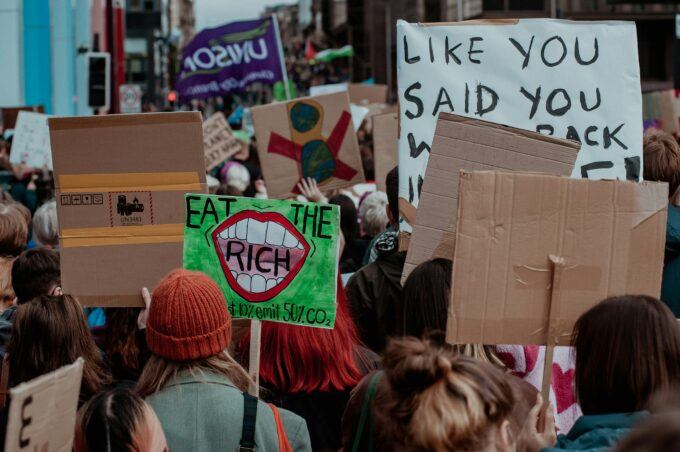
Image by William Gibson.
Historically, periods of widespread economic suffering have often seen a surge of left-wing organizing, and even notable victories. In 1789, desperation among the peasantry and urban working class helped catalyze the French Revolution. The 1880s and 1890s in the United States saw the Farmers’ Alliances and the People’s Party sweep the interior of the country, in a vast movement to overcome the exploitation and poverty of farmers and workers. During World War I, the miseries of the Russian peasantry and industrial proletariat provided the context for the overthrow of Tsardom and then, months later, the overthrow of an ineffectual parliamentary government. The Great Depression of the 1930s saw, in the U.S., the birth of the welfare state and the triumph of industrial unionism.
It is no surprise, then, that the suffering of a large proportion of Americans today is helping to bring forth a new left, which has lately been seeing electoral and policy victories. Zohran Mamdani and Graham Platner are two figures with national name-recognition, but it might not be long before more people have heard of Chris Rabb, a member of the Democratic Socialists of America in Pennsylvania who is headed to Congress this year; Janeese Lewis George, a DSA member who is set to become mayor of Washington, D.C.; Brad Lander, Darializa Avila Chevalier, and Claire Valdez, New York leftists entering Congress; Nithya Raman, a socialist who might be the next mayor of Los Angeles; Melat Kiros, a socialist from Colorado who won her primary; Abdul El-Sayed, a leftist who may soon be the newest senator from Michigan; and others.
There isn’t anything like a French Revolution or a Russian Revolution on the horizon, but in the coming years, as the American economy continues to leave working people behind, it is certain that we’ll see more left-wing victories. By the 2030s, the stagnant center will be in dire condition, faced with a well-funded far-right and a left stronger than at any point since the 1960s.
What are the economic trends that forecast such an outcome? Some of them are almost universally acknowledged. Most obviously, inequality continues to skyrocket. Even before Elon Musk became a trillionaire—a fact, incidentally, that itself proves the insanity of American capitalism—the top 1% of American households owned 32% of all U.S. wealth, about equal to the bottom 90% combined. America’s billionaires own more than $8 trillion. The income of the richest 1% averages to more than 100 times that of the bottom 20%. It is hardly surprising, then, that among peer countries, the U.S. has the highest rate of poverty, the highest rate of infant mortality, and the second lowest life expectancy. Nor is it a surprise that a majority of Americans think a middle-class lifestyle is out of reach, or that less than half of families were able to afford medical expenses in 2025.
The picture is clear. There are good reasons that Bernie Sanders, the democratic socialist, is consistently one of the most popular politicians in the country. Mainstream liberal commentators fret that running leftist candidates may cost the Democratic Party votes, but such commentators are evidently far out of touch with voter sentiment. According to polls, three quarters of Americans think the country’s political and economic system needs major changes. The Democratic Party is viewed unfavorably by 59% of adults (not much different from the Republican Party’s 58%). Chuck Schumer, a veritable symbol of the centrist status quo, is disliked by 68% of voters. Left priorities like Medicare for All, a substantially higher minimum wage, strengthening unions, raising taxes on corporations and the wealthy, increasing affordable housing, doing more to protect the environment, and cutting the military budget regularly poll well.
Far from the left’s ascendancy being a threat to the Democratic Party’s power, it is more plausibly seen as the best way to save the party. From Franklin Roosevelt to Bernie Sanders, populism, especially economic populism, is popular. It is a little odd, therefore, to see a party’s leadership consistently doing everything it can to harm its own electoral prospects, by trying to crush populist insurgents and suppress a populist message.
Longer-term trends, too, look good for the left. It isn’t often enough remarked that the U.S. is in many respects in a situation comparable to that of the late 1920s, just before the Great Depression. The soaring inequality is one parallel, as is the soaring stock market. It has become commonplace to observe that the AI boom has features of a bubble. Another parallel is the extreme weakness of organized labor both today and in the late 1920s. Actually, the union membership rate in the private sector today, 6%, is even lower than it was in 1929, about 10%. The weakness of unions has contributed mightily to the stagnation or decline of wages among the working class, and thus to the low purchasing power of consumers. In the 1920s, a huge expansion of consumer credit, such as installment buying, was necessary to maintain the economy’s rate of growth, because millions of people simply weren’t making enough money to buy the things they wanted. Today, likewise, total household debt is at a record level, over $18 trillion.
In fact, the top 10% of earners now account for half of consumer spending—which is reminiscent of the late 1920s. The economy, therefore, faces serious problems of aggregate demand. Altogether, these are ominous tendencies. Particularly because one of the major priorities of the Trump administration has been to accelerate the transfer of money from working people to the rich, thus further shrinking aggregate demand in the long run. One method of doing so has been to reduce taxes on the wealthy while increasing them on the lowest-income households. Another has been to slash the social safety net, for example SNAP and Medicaid benefits, which causes low-income households to cut back on their spending. Attacking unions and laying off hundreds of thousands of federal workers has been a third way Trump is harming the prospects of sustained economic growth. And the list goes on.
In short, it is virtually certain that in the not-too-distant future, very hard times are coming. Such times, of course, provide an ideal opportunity for left organizing and left politics. Millions of people will get “mad as hell” and they “won’t take it anymore.” A populism of class struggle will rise to the fore again, since it will resonate with people’s experiences and grievances. Organizations like the Democratic Socialists of America, the Working Families Party, and Justice Democrats will continue to cultivate a new generation of left leaders, doubtless with ever-greater success. Far-right populism will probably see victories too, and it’s impossible to predict how the conflicts between left populism and right populism will play out.
But what we can predict is that the Democratic Party, as it exists today, is doomed. The era of Clintonite centrism is passing, at long last. The future is much more interesting than that.