
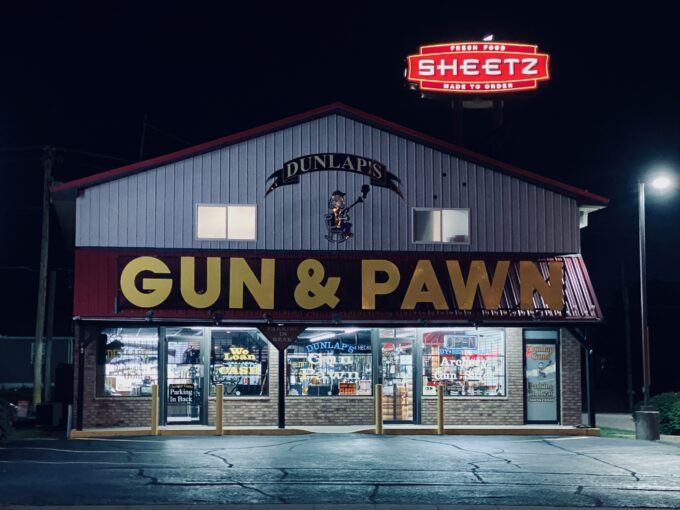
Midnight at the Gun and Pawn Shop near Milton, West Virginia. Photo: Jeffrey St. Clair.
Raised the rifle to my eye
Never stopped to wonder why…–Neil Young, “Powderfinger”
A riff on DH Lawrence’s assertion that the “essential American soul is a killer.”
The US is a violent country. Every American knows this. We need violence to get through the day. We need to watch it. We need to play at violence in games. We need to hear it and feel it. We need to believe we’re more violent than anyone else. We need the security of thinking no one can take our violence away. We’re frightened by the violence around us and turned on by the violence done to others. Many of us are scared we’re not violent enough, that when push comes to shove, when it comes time to prove our violence, we won’t measure up.
Violence is the American pathology. Killing is our pathogen. No masks allowed. Let it spread.
We celebrate our violence in national holidays. Put on violent displays on the lawn of the White House. We light up the skies above us with simulated missiles and explosions and ooh and awe in tones reserved for the sex Americans can’t seem to enjoy unless it too seethes with more than a touch of violent domination. Hollywood has trained us to think of our orgasms as fireworks going off, bombs exploding. Sex and death are conflated in our minds, forever merged. Our pleasure principle runs on the desire to inflict pain, to demonstrate our power, even as the power of the country fades. The American male feels empty and impotent without it.
We take our violence with us. To work. To the bar. To the football stadium. To the bedroom. To Europe. To the Middle East. We must demonstrate who we are, wherever we go. To ourselves and to others. We take our violence into the woods. Into the mountains. Into the deserts. We inflict violence whenever we can against any living creature that passes our way. But it’s no good to merely kill. We must prove we’ve killed. Others must know. So we take home the skins, the heads, the bones of what we’ve killed as trophies. We film our acts of killing. We pose with the carcasses. We broadcast the images. We kill for the sake of killing. Our way of life is a bloodsport. Though few who act out the scenes in its pages have read it, Cormac McCarthy’s Blood Meridian has become our Holy Text, the how-to guide to becoming an all-American white man. Not white in the flesh, necessarily, but bleached white in the mind, bone white in the soul–a post-modern Deerslayer, primed to go off on full-automatic.
We sanctify ourselves in the blood of what we’ve killed. Mark ourselves with it. We initiate our children with stories of bloodshed. We sit them in front of a screen where they will see more than 12,000 violent acts a year, 33 killings a day, day after day, some of the snuff films produced almost weekly by our own Department of War. We indoctrinate our children into our violent ethos. By the time they are 12, they are as drenched in virtual blood as was the young Ike McCaslin in Faulkner’s “The Bear,” one of the best stories ever written about how endemic violence is to the American character and the way violence defines how we think of ourselves. Americans tell themselves tall tales about how heroic our killing is and we believe that the stories are real. That they are history. Our history. Our birthright. Inscribed in our Constitution, as it were. Ritualized. The world is there for us to kill and consecrate ourselves with its blood.
We need to “get” our deer, our elk, our salmon, our trout, our fox, our beaver, our coon, our wolf, our bear. We see ourselves as failures if we don’t come back with something dead in our bag, over our shoulder, on a sled, in a cooler, in the truck bed, or strapped to the hood of the SUV. We’ll kill birds and insects and reptiles and trees and cacti and rocks. We’ll kill entire mountainsides. We’ll kill rivers. We’ll kill each other. We’ll even kill the dead. We count the kills in our games and share the scores with others. We must kill more today than yesterday. We will kill until there’s nothing left to kill. Then we’ll kill ourselves.
Here, the honor is not in how one kills, but in the act of killing itself. The ability to kill. To kill without regret. Without being haunted by the lives you’ve cut short, even innocent lives. Especially innocent lives. To kill with your hands, with a knife, with a gun, with an arrow, with a joystick, by pressing a button, by opening the bomb-bay doors, by striking a match, by inserting a needle, by flipping a switch.
That’s the ideal American psyche at work, the way we’re programmed to be. We must kill and demonstrate that we killed as proof of citizenship, a symbolic passport into the Republic of Death. The real American psycho isn’t an outlier. Not here, anyway. He’s your neighbor, your uncle, your brand representative, your lawyer, your banker, your golf partner, your kid. The kid you made. The kid youshaped and molded to be just like you.
We’ve seen regular American kids do their wet work at Shiloh and Antietam, Sand Creek and Wounded Knee, at Samar and Moro Crater in the The Philippines, during the Caco War in Haiti, in Okinawa, Hiroshima and Nagasaki, at Cinacattì and Biscari, at Maledy, Chenogne, and Dresden, at No Gun Ri, in Selma and Birmingham, at My Lai, Chu Lai, Thuy Bo, Hué, and Son Thang, at Benedict Canyon and on Cielo Drive, at El Mozote, in Jonestown, at Columbine, in Amiriyah, in Waco, at Bagram, in Maiwand and Panjwayi, at Fallujah and Abu Ghraib, at Sandy Hook and Uvalde, at a girls school in Minab, Iran. Any mother’s son can become an American killer and get praised by the President, even for jabbing a knife into an injured prisoner of war, who was just a kid, a teenage boy, then posing for a photo with his corpse and sending it to your buddies, like Eddie “the Blade” Gallagher. Or you can brag in your memoir about shooting your puppy in the head and casually tossing its body in a quarry, to prove a woman could be as cruel as any white man, then get rewarded with a cabinet post, like Kristi Noem.
The white American mind is wound tight. It’s coiled on itself so tightly that it forever feels the need to strike out to prove itself. It’s perpetually wound and coiled to the bursting point. It cares for nothing but itself. It believes in nothing but itself and its ability to commit violence.
Violence relieves the pressure. It finds liberty in violence. Killing is freedom. This is de Sade’s message, even though none of them have read de Sade. They’ve inherited the message subconsciously. There’s no freedom like the freedom to kill. To kill without consequences. It’s the ultimate form of democracy. It’s how the white American mind spread democracy to Vietnam and Indonesia and Chile and El Salvador and Afghanistan and Iraq and Iran.
They’ll thank us for it someday. Or they won’t. The white mind doesn’t care. It’s learned not to care. It doesn’t need gratitude. That’s not what it feeds on. It feeds on dread. It feeds on fear. The fear of others. To be loathed is to be powerful. To be powerful is to cast a shadow of fear over others. To make them tremble at your sight, at any whispered news of your coming. The white man with the guns. The white man who kills, who is infatuated only with himself and his violence. This is the foundational logic of the Empire. Not logic, really, but impulse. The imperial impulse. The white mind can’t master itself, so it must master others. If they resist, they must be forced to submit or to be put down.
And to be put down on film. Because the violence must be memorialized. The optics may be bad, very bad. But they serve as a testimonial to your “whiteness” as an American man. How you prove you’re a true killer. That what you’ve done is real, that you’ve got powder on your finger, boy. Gratuitous violence is only meaningful when it’s conspicuous. When it is shared and shared again. When it gets a lot of likes or dislikes. Doesn’t matter which. People have to know what you have done, how you did it and, most importantly, that you’ve done it without regrets. That beneath, what DH Lawrence called all the “flux and fluff” of American life, this is your intrinsic nature.


