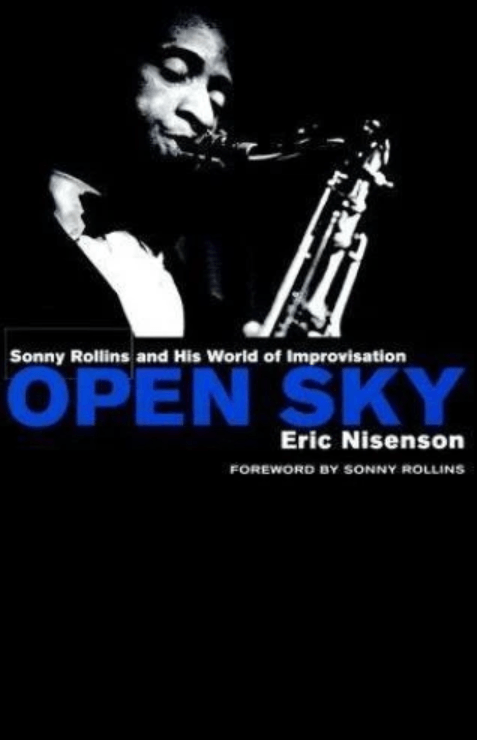
Open Sky: Sonny Rollins and His World of Improvisation reads like a book that was sold before it was written. Eric Nisenson probably had a plan for a biography of Sonny Rollins, and St. Martin’s Press bought into it because of his previous books on Miles Davis and John Coltrane.
Sonny Rollins probably cooperated for the same reasons. Never an easy interview, his Foreword to Open Sky makes it clear he was a “reluctant” participant. Here’s an example of what I mean.
Sonny Rollins’ most famous album is undoubtedly Saxophone Colossus, the title of an in-depth biography of Rollins by Aidan Levy, and a completely separate documentary film about Rollins by Robert Mugge. Nisenson would be mocked if he failed to ask Rollins about this recording date. Rollins’ reply:
“I know a lot of people think it was an especially great album, but it just seemed like another record when I did it. I don’t have any special memories about making it.”
Bam! Shut down!
The book is based on a series of conversations between Rollins and Nisenson from 1997-1999. Rollins was 67 when the book started (he is 95 as I write this). He has lived a stunning life that could only be captured by a biography like Aidan Levy’s 715-page one. Even though Nisenson’s Open Sky is not and does not attempt to be a biography, it does contain mostly transcribed interviews, which are priceless.
As beautiful a writer as Nisenson is, his prose is just window dressing for the main act, Sonny Rollins’ reflections and assessments of his oeuvre and his goals. Blue Sky focuses on Rollins’ life and work from the mid-1950s to the mid-1960s. In 1953, Rollins recorded with Thelonious Monk; in 1954, with Miles Davis; and after a stint in detox in Lexington, Kentucky, he joined the Clifford Brown/Max Roach quartet, a “clean band” that challenged Rollins’ capabilities every night.
Rollins was a practitioner of the Tristano Method (see my review of Saxophone Colossus), a system developed by the blind piano teacher Lennie Tristano in collaboration with Charlie Parker in the 1940s. The Tristano Method is to learn to sing a song before you play it, learn to play it in every key, and then at a variety of tempos and rhythms until you arrive at a personalised way of playing that specific tune, custom-tailored to your sound. This regimen enables musicians to improvise endlessly on a song. Along the way, they find variations that can be copyrighted.
Rollins never studied with Tristano, but many of his favorite sidemen did, such as Charlie Parker, Max Roach, Art Taylor, Henry Grimes, and Peter Ind. Unfortunately, Tristano became associated in the media with “cool jazz” and legendary players such as Stan Getz and Lee Konitz, but his method of learning how to be an improvisor is the basic theory behind bebop and informs all musics since.
Rollins’ gift is his relentless determination to get to the bottom of something he still has not found. He started by learning all the songs, then all the variations on all the songs, then composing his own songs based on this broad musical knowledge. After Charlie Parker died in 1955 and Clifford Brown died in 1956, Rollins started taking jazz in a new direction as a bandleader.
In 1956, at the age of 25, Sonny Rollins made seven recordings, culminating in Saxophone Colossus, the one he has nothing to say about. But he says plenty on A Night at the Village Vanguard in 1957 and Freedom Suite in 1958. He shows how to use melody as a roadmap for improvisational development. Nisenson calls it “thematic improvisation.” The concept is very similar to harmolodics, Ornette Coleman’s theory of using harmony, melody, or rhythm as a map for improvisation.
It’s not an accident that Rollins was taking in what Ornette Coleman and John Coltrane were doing. He had practiced with Coleman on a west coast tour and caught him at the Five Spot in 1958 when the alto saxophonist turned the New York jazz world upside down. In 1960, Rollins dropped out of the scene at the height of his popularity to work on some personal and musical problems.
Rollins restructured his diet to eat mostly vegetarian food. He began a bodybuilding regimen that he maintained for years. Later, he added hatha yoga to his fitness routine, and even opened a nonprofit organisation to encourage the spread of yoga in the U.S. Under the Williamsburg bridge, he practised incessantly with the likes of trumpeter Don Cherry and soprano saxophonist Steve Lacy.
When Rollins came down from the bridge in 1962, the music wasn’t all that different. Just as he appeared to be veering toward the avant garde (“I have always thought of myself as an avant garde player,” he tells Nisenson in 1998) he ran smack into the Bossa Nova. Rollins’ music and sidemen were all over the place for the next five years, until he disappeared again and moved to India.
When Rollins returned from India in 1971, he reunited with his wife, Lucille, and she became his business manager. Finally, Sonny Rollins got the life he’d always dreamed of: 15 concerts a year, no more club gigs, control over his recordings, reasonable advances and royalties, a home in the country, and an apartment in Tribeca.
The stability enabled Rollins to keep a band together, something he previously had not been good at. He’s the only jazz artist I’ve ever read about who hired a new band between sets. Just as Sonny Rollins took apart show tunes and reassembled them to make them his own, he took apart bands and reassembled them until every element was customized for his sound.
His later recordings with Bob Cranshaw on bass and Clifton Anderson on trombone are as dramatic and exciting as anything that came before. Plus, if you listen to Without a Song: The 9/11 Concert, recorded in Boston four days after the Twin Towers came down, you will hear something more: a control of tonality that is unearthly.
“I am an energy player,” Rollins told Nisenson, adding later, “I would like to do something more primitive.” And this is exactly the thing that makes every Sonny Rollins solo a unique excursion: “What I’m trying to do is get to the point where I can have a really complete expression of what I’m thinking about.” Thank goodness he’s never gotten there!
Open Sky: Sonny Rollins and His World of Improvisation
Written by Eric Nisenson.
Published in 2000 by St. Martin’s Press, New York, NY.
ISBN 0-312-25330-3, hardcover, 216 pages, $24.95
No index, no discography, no bibliography.