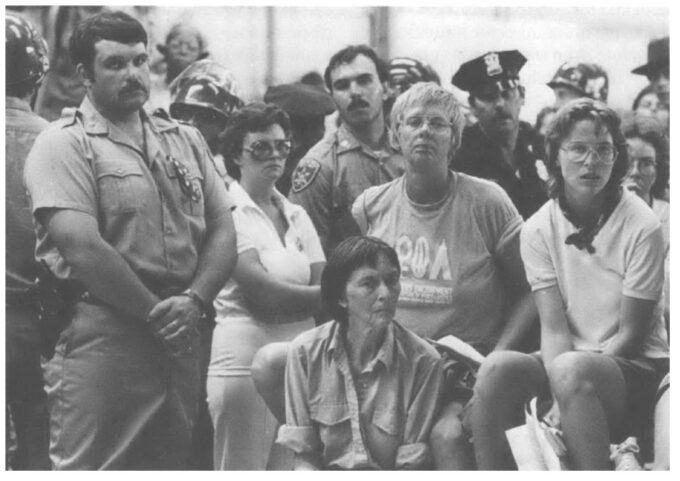
In the makeshift courtroom at the Seneca County Fairground @JEB. Joan E. Biron (from Prisons That Can Not Hold, by Barbara Deming with photo essay by Biron)
This Memorial Day, I found myself thinking about Waterloo. Not the Waterloo of Nelson vs. Napoleon, battleships, and London’s Trafalgar Square, but Waterloo, New York.
In 1966, Congress declared Waterloo the birthplace of Memorial Day, recognizing that 100 years earlier, the New York town’s residents closed their businesses, lowered their flags, and walked to the cemeteries to honor the Civil War dead. That origin story, while real, is contested. The fuller story of who first honored the dead — includes thousands of Black mourners in Charleston in 1865 whose ceremony, to dedicate the graves of hundreds of union war dead, was quietly erased from the record.
And when I think of Waterloo, I think of something else entirely: an anti-war protest in that same Finger Lakes village, that resulted in the mass arrest of 54 non-violent women, the governor declaring a state of emergency, and youngsters (like me) meeting people – and ideas – I will never forget.
Memory is always about the present. Who we choose to remember; who we choose to forget, they all make us who we are. This Memorial Day, I choose to remember the Waterloo 54.
I spent much of the summer of 1983 at the Women’s Encampment for a Future of Peace and Justice, a women’s peace camp set up outside the Seneca Army Depot — a facility the military would neither confirm nor deny was storing nuclear weapons bound for Europe.
On July 30 of that summer, roughly seventy-five women from the Women’s Pentagon Action in New York set out to walk to the Encampment from Seneca Falls, site of the Women’s Rights Convention of July 1848.
Their intent, in the words of the statement they issued from jail, was “to honor the great defiant women in our past who resisted oppression and to bring their courageous spirit to the Encampment.” The women they honored included many from that part of the country: Elizabeth Cady Stanton, from Seneca Falls, Harriet Tubman, who lived in a house near what was now the army depot; women of the Iroquois Nation who convened in 1590 – to demand an end to war among different tribes. The walkers carried large cardboard placards with their portraits, and others.
In Seneca Falls, they paused at the site of the 1848 Convention. “It’s no accident that the chapel which housed our first women’s rights gathering was allowed to become a laundromat,” wrote Barbara Deming later. In the nearby town of Waterloo, they stopped at the house where the women’s rights manifesto had been drafted, the “Declaration of Sentiments”.
As they walked, they were confronted by a crowd whose sentiments got louder and more furious. Someone chalked theirs on a garage wall: “Nuke’m til they glow then shoot’m in the dark”.
A crowd of two the three hundred people, mostly men, packed in densely, some carrying guns. Eventually, the mob, wielding American flags with pointy pole tips, blocked the women’s way as they approached the bridge heading out of town. Some of the women sat down to de-escalate the tensions. Others tried to talk to the hecklers.
The sheriff ordered them all arrested — the women, that is. Fifty-four were transported from the local jail at night to the Interlaken Junior High School where they were held for five days in the cafeteria, before all charges were dismissed.
I was not there that particular weekend. But I came to know those women. Among those arrested was Barbara Deming. Barbara Deming’s been called one of the least known of all the great theorists of nonviolence in the US. This Memorial Day, we need to remember Barbara Deming.
Deming had been jailed in Albany, Georgia for two months fighting segregation. She had walked the 2,800-mile Quebec-to-Guantanamo integrated peace march in 1964 and been beaten for it. She demonstrated at the Pentagon against Vietnam. By the time she sat down on that bridge in Waterloo, she was 65, in failing health, and had been doing this work for twenty-five years. She came anyway. She understood something we keep having to relearn: that the violence a government exports and the violence it tolerates at home are not separate problems. As she wrote, “the struggles for disarmament and for Negro rights were properly parts of the one struggle… our struggles were fundamentally one.”
She left us a philosophy as well as an example, a concept she called the “two hands of nonviolence”: With one hand, you say to the oppressor or the unjust system, “Stop what you are doing. I refuse to honor the role you are choosing to play. I refuse to build the walls and the bombs.” But the other hand, she wrote, is always outstretched: “I won’t let go of you or cast you out of the human race. I have faith that you can make a better choice than you are making now.”
In 1967, she spoke of the need “to be more bold, and therefore more effective” and how that would bring more government repression. “And then if we do not all stand together, helping always whomever is singled out for punishment, our effectiveness will end.”
When she died, in 1984, The New York Times gave her obituary barely 100 words. That’s how the paper of ‘record’ indicates who the state would prefer us to remember and who not.
Grace Paley was also arrested on that bridge, the writer who spent her life insisting that the personal and the political were never separate, who showed up everywhere there was a line to cross. Also Vera Williams, a children’s book illustrator and lifelong member of the War Resisters League. I saw Williams and Paley at every protest for years, their hairs going from peppered, to gray to white.
The encampment itself was overwhelmingly white, and rightly criticized for that — and yet many of those women carried decades of anti-racist organizing that history has largely declined to record. The connections they made between militarism, racism, poverty, disability, and violence against women didn’t disappear because people stopped making them. They just got harder to hold. And the commitments weren’t just on paper, or principle. At Seneca, Kady Van Duers, a friend of Deming’s not only made her friend a makeshift bed to protect her already fragile body, but led us all in making wide wooden boardwalks in order to make the camp more accessible to disabled women.
For a primer, this Memorial Day, I re-read the Encampment’s long “Resource Handbook” with its sections on violence, labor, military conversion; abolition, ecology, speciesism, the global anti-nuclear movement, the Cayuga nation, nonviolence, and “doing time.”
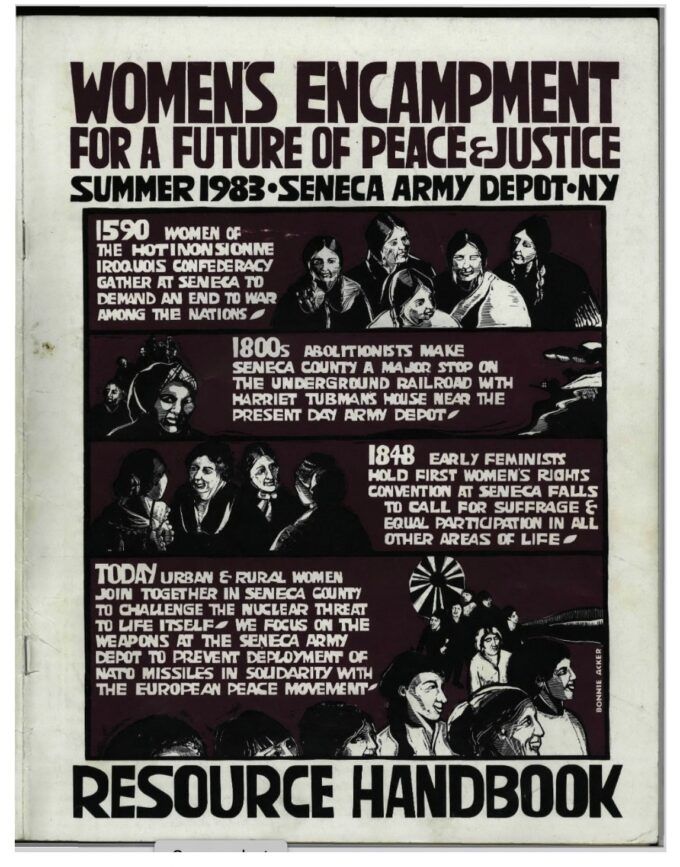
What were we saying in 1983? We were saying that a weapons depot in rural upstate New York was a link in a chain, a very long and painful chain, that begins and ends in annihilation.
Memorial Days, at the very least, should give us pause before we manufacture more dead to memorialize. And how about we remember all of it? Not just the uniformed and honored dead, but the living who spent themselves trying to prevent more killing and death; the wars fought, and the wars we were warned against.
At the Seneca Peace Encampment we flew many many flags (a long story) but one banner hung off the front porch all summer as I recall. “US Out of Central America. Everything is Connected.”
The men with the guns didn’t get arrested. The women in the circle did. We have seen this before and since. The question Memorial Day puts to us, if we let it, is not only who we have lost, but who – and what – we need to remember, and how do we connect those memories to this moment?
I’m not done thinking about all of this, but I’m done for today, and I’d love to hear your thoughts in comments.
In the meantime, stay kind, stay curious.