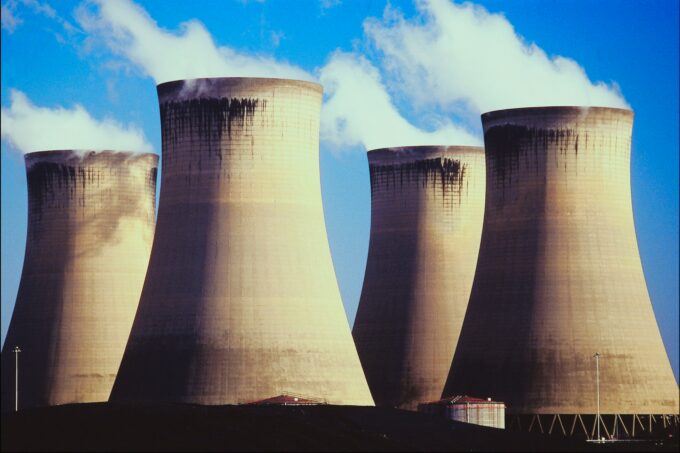
Image by Unsplash+.
Nuclear Power would never have existed without government handouts and ratepayer subsidies. The commercial nuclear power Gordian knot, from mineral extraction to component manufacturing to reactor operation to Price-Anderson Nuclear Insurance, and ending in waste disposal, exists only because of opium, whoops, OPM, Other People’s Money, in the form of taxpayer subsidies. Intense political pressure from the DC-based Nuclear Energy Institute prevents national and state politicians from cutting that twisted knot into pieces.
The financial problems associated with constructing and operating commercial nuclear power plants and the need for federal subsidies had been identified as early as 1958 by Time Magazine.
“The program needs a strong infusion of Government aid because
commercial nuclear power is so new, complex, and costly that private
companies cannot carry that burden alone,”[1]
And again at the turn of the 21st century according to Scully Capital Services Inc, a Washington-based investment and financial services firm, when the “Nuclear Renaissance” was being hyped by NEI:
“without government participation, some risks and costs of new nuclear reactors may remain at unmanageable levels.” [2]
Just before the Fukushima meltdowns in February 2011, the Union of Concerned Scientists again identified how heavily subsidized nuclear power had been and continued to be:
Government subsidies to the nuclear power industry over the past fifty years have been so large in proportion to the value of the energy produced that in some cases it would have cost taxpayers less to simply buy kilowatts on the open market and give them away… Piling new subsidies on top of existing ones will provide the industry with little incentive to rework its business model to internalize its considerable costs and risks.[3]
In 2018, sixty years after that Time Magazine subsidy analysis, the United States Congressional Research Service issued an analysis[4] of total government energy research and development funding spanning 71 years between 1948 and 2018. The report concluded:
Energy-related research and development (R&D)—on coal-based synthetic petroleum and on atomic bombs—played an important role in the successful outcome of World War II. In the postwar era, the federal government conducted R&D on fossil and nuclear energy sources to support peacetime economic growth. … For the 71-year period from 1948 through 2018, nearly 13% went to renewables, compared with nearly 5% for electric systems, 11% for energy efficiency, 24% for fossil, and 48% for nuclear.
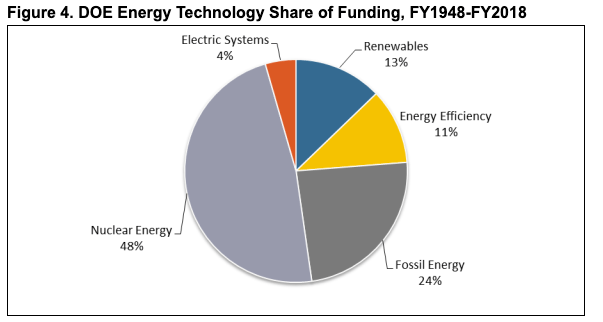
The graph shows that for seventy years after the secrets of the atom were unleashed on Hiroshima and Nagasaki, America plowed almost half (48%) of its research funds into more nuclear subsidies. What did those expenditures buy us? At the peak of the Atoms for Peace nuclear building spree in 1990, nuclear power provided about 20% of America’s electricity. But electricity is only a small part of the total energy America consumes; most of the US energy consumption comes from fossil fuels for transportation and heating. The nation’s overall energy consumption shows that nuclear power provides about 9 percent of the energy that our society runs on[5]. The bottom line is that half of America’s research expenditures over 70 years subsidized nuclear power’s 10% energy contribution. That is hardly a worthwhile investment unless you are the companies receiving all that cash!
I can understand that subsidizing a nascent industry in 1950 might be a reasonable policy decision, but nuclear subsidies have continued for eight decades. When your kids return from college, letting them have their bedroom back might be reasonable. But when the kids turn eighty years old, it’s long past time to end that subsidy. And ending those subsidies is exactly what the Nuclear Energy Institute was created to prevent.
It’s time to pick up the pieces from Atoms for Peace. Without subsidies, nuclear power is simply not competitive with renewable energy.
NOTES
1. February 10, 1958 Time Magazine ↑
2. July 2002 Business Case for New Nuclear Power Plants, Scully Capital Services, Inc. ↑
3. https://www.ucs.org/resources/nuclear-power-still-not-viable-without-subsidies?utm_source=SP&utm_medium=more&utm_campaign=NuclearSubsidies-02-23-11-more ↑
4. https://www.congress.gov/crs-product/RS22858, Renewable Energy R&D Funding History: A Comparison with Funding for Nuclear Energy, Fossil Energy, Energy Efficiency, and Electric Systems R&D, CRS Product Number RS22858 ↑
5. https://usafacts.org/articles/what-kinds-of-energy-does-the-us-use/ ↑