May Day is traditionally a day for workers to celebrate their collective power. In Florida, however, lawmakers have advanced yet another bill meant to undercut just that by weakening the state’s public-sector unions. Critics have characterized SB 1296 as a naked attempt to bust public sector unions. The bill’s champions include the Freedom Foundation, whose CEO reportedly lauded the legislation as a step toward the “decimation of Florida unions.”
SB 1296 would harden existing hurdles for unions by tightening the rules for union certification and recertification. Recertification elections require workers in an already-unionized bargaining unit to affirmatively vote to retain their existing union as their representative. Requiring them shifts the burden onto an already certified union to repeatedly prove that it should continue to exist. Under the bill, unions would need not only a majority of votes cast, but also participation from a majority of eligible voters in the bargaining unit. In other words, even if most participating workers vote to keep their union, the union could still fall short if too many eligible workers do not vote. SB1296 effectively treats failure to cast a ballot as a vote against the union rather than an abstention.
SB 1296 builds on SB 256, which passed in 2023. That law prohibited many public employers from deducting union dues directly from workers’ paychecks, requiring unions to spend time and resources moving members onto less efficient alternative payment systems. It also required unions to submit annual registration renewal applications that include audited financial statements and detailed membership information. Public employers may challenge those applications before the Public Employees Relations Commission (PERC), and PERC may revoke a union’s registration and certification if it finds the application inaccurate or noncompliant. If fewer than 60 percent of workers in the bargaining unit were dues-paying union members, the union would have to petition PERC for recertification within one month of submitting its renewal application. This requirement means that even unions with clear majority support in a workplace could be forced to spend time and resources defending their existing status as workers’ bargaining representative.
Taken together, the laws are clearly designed to weaken existing unions. SB 256 makes dues collection more difficult, then uses the dues-paying share of the bargaining unit as a basis for forcing recertification. SB 1296 then raises the stakes of recertification elections by adding a participation requirement, giving employers another avenue to bust unions merely by obfuscating and undermining election turnout. Both SB1296 and SB256 exempt police and firefighters unions, a common thread among state laws that otherwise target state and local government workers.Both SB1296 and SB256 exempt police and firefighters unions, a common thread among state laws that otherwise target state and local government workers.
The underlying principle of solidarity is that an attack on one is an attack on all. In Florida’s case, however, it’s an attack on many. Public sector workers account for 52.7 percent of union members in Florida, and state and local government workers comprise 38.6 percent.
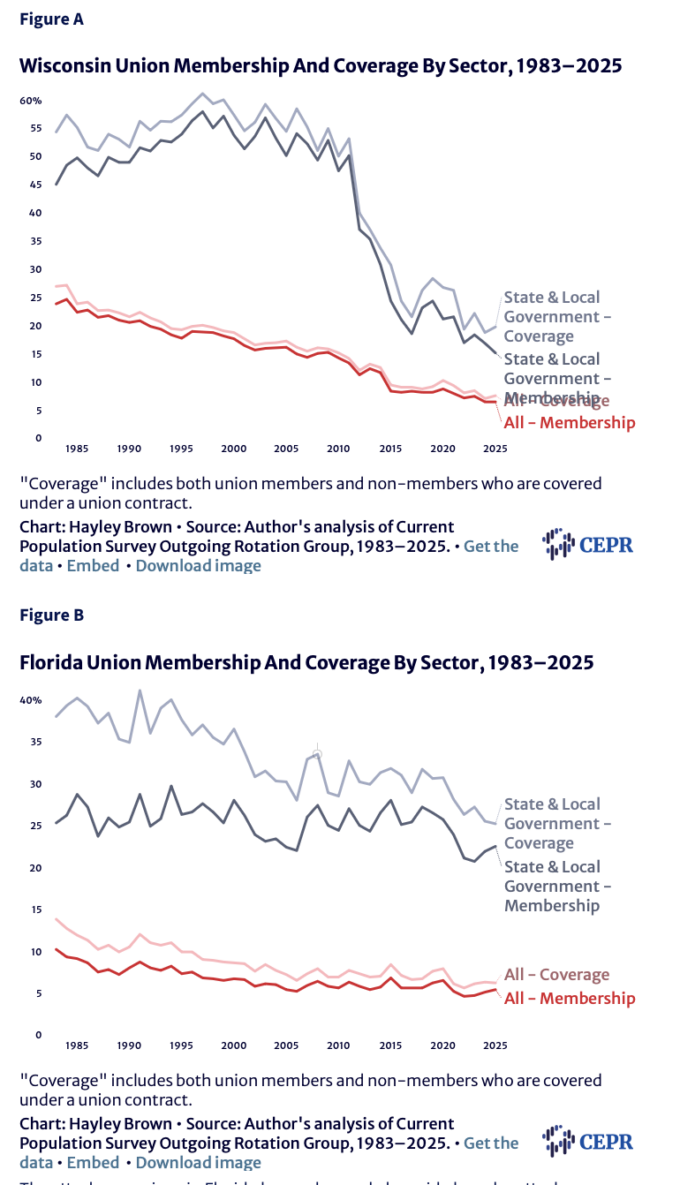
The effects of anti-union legislation can be dramatic. In Wisconsin, the passage of Act 10 — one of the most sweeping pieces of anti-union state legislation in recent history — coincided with a significant decline in public-sector unionization, driven by a decline in state and local unionization (Figure A). Wisconsin differs from Florida in that it started as a strong union state and thus had further to fall. Florida’s trajectory since 2023 (Figure B) has been far less striking than Wisconsin’s in the wake of Act 10, which was admittedly a harsher piece of legislation for unions. However, additional evidence suggests that more than 63 thousand Florida workers have lost union representation because of SB256 alone. It remains to be seen how much the addition of SB1296 may affect union membership rates among Florida’s state and local government workers going forward.
The attacks on unions in Florida have advanced alongside broader attacks on unions in general and public sector unions in particular. But despite conservatives’ best efforts to demonize them, unions remain very popular with the US public. The Freedom Foundation, a key union antagonist, asserts that “…government unions are a root cause of every growing national dysfunction in America.” Polls suggest that Americans believe the opposite, however, with 60 percent agreeing that falling unionization hurts the country and 62 percent saying that it hurts working people.
Laws that target public sector unions are attacks on the entire labor movement. A meaningful workers’ movement must explicitly include public-sector workers, and their right to organize must not be treated as optional. Federal legislation like the Public Service Freedom to Negotiate Act of 2025, which would codify organizing and collective bargaining rights for government workers, is an important step toward this goal. This May Day, lawmakers at every level of government should do both the right and the popular thing and ensure that all workers — public-sector included — have a real, enforceable right to organize and bargain collectively.
This first appeared on CEPR.