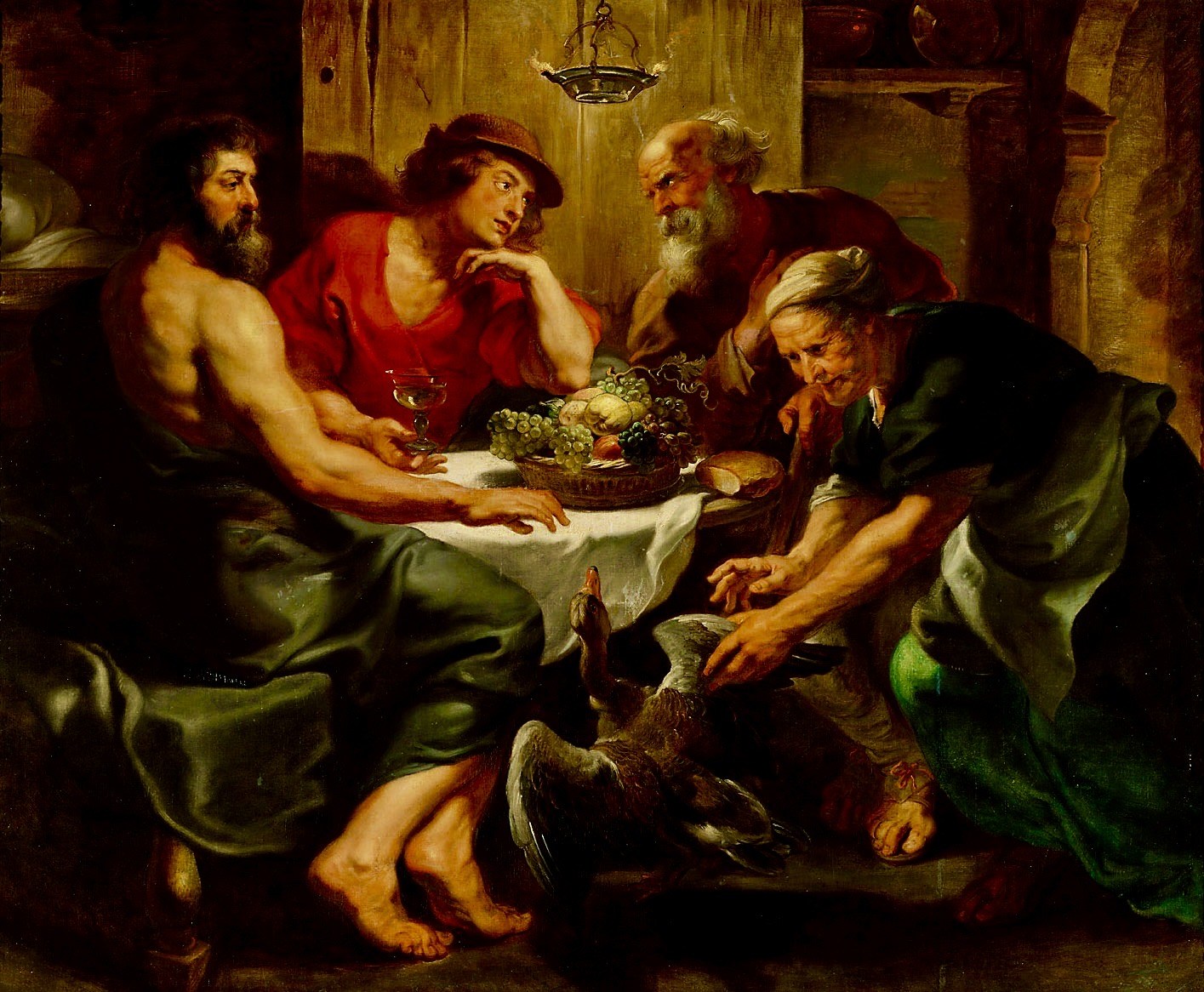
Zeus and Hermes in the house of Philemon and Baucis, testing philoxenia / hospitality in the village. Baucis and Philemon were hospitable to the gods. Zeus and Hermes rewarded them but punished the villagers who ignored them and philoxenia. Painting by Peter Paul Rubens, 1630–1633. Kunsthistorisches Museum, Vienna. Photo: Georges Jansoone. Public Domain
I was born and brought up in Kephalonia, a Greek island in the Ionian Sea between Greece and Italy. The island is beautiful with Mt Ainos at its center. During the late 13th century BCE, Kephalonia and Ithaca, a much smaller island next to Kephalonia, were the center of the kingdom of Odysseus. Homer wrote the Odyssey to sing the courage and intelligence and shrewdness of the hero Odysseus, who spent about ten years trying to find his way back home to Ithaca after the end of the Trojan War.
I, too, had my Odyssey, not as dangerous as that of Odysseus, but much lengthier and not less challenging. I neither met Polyphemos nor lived for seven years with the beautiful goddess Calypso. However, I struggled with cannibals and the antagonisms and hatred of monsters not that much different than Skylla and Charybdis. No wonder I used to tell my young daughter I was the first cousin of Odysseus.
Kephalonia is ancient, beautiful and wild. My exploration of Mt. Ainos, home of Ainesios Zeus, sent me – at least in my imagination — back millennia, all the way to the Bronze Age of the Trojan War – and my cousin Odysseus. This inner quest for knowledge and affection for the ancient people of Kephalonia and Hellas saved my life.
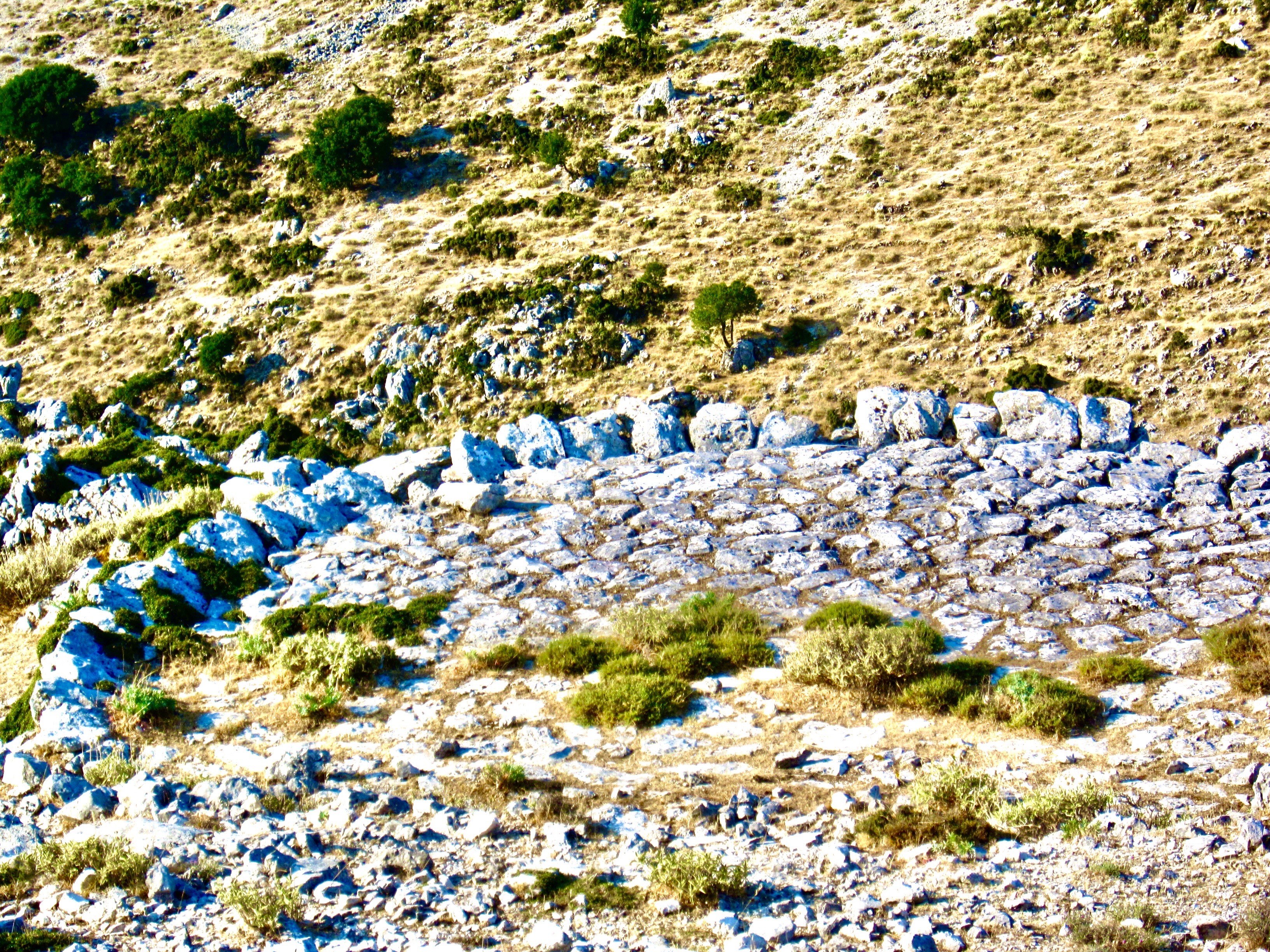
Ancient threshing floor for wheat on Mt. Ainos. Photo: EV
Xenios Zeus and Philoxenia
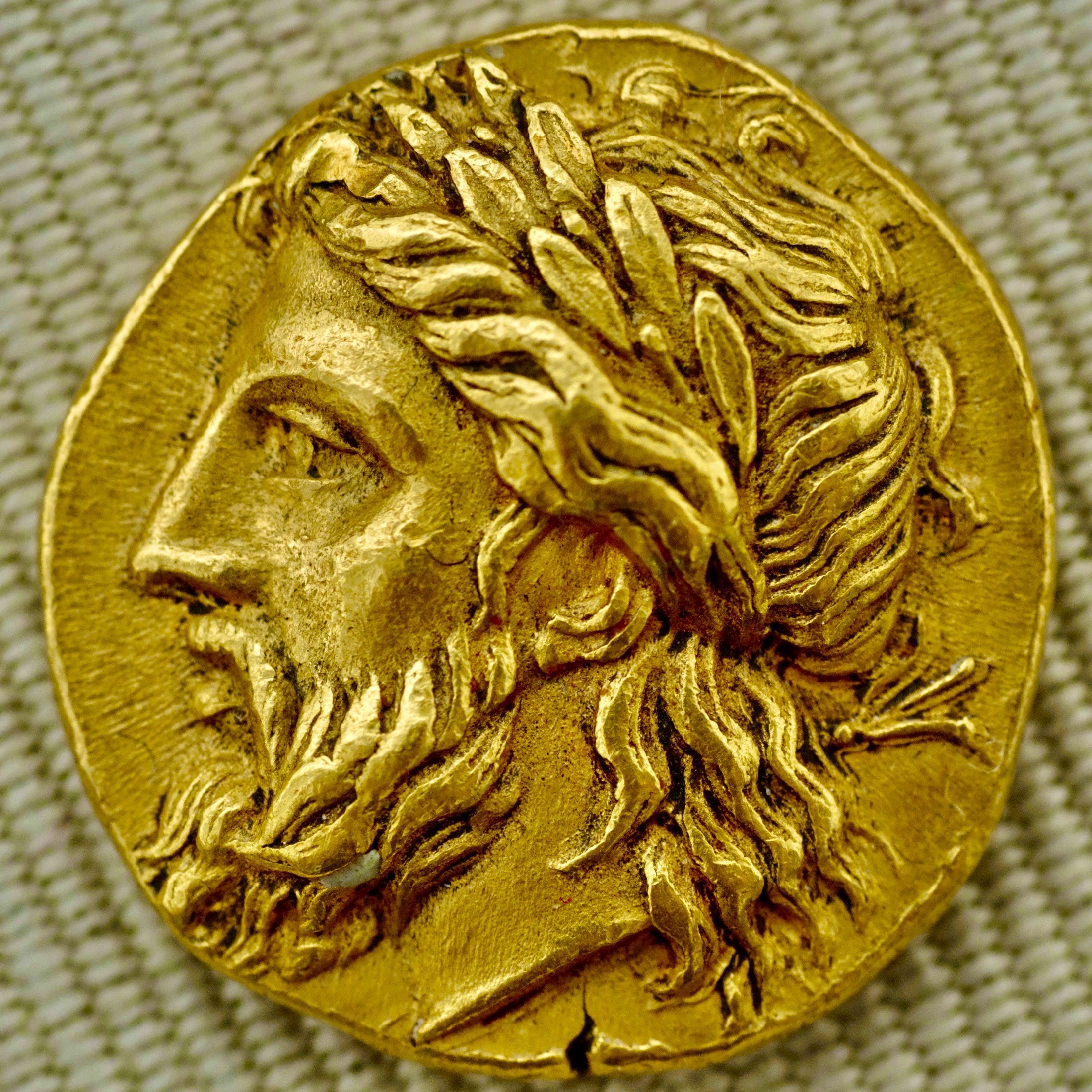
Zeus with a laurel crown. Gold stater from Lampsacus, Mysia, Asia Minor (ca. 360–340 BCE), Photo: Jastrow. Wikipedia Commons, Public Domain
One of the names of Zeus was Xenios, protector of foreigners visiting Greece. From Xenios Zeus the ancient Greeks developed the tradition of philoxenia / hospitality. Philoxenia is still a valuable tradition among modern Greeks. But World War II and the devastation of Greece by the Germans and the civil war they and the British invented to continue the destruction of Greece, left the country desperate for foreign assistance and foreign allies. The US created NATO as a fence between capitalist and American-dominated Europe and communist Soviet Union / Russia. US recruited Greece and Greece’s millennial enemy, Moslem Mongol Turkey, for NATO. That choice was very bad. It told the world that its new chief, the United States, cared less about history. The US should have known that killers and victims never reconcile. In addition, the US should have known it owned its democracy, science and civilization to the ancient Greeks, ancestors of modern Greeks. But weak Greece had no choice. Both the US and the European Union allies kept telling Greece it had to reconcile and resolve its “problems” with her neighbor, Turkey, that oppressed Greeks for centuries and, in early 20th century, practiced genocide on the Greeks still living in Turkey. These foreign pressures, from the US, NATO and EU, forced Greece – at least the country’s leadership – not to respect themselves and their country. I call them ethnonihilists. At the same time, Turkey understood correctly the US, NATO and EU valued it much more than Greece. The result has been an unmistakable low-level war Turkey has been waging against Greece: talking and acting as if the Aegean was part of Turkey and forbidding Greece with its warships to even install a sea cable connecting Crete, Cyprus and Israel. Turkey also is looting most of the fish in the Greek Aegean. At the same time, Erdogan, president of Turkey, like the Persian King Xerxes, 518-465 BCE, is suggesting to Greek leaders to join him and abandon efforts to keep Greece independent. In 480 BCE, Xerxes invaded Greece with a gigantic fleet and land army employing an Earth scorch policy, according to Herodotos (The Histories 8.33-35). Despite those forces, the fewer Greeks won and dealt a decisive blow to Persia’s imperial ambitions. They need to do the same thing to Turkey. Like the hubris of Xerxes, the arrogance of Erdogan has no limits. One wonders why Greece is not using its navy to protect the Aegean. These invisible conflicts conveniently disappear in the tourist seasons.
Tourism
Foreigners visit the fabulous archaeological treasures in the Greek museums. Foreign visitors to Greece increased in the decades after the end of the Cold War, that is since the 1980s. During my latest visit to Greece, in 2023, about 30 million “tourists” spent time in the country — still ravaged by debt. Now, in 2025, the number of foreigners visiting the natural and archaeological treasures of Greece must be around 40 million.
In a peace-loving world and, especially, a peace-loving neighborhood, these foreign millions of visitors in Greece would be a great asset for spreading Greek culture, increasing economic prosperity in Greece, and friendship and Philhellenism among people seeing the wonderful treasures of Greek civilization. However, beyond the glitter, too many tourists in a small and indebted Greece are harming the country.
Mainland Greece and its islands have been living the extreme difficulties of overpopulation and heavy industrialization without in fact a large population or industry. Tourists, millions of them with plenty of money, are responsible for the deterioration of society and the environment in Greece. Islands suffer the most.
In early August 2025, a couple of reporters said that my home island, Kephalonia, had escaped the vandalism of too many tourists:
“While other Greek islands continue to struggle with tourism-fueled overdevelopment, Kefalonia, the largest of the Ionian Islands, west of the mainland, has largely escaped the glitz and frenzy. Its centerpiece is the 5,341-foot Mount Ainos, set within the only national park on a Greek island. The mountain’s slopes, which produce Kefalonia’s celebrated robola wine grape, turn into rolling hills that meet a spectacular cyan sea, made brighter by shimmering sediment from the surrounding limestone cliffs.”
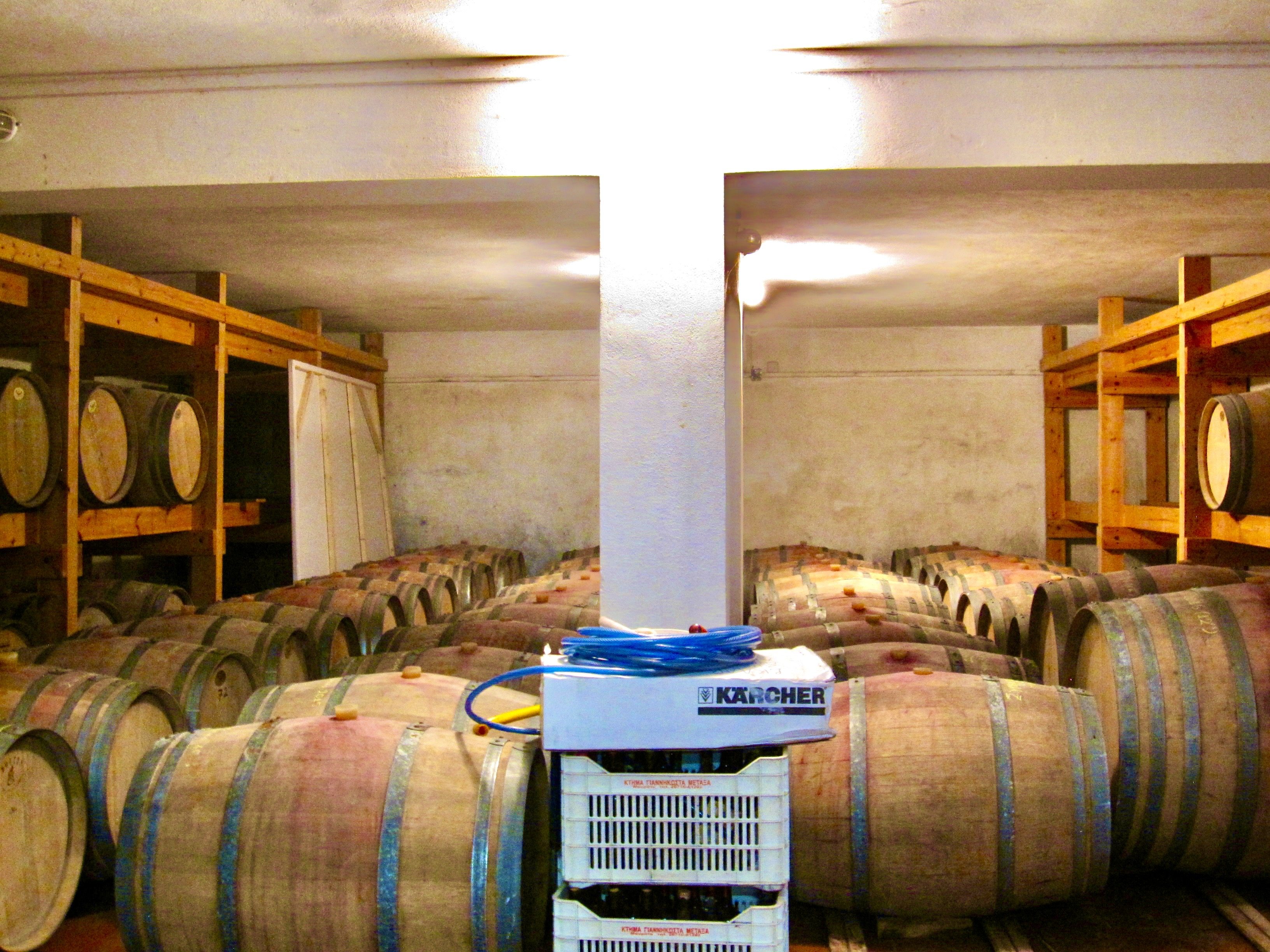
Winery: robola wine barels, Lixouri, Kephalonia. Photo: EV
All true. The wrath of tourism has yet to land in Kephalonia. Nature on mount Ainos is sometimes exquisite, delicate, beautiful:

Viola cephalonica is an endemic and perennial rare plant growing in the highest peak of Ainos. Photo: Courtesy Ainos National Park.
Dangerous tourism
The rest of the country is a tourist occupied country. According to the Greek reporter Tassoula Karaiskaki, tourism is threatening the historical and traditional culture of Greece, indeed, the very existence of the country. She says tourism in Greece “is growing exponentially,” thus becoming “a noose,” gnawing “away… everything that has kept Greece attractive through time.” She sums up the consequences of unregulated tourism:
“The historic centers of cities are being swept away by tourism and catering businesses and the constant spread of Airbnbs, which is transforming buildings into pseudo-modern accommodation complexes. The islands are being feverishly overdeveloped, exceeding their carrying capacity, overcrowded, with traffic jams, pollution, water shortages, and garbage… Short-term rentals, went from the occasional subletting of a residence to a full-fledged economic activity, while permits for new hotel units in vulnerable ecosystems are effortlessly being issued – 48 in [the Aegean island of] Milos alone. Do we want more than 41 million tourists? Many people live off tourism… turn a blind eye to the blatant deviations, the mafias, the thuggery, and ultimately the deterioration of the vaunted paradise. There is no direction, no measure – only a mass stampede on the road to the glittering accompaniments of immediate wealth.”
Karaiskaki is telling the truth. Too many tourists and the absence of the Greek state in planning and protecting the integrity of its society and natural world licenses abhorrent behavior and long-term adverse effects.
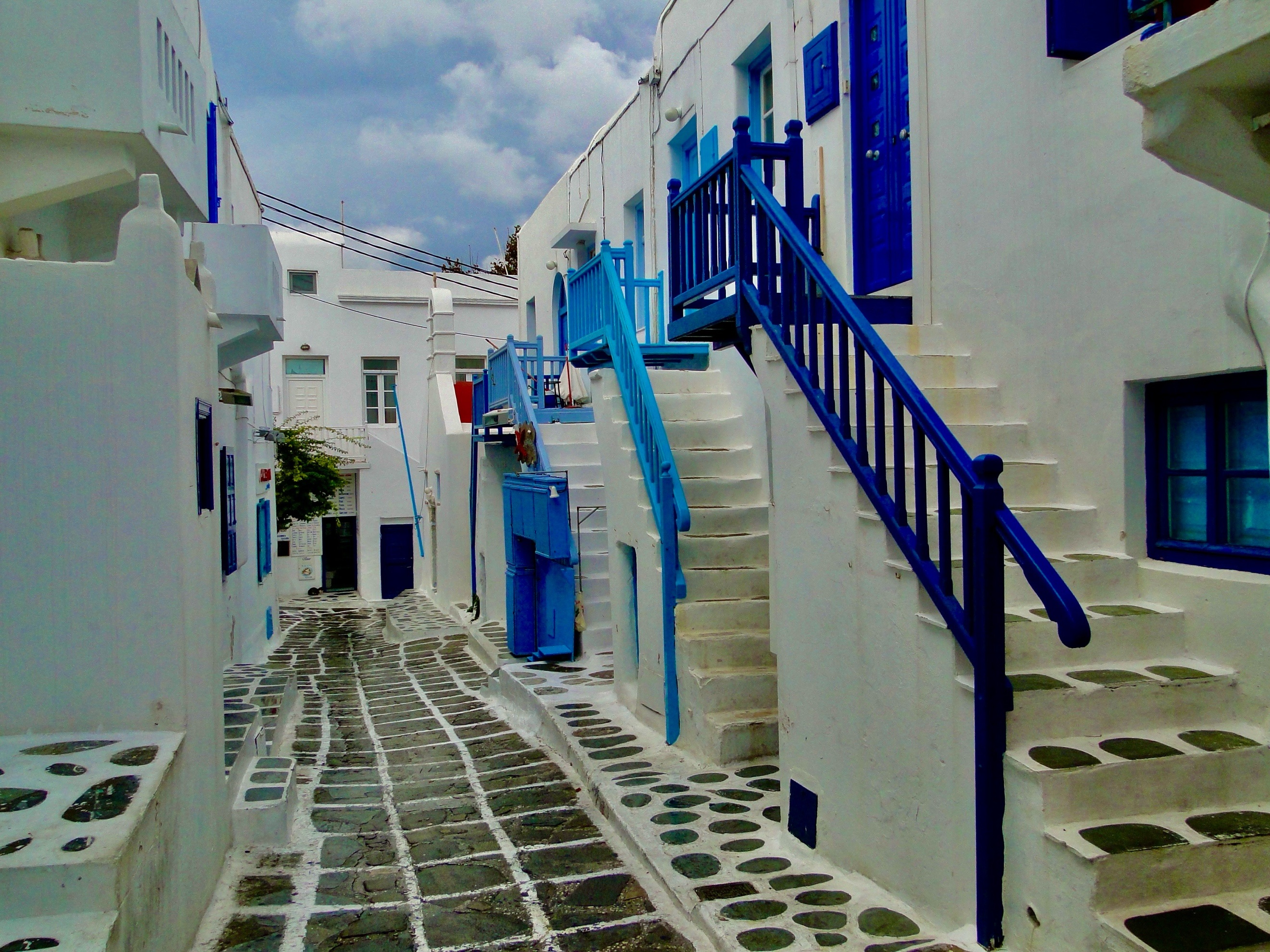
Beautiful houses in Mykonos threatened by too many tourists. Photo: Bernard Gagnon. Wikipedia Commons
Are the lenders of the Greek state responsible for this almost criminal behavior of the Greek government to allow the tourists to radically change Greece? The lenders, European Union and America’s International Monetary Fund, want Greece to repay all its loans, no matter the consequences. For more than 15 years, they treated Greece like an enemy, stripping the country of its sovereignty and assets, selling them to foreign countries. The trains that crashed on a head on collision in February 2023 near Tempe, Thessaly, were owned by an Italian company. The lenders are possibly the agents behind the apathy of the Greek state: ignoring the tourists and companies behind tourist development of Greece. Let them do as they please, earn more money from them and give the money to the lenders.
Karaiskaki bemoans the loss of local self-reliance, identity and talent to outsiders taking over tourist business. “The social characteristics of small places are changing,” she says, “they become other entities, personal, dynastic.”
Conclusion
Yes, dynastic. Extreme capitalism. Billionaires. Emerging feudalism.
In the midst of this tourist and political chaos there’s another unspoken downside of exponential and unregulated tourism. And that is the hidden war Turkey has been fighting against Greece. Exactly the same war the Ottoman ancestors of Turks fought for centuries against the Greeks before they captured Constantinople in 1453. But in 2025, just imagine the drastic effects of a sudden Turkish attack on a Greek island in the tourist season. The country will see the millions of tourists disappear. The economic and political effects of such an incident will probably explode in a full-scale war between Greece and Turkey. Avoiding such a possibility freezes Greece to accepting the humiliations of Turkey in the Aegean. The US, NATO and EU observe the silent hostilities of Turkey against Greece in the Aegean. They say and do nothing. In fact, they are strengthening Turkey with promises of possible huge contracts in the rearmament of the EU. So much for their knowledge of history, respect for the civilization they borrowed from Greece, credibility, trust and the rule of law they claim they uphold.
Time has come for Greece to wake up and act decisively. First, Greece must change government. The present government is unacceptable for its cowardliness and timidity and dependence on unreliable “allies.” The country needs leaders who love Greece. My hope is that Maria Karystianou, the courageous pediatrician mother who lost her daughter at the tragic train crash at Tempe, Thessaly, would become a candidate for prime minister. She led the 2025 national protest for the collision of the trains in 2023. She has a large following and trust among Greeks. She is a patriot. If she formed a government, it must strengthen the armed forces to the point of Greece regaining sovereignty of the Aegean and its borders. If NATO and EU keep supporting Turkey at the expense of Greek national security, Greece needs to find new allies. India and China would be in a position to help Greece to improve Greek national defense and facilitate the country’s energy transition to zero carbon economy. China could build factories in Greece for solar energy and electric cars.
Second, Greece must put a brake and stop unregulated tourism. Abolish all illegalities and issue rules for civilized behavior for local authorities and tourists. Resolve the needs for water and sanitation. Don’t allow more tourists on an island or the mainland if the infrastructure is not capable to provide sufficient water, healthy food and safe and enjoyable stay for the visitors.
Third, the new government must demand the money Germany owns the country from its murderous, destructive and starvation policies during its occupation of Greece, April 1941 – October 1944. Economists have calculated the German debt to Greece is about 1 trillion euros. Moreover, Germany must return the Greek archaeological treasures it looted in occupied Greece.
This is not an easy agenda for a new Greek government. But with love for Greece, it can be done. There are countries and millions of tourists who will side with Greece. Philhellenism triumphed during the Greek Revolution of 1821. It can blossom again in 2025. Greece is a cultural superpower. This explains the behavior of enemies like Germany and Turkey and antagonists like Britain always assisting Turkey. Greece can direct Philhellenism to change the British and NATO support for Turkey, which despises Western civilization. Turkey has never been a serious obstacle to Russia. So, the US should abandon jihadist Turkey and, in fact, the US and NATO ought to throw Turkey out of NATO.
Finally, the new Greek government, if it comes to power, should adopt autarkeia / self-reliance in food, manufacturing, energy from the Sun, and national defence.