
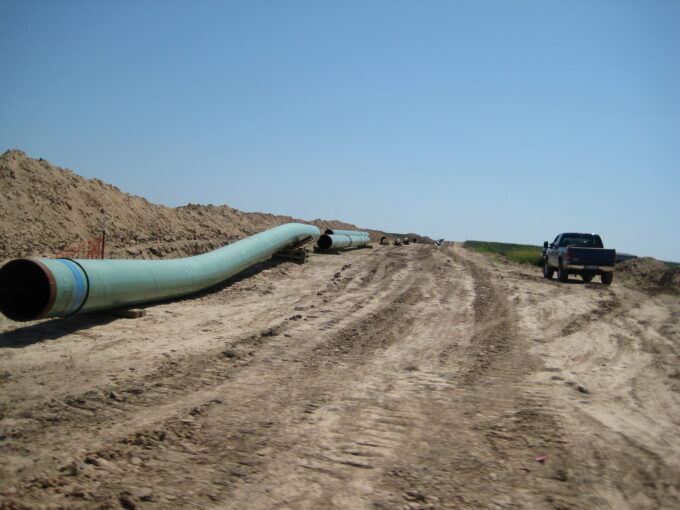
Pipes for the Keystone Pipeline. Photo: Shannon Patrick, Wikimedia. CC BY 2.0
The Senate is poised to vote on the misleadingly-named BAAJA (Bipartisan American Affordability and Jobs Act), billed as “permitting reform.” It’s not about affordability, and it’s not about jobs; instead, this bill is a sellout of public lands to corporate exploiters, larded up with loopholes for environmental requirements. It’s about creating loopholes to the federal protections for rare and imperiled wildlife under the Endangered Species Act, and for Indigenous sacred sites under the National Historic Preservation Act, while cutting the public out of their right to comment on industrial and commercial activities under the National Environmental Policy Act. This bill is the most dangerous frontal assault on commonsense safeguards for lands, wildlife, and cultural resources in a decade. That shouldn’t be surprising, being the product of a Republican Congress, with Mike Lee (R-UT) as one of the lead sponsors. Lee is justly famous as the most anti-environmental Senator, having introduced legislation to sell off public lands, lobbied President Trump to shrink Bears Ears National Monument, and later sponsored a bill that would eliminate the management plan for Bears Ears and block any similar management plan from being adopted ever again.
But what if Congress decided to undertake real permitting reform? So we got permitting where projects wouldn’t have major negative impacts on public lands and wildlife. So industrial users of public lands, if allowed at all, had to harmonize their activities with public values like conservation and healthy lands and abundant wildlife. So corporate exploiters could no longer run roughshod over the public interest. So the public’s influence on permitting decisions was strengthened, not undermined. If we had permitting reform that fundamentally transformed the way that public lands and resources got used by those who want to line their own pockets at public expense, we could finally limit any resource development to levels compatible with conservation and public enjoyment of public lands for a change. And we could create a sustainable path to transition from fossil fuels to renewable energy into the bargain. Here’s how.
In 1980, the Reagan administration finalized forest planning rules, which required the agency to maintain habitat for viable populations of native and desired non-native species, well-distributed throughout each National Forest. In 2012, the Obama administration unwisely limited this requirement to officially-designated “Species of Conservation Concern,” a new designation which the agency then dragged its feet to designate. Real permitting reform would restore the original species viability requirement, and apply it across all federal agencies, in cases where commercial or industrial activities are permitted.
The current permitting reform bill provides loopholes to Endangered Species Act protections, fast-tracking rare and declining plants and wildlife to extinction. There are few things the American public is more united behind than protecting imperiled wildlife, so this is clearly a sop to industries at the expense of the public interest. We propose a more workable solution that doesn’t throw endangered species under the bus.
In 1976, the Federal Land Policy and Management Act, or FLPMA, forbade the Secretary of Interior from allowing “unnecessary or undue degradation” to lands under its management. But Congress left the new requirement undefined, leaving the courts to guess at its meaning. At the same time, both the Bureau of Land Management and the U.S. Forest Service designated Sensitive Species that deserved extra conservation attention, but neglected to help these species beyond creating a list. Instead of granting loopholes for Endangered Species Act compliance, Congress should clear up the ambiguity by defining “unnecessary or undue degradation” as any agency-permitted activity that causes a significant negative impact to Sensitive Species or their habitats. This would help reverse species declines proactively, before Endangered Species Act thresholds are triggered, benefitting native wildlife (and the public interest in protecting and recovering them) and the ESA would be triggered less often as species recovered before they reach the brink of extinction.
One of the biggest problems with permitting of federal projects is that instead of federal agencies managing commercial and industrial uses to balance competing multiple uses (legally defined to include commercial uses, but also wildlife and fish, watersheds, cultural resources, and public recreation), the agencies tend to let the industry proposing the project call the tune. The result is that projects tend to be streamlined to maximize profits, and minimize protections for lands, wildlife, and local communities through waivers, exceptions, and modifications. As a result, public lands get managed first and foremost for private profit. The public has long noticed this imbalance in multiple uses, and is getting fed up.
Real permitting reform would take profit-making industries out of the driver’s seat, and require that all federal agencies put conservation and public values first, and allow commercial and industrial uses only to the extent that they are compatible with maintaining healthy public lands, and recovering damaged ones. Federal agencies would be required to conduct all environmental assessments and environmental impact statements, with no option for wealthy industries to hire contractors of their choice to design project management that weasels out of environmental protection standards. NEPA public participation processes, instead of being cut off, should be reformed so trade groups and local government officials that lobby behind the scenes for their interests get exactly the same input as the rest of the public, not a privileged position to allow back-room dealmaking, as presently happens through “cooperating agency status” and other forms of improper inside influence.
Real permitting reform would stop enabling agencies to rubber-stamp livestock grazing permits without any adjustments due to a congressionally-manufactured shortage of agency staff and federal funding. Federal agencies are now using a legal loophole that allows grazing leases to be renewed without any public process or environmental review, but only under the original terms. That blocks agencies from incorporating improvements or adjustments to protect wildlife habitats or sensitive resources. One analysis shows that federal agencies are disproportionately taking advantage of this loophole in the cases where adjustments are needed most: sensitive habitats most important for sage grouse, National Monuments where special management is needed, lands failing the most basic standards of land health due to excessive livestock grazing. A second analysis shows that federal agencies are chronically unable to monitor livestock grazing and the health of public lands rented out to livestock producers. Real permitting reform could solve both problems simultaneously by stripping the auto-renew provision from federal law while funding a level of range management staffing that can provide basic oversight and management on each livestock grazing allotment.
If Democrats in Congress really want to address the climate crisis, they should stop trying to ramrod industrial-scale renewables projects down the throats of local communities, and start promoting “distributed renewables,” which empower citizens and local businesses (rather than utility corporation profits). A distributed renewable future powers the nation through solar panels on every rooftop, shading ever parking lot, and shielding every major irrigation canal from evaporative water loss. It’s an elegant solution, where power generation happens in built environments that already lost their habitat value and agricultural potential. Massive wind farms and solar arrays can be controversial, killing eagles or wiping out desert tortoise habitats or shredding flocks of seabirds. That pits our renewable future against the equally-compelling need to solve the global biodiversity crisis, and enables backers of the fossil fuels industry a legitimate claim that renewable energy development isn’t really environmentally sustainable.
Let’s take that argument away by using permitting reform to shift renewables policy from large, potentially destructive projects on public lands or fertile farmlands to millions of rooftop photovoltaic arrays that generate the electricity right in the communities and industrial centers where it’s needed. The Inflation Reduction Act provided $9 billion in subsidies for this (despite its much greater focus on industrial-scale renewables), and there is no reason that the repeal of this funding under Trump’s One Big Beautiful Bill Act couldn’t be reversed, even increased many-fold, in a permitting reform package. That way, there is no need to subsidize massive, multi-billion-dollar transmission lines that require the use of eminent domain to cross private lands and trigger the ire of property rights activists. This approach would do much more to address the climate crisis, while minimizing controversy and local blowback.
Finally, let’s solve the permitting puzzle of permitting for data centers on public lands with the most decisive permitting reform of all: Congress should simply prohibit public land sales for for, or any permitting of, data centers on public land, full stop. Data centers are the projects of the wealthiest corporations in the world, and regardless of how citizens might feel about artificial intelligence or the massive electricity and water demands of data centers, I think we all can agree that Big Tech can afford to buy its own private lands if it wants to build data centers. And while we’re about it, permitting reform should specify that communities should not bear the burden of demands on scarce water or higher electrical bills where data centers are sited.
These are big ideas, and they deserve detailed consideration. There are assuredly other permitting reforms to further improve the management of federal projects, which would have the opportunity for thoughtful consideration, if Congress would only slow down and take a deliberate approach. Why is Congress stampeding to pass a corporate-promoted permitting reform package as rapidly as possible? The most democratic thing would be to simply wait a couple months, respecting the wave of public dissatistfaction with current governance, then start over with a permitting reform package that reflects the interests of the American public, instead of the interests of a handful of corporate interests profiteering off public lands and public resources.
Federal laws tend to last for decades, so it makes sense for every Member of Congress to take their time and get it right. And when Congress comes back into session next year, they will have all the time they need to take a step back, re-assess what federal permitting really ought to look like, and craft a package that actually advances the interests of the American people.


