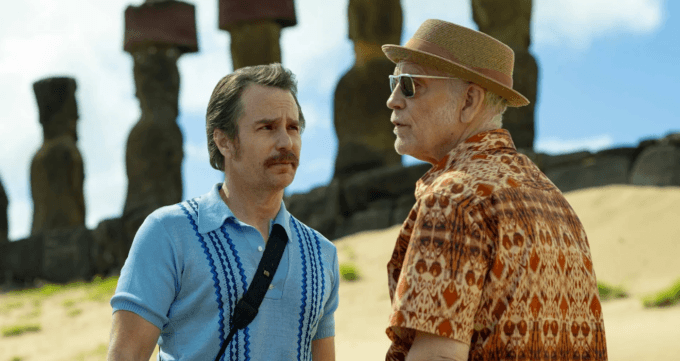
Still from Wild Horse Nine. Diego Araya Corvalán/Searchlight Pictures.
It was bucketing down as I passed the star-shaped Seven Dials in London’s West End, close to some of my old stomping grounds, including the Coach and Horses and the French House.
The cobbles were slippery, the rain relentless and everyone had their collars up. London was still being told to prepare, to stock up, although quite what for remained unclear. Then again, unclear is an anagram of nuclear. Friends were discussing a reported Gang of Eight intelligence briefing in Washington and the arrest in Gloucestershire of a senior American military figure on suspicion of spying for Russia. It seemed an appropriate atmosphere in which to be thinking about the CIA.
I was on my way to the Covent Garden Hotel for a screening of Martin McDonagh’s Wild Horse Nine. One of the trailers had been so good that I’d been sending it out to friends.
What I hadn’t anticipated was just how much more it would turn out to be than a dark comedy about two ageing CIA operatives confronting their past.
Yes, it is a political romp about espionage, American intervention and the peculiar moral universe inhabited by those who do terrible things in the name of something supposedly greater. But it is also an uncomfortable examination of regret and complicity, and the terrifying possibility that a lifetime spent serving powerful institutions might leave you with very little beyond a conscience that has finally caught up with you.
Some might think it gives too much emotional attention to those responsible for political violence rather than to those who suffered from it. The BFI (British Film Institute) raised this concern in Sight & Sound, including criticism of contrasting the assassination of Congolese leader Patrice Lumumba with that of JFK, but I thought the film so much more than that.
Without spoiling it, Wild Horse Nine is about what happens when people who have spent their lives exercising power in the name of a greater good are finally forced to confront what they have done.
Early on, Chris (John Malkovich) and Lee (Sam Rockwell) meet two young Chilean women, Monica and Alicia, at an airport. Though hilarious at times, the conversation becomes intolerable when Chris openly tells them that he works for the CIA, effectively boasting: “We came here to destabilise your democracy and it is going great.”
Lee, being Lee, immediately tries to distance himself from the admission.
We know that powerful countries interfere in other nations’ democratic processes while presenting themselves as defenders of freedom. By revisiting American involvement in Chile during the early 1970s, particularly the destabilisation of Salvador Allende’s government before the 1973 military coup, the film reminds us that foreign intervention has very real consequences for ordinary citizens. The Chilean characters are not simply there as a backdrop to an American spy adventure. Their country and their futures are at stake. The humour, if anything, makes it more uncomfortable.
As the film progresses, Chris and Lee’s conversations become increasingly philosophical. They even discuss, forgive any tonal whiplash, dinosaurs having souls and whether so-called terrible people can enter heaven. As Chris confronts his past, the comfortable assumptions that have sustained him become harder and harder to defend.
The really difficult question is whether recognising the evil of your actions means anything if you can never undo them.
There is wonderful humour along the way. At one point, Chris contrives an outrageous connection between American cheese, homosexuality and American failure. His voice is that of a man perpetually on the edge of a cough, with never quite enough air to fill his lungs.
One of his lines is: “You only have to taste American cheeses once to understand why we lost Vietnam.”
But beneath the farcical humour is a sustained assault on American confidence, nationalism and the belief that America is always right. Through a pair of IRA references, the Brits don’t come out particularly well on a couple of occasions either.
London-born Martin McDonagh is very good at using comedy to make audiences question political and cultural assumptions. He gives rather than takes away—the opposite of a pickpocket, he is forever slipping us things.
Monica becomes particularly important as Chris’s moral unease develops. She challenges his dishonesty and encourages him to do something specific about it. Later, he warns her about the dangers she faces and tells her not to surrender if she is ever threatened. For perhaps the first time, Chris starts to think about protecting someone rather than controlling or destroying them.
The final sunlit moments between Chris and Lee bring these themes together beautifully. I will only say that in the closing voiceover Chris arrives at a remarkably simple conclusion.
As I left the screening, I have to say my head was abuzz with the film’s fascinating questions about power, responsibility and the extraordinary capacity of people to convince themselves that what they are doing is okay.
Perhaps that is the real sting. Wild Horse Nine is about the human cost of believing that the ends always justify the means, and the possibility that by the time conscience finally catches up with you, there is precious little left to put right.