
Photograph by Nathaniel St. Clair
The postmodern thought creeps up on you the way it crept up on the prophet Bob Marley: You feel like bombing a church / now that you know the preacher is lyin. Our all-watching God was a tyrant who liked to bet with Satan on his total control of his human subjects. He loved Man the way Netanyahu loves democracy.
Depending on which version you trust, here’s how it went. Something rubbed God the wrong way, and his best bud Satan was defenestrated from Heaven. On his way to Hell, he got his payback by desecrating the stained-glass perfection that was Eden. He seduced Eve at the Tree of Knowledge of Good and Evil and impregnated her with Cain. She covered the apostasy by sexing up Adam. An outraged Yahweh exiled them, too, doomed to the travails of history and the tortures of moral choice for millennia. Cain, the first humanoid child, was born, followed by Abel, the first all-human one. Cain killed Abel in a fit of jealousy over the Lord’s love for him and was exiled to the land of Nod, east of Eden. We have no descendants from Abel. Only from the convict Cain and the third son, Seth, a mediocrity.
Stripped down, the Cain and Abel story says thou shalt not kill thy brother. We discover too late that we need each other to thrive, and that not killing, when we could, is the first big step toward civilization and reality negotiated by way of language. One tradition puts the first murder in a cave on a mountain above Damascus. Today, less than two hundred miles away from that spot, Cain and Abel are at it like never before: two Semitic peoples in mortal combat, and only one of them gets to define antisemitism.
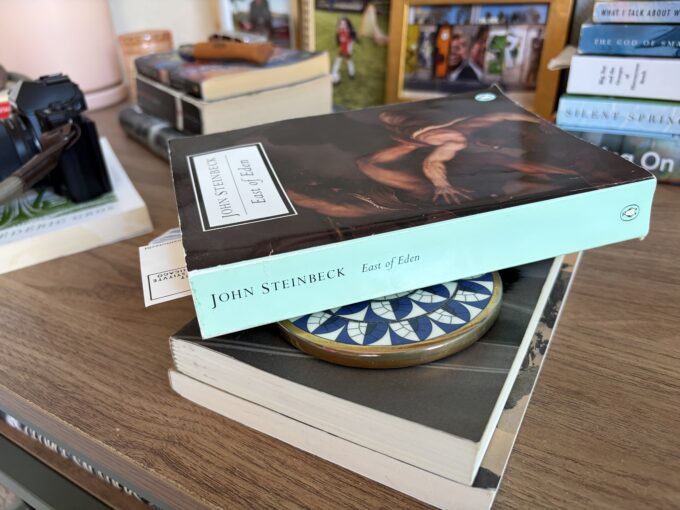
Now Netflix has a seven-part East of Eden, from the novel by John Steinbeck, who came from proto-Christian Zionist stock. In the 1850s, his grandfather went to farm the Holy Land with a colony of Christian millennialists, and the survivors came home after raiders murdered his brother. Think West Bank. The series is an intergenerational retelling of Cain and Abel, and a reanimation of the fabled curse of evil Woman. Brothers shouldn’t kill each other. And females should not fuck up love by letting every busy little drone bee with a stinger open up her tender, wet, rosy leaves of love.
The series opens on such a woman beaten nearly to death in the pursuit of her whoresome ways. Meet Cathy, who will soon clown Adam and extract his desire and will to live. He nurses her back to health, and she ends up shooting him (the look of surprise — wah!) to get away from motherhood and the nuclear wasteland of marriage and its drudgery.
Steinbeck had a name for what she is. His eighth chapter opens on the proposition that there are monsters born in the world to human parents. Some arrive with a tail or a third arm. Others arrive with a lovely face and something missing behind it. Steinbeck named his second kind Cathy Ames, and Zoe Kazan has built seven hours of prestige television around her.
All seven episodes dropped on October 1. Kazan created and wrote the series, with Jeb Stuart as co-showrunner and the novelist Alexander Chee sharing the script for episode 5. Garth Davis directed the first four episodes and Laure de Clermont-Tonnerre the last three. Florence Pugh, also an executive producer, plays Cathy. Christopher Abbott and Mike Faist are the half-brothers Adam and Charles Trask, Tracy Letts is their father Cyrus, Ciarán Hinds is the neighbor Samuel Hamilton, and Hoon Lee is Lee. Joseph Zada and Joe Anders play the next pair of brothers, Cal and Aron. Within days it sat at the top of Netflix’s global chart.
Most of us know the shape of the story, or used to. Two generations of brothers reenact Cain and Abel in California’s Salinas Valley, and Steinbeck hangs the whole contraption on a single Hebrew verb, timshel, thou mayest. The surprise is where Kazan puts the weight. Her series belongs to the monster.
That choice has a warrant in the book. In chapter 17, Steinbeck’s narrator stops and admits he is no longer sure Cathy was a monster at all. Calling her bad, he says, means little unless we know why. Kazan takes that doubt and builds a series on it. My question is what the rest of Steinbeck’s Eden loses to make room for her, and whether thou mayest can survive seven hours in the company of a woman the story says was born without a conscience. The delivery system adds its own joke: a parable about free will, served up by a recommendation engine whose entire business is predicting what you’ll choose next.
Cathy, Kate, Catherine
Pugh plays Cathy as a reader of people. She studies what each victim wants and hands it over until the victim belongs to her. Faye, the madam Martha Plimpton plays with sentimental warmth, ought to feel the evil walking into her house, the way we sometimes do. Bette Davis’s Margo Channing felt it in All About Eve, and she had Thelma Ritter’s Birdie to say it out loud. Faye has no Birdie. Cathy offers her security, a daughter and company, and Faye falls because the woman says the right things. Steinbeck’s Faye falls the same way, naming Kate her heir shortly before Kate poisons her.
The method is the horror. Cathy turns her victims’ humanity against itself, and in doing so shows how fragile that humanity is. Today we’d call her a psychopath and point to the gap between cognitive empathy, which she has in abundance, and affective empathy, which she lacks entirely. Steinbeck said much the same in 1952, describing a child born without kindness or the potential of conscience. The clinical label renames the birth defect and leaves the claim intact. Call her the genital monster: sex is the tool she works with, and the men of Salinas keep bringing it to her.
Kazan complicates the birth story without retracting it. Episode 2 gives Cathy a childhood of sexual abuse. In episode 5 she tells Adam that her Latin teacher, Mr. Grew, wanted her when she was a child. Steinbeck’s own facts allow that reading. She is fourteen, he is a grown man who washed out of divinity school, and he ends by shooting himself in front of the altar. The narrator, though, presents her as the one who acted, and shows her planting a rumor afterward to cover her tracks. The series leaves us to decide whether to believe a manipulator’s account of her own victimhood. That is the honest choice, and it is also where the series stalls.
The reunion in episode 5, after Samuel’s funeral, is the best scene in the series and the clearest statement of Cathy’s theology. She pulls out her envelopes of flash-powder photographs: a senator, a councilman, a Berkeley professor, a doctor, a judge, a minister. (Steinbeck’s list has a rancher where Kazan put the doctor and the judge.) Her point is that everyone is a liar and she has the pictures to prove it. Kate is a Calvinist with a camera, proving total depravity one envelope at a time. Adam’s answer stays close to Steinbeck’s: what she hates in those men is the good in them she can’t get at. Then he walks out free.
The novel’s real answer to Cathy comes later, from her son. In chapter 39 Cal goes to her house afraid he has her in him, and leaves having decided that if he’s mean, it’s his own mean. He tells her he’s glad she’s afraid.
Episode 7 is about madness and death, and Kazan stages Cathy’s end as a mind caught out by a conscience it was never supposed to have. In the novel the pressures pile up: arthritic hands, fear of what a discarded whore named Ethel knows about Faye’s death, and Aron’s recoil when he finally sees his mother. She swallows the capsule she has worn on a chain around her neck, saying “Eat me,” like Alice. Her will leaves everything to Aron, and she signs it “Catherine Trask.” After a lifetime of aliases, she dies under her married name.
The bequest is payback, whether or not she thought it through. Adam refused Cal’s money because it came from the war. Cathy forces her money on Aron, and it comes from the brothel. Each parent wounds a twin with cash.
The other women get less room. In the novel Abra is Cathy’s counterweight. Her father is an embezzler, she tells Cal she carries his blood the way Cal carries his mother’s, and she fears that Aron loves a girl he made up. Kazan turns Mr. Bacon into one of Kate’s customers, which keeps the dirt and loses Abra’s inheritance. Liza Hamilton barely appears. Dessie is gone.
So here is the complaint. With Cathy at the center for seven hours, this becomes a study in evil, and a familiar one. The complicated female monster is a streaming genre now. Mike Flanagan’s Carrie lit up on Prime Video six days after this series, pitched as a story about whether we’re watching a hero or a monster. Centering Cathy also risks restoring the oldest reading of Genesis, with the woman as the family’s fall. I’d like to blame the studio, but the evidence points at Kazan. Kazan has been open that Cathy is her main interest, Pugh has been attached as star and producer since the project was announced in 2022, and Netflix’s one documented intervention went the other way: it added an episode for Faist’s Charles. Chapter 17 gives Kazan the right to try. The fair complaint is about proportion, and the Hamiltons pay the bill.
Thou Shalt, Do Thou, Thou Mayest
Steinbeck tells the Cain and Abel story twice, and Kazan keeps both tellings. Cyrus Trask, a fraud who built a career out of a war he barely saw, prefers Adam’s birthday gift, a mongrel pup from the woodlot, to Charles’s store-bought knife. Charles beats Adam bloody for it. A generation later Adam, now on the draft board, refuses Cal’s $15,000 in bean profits, because he sends boys to the war and can’t take a profit on them. Each time the father prefers one offering and gives no good reason, which is how Genesis tells it. God accepts Abel’s lamb, rejects Cain’s grain and never says why. A skeptic could say God behaves more like Cain than Abel in that story: jealous by his own account, arbitrary in his favor, and quick to protect the murderer with a mark.
Steinbeck wrote the pattern into the names and wanted us to notice. The C’s and A’s alternate down the generations: Charles and Adam, Cathy and Adam, Cal and Aron, with Abra waiting at the end. When the twins are named, Samuel likes Aaron but remembers that Aaron never reached the Promised Land. Years later Cal tells his mother that Caleb did. The Torah supplies the ending in advance. Caleb crosses the Jordan, and Aaron dies on Mount Hor. Aaron also made the golden calf, which suits a boy who wants to be a priest and can’t bear an impure world. Cyrus, for his part, carries the name of the Persian king who sent the exiles home.
The title points the same way. In Genesis the cherubim guard the east side of the garden, and Cain goes out to the land of Nod, east of Eden. Nod is a pun on the curse: God sentences Cain to be na va-nad, a fugitive and a wanderer, and the land is named for the wandering. There Cain builds the first city. Samuel says it plainly in the novel: Abel died childless, so we are all Cain’s children. American settlement ran that map backward. The fallen came out of the East with Cain riding in the Conestoga, fought the Indian Wars for the land, and brought along the parasites Scorsese put on screen in Killers of the Flower Moon. Then they built their cities in the garden.
The rabbis read the beginning as a split, too. The Hebrew tsela, translated “rib,” means “side” elsewhere in the Bible, and Genesis Rabbah has the first human created double and then sawn apart. Steinbeck keeps re-splitting that one being. Adam and Cathy are mirror images: she sees only the ugliness in people, and he saw only the good. “The wife I had, I made up,” Adam tells Lee in episode 5. Steinbeck gave a version of that line to Lee himself, and gave Abra the fear that Aron loves a girl he invented.
The timshel scene in episode 5 follows the novel closely, with one cut. In Steinbeck, Lee takes Genesis 4:7 to four elderly scholars of his family association in San Francisco. The old men hire a rabbi, learn Hebrew with brush and ink, outpace the rabbi so badly that he brings in a colleague, and after two years arrive at “thou mayest.” The series keeps the Jewish scholars and drops the old Chinese men, which costs it the novel’s strangest image. Samuel then gives Adam his “medicine,” the news that Cathy runs a whorehouse in Salinas. The series sums up the moment as “out of knowledge comes choice.” Steinbeck’s Samuel says he exercised the choice himself by telling.
The word itself wobbles. The form in Genesis 4:7 is timshol, so Steinbeck’s spelling is wrong, and the Hebrew imperfect can carry future, command or permission. “Thou shalt,” “do thou” and “thou mayest” are all defensible. But 4:7 echoes 3:16 almost word for word, where God tells Eve her desire shall be to her husband and he shall rule over her, and nobody reads that verse as permission. Read side by side, “thou mayest” is the weakest of the three. Steinbeck built his gospel of free will on a translator’s choice, which may be the purest demonstration of timshel ever printed. Jerome made a similar call when his Vulgate gave Moses horns coming down from Sinai, and Michelangelo carved them in marble. The word you choose becomes the world people see.
Nietzsche, a philologist before he was anything else, went back to origins mainly to show how little they govern what comes later. Lee went back to the Hebrew and came out with an American idea. A skeptic would push further and say Eden offered no real choice at all. Adam and Eve had no knowledge of good and evil, so they couldn’t know the fruit was wrong. In Nietzsche’s version, choosing begins only after the madman announces that we have killed God.
Not in San Francisco
Lee is the series’ best expansion, and episode 5, the one Chee co-wrote, is its best hour. Hoon Lee plays him as the smartest man in every room, performing pidgin for people like Mrs. Bacon, who informs Adam that “the Chinaman’s no substitute for mother.” Steinbeck’s Lee explains the act to Samuel early on: pidgin is what white listeners expect, so pidgin is what they hear. Samuel calls Lee’s queue a badge of slavery imposed by the Manchus. By the time Lee brings home the Hebrew, the queue is gone.
The series moves Lee’s birth story. In the novel he tells it to Adam alone, late at night after Samuel’s death, and admits he never told Samuel. Kazan gives it to the boys as part of an argument for telling them the truth about their own mother, using his father’s line about the dreadful beauty of the truth. The story itself is the same. Lee’s mother disguised herself as a man to stay with his father on a crew blasting railroad tunnels through the Sierra. When she went into labor, the men discovered her and attacked her, and she died on the shale after Lee’s father cut the baby out of her.
Steinbeck uses Lee to make the exclusion argument himself. The men were imported only to work, and only men were brought, because the country didn’t want them breeding. When the work was done, the survivors were to be shipped back. Lee’s father planned to pay for the escape by signing on for five more years. The word for that is indenture.
Then the series adds a scene Steinbeck never wrote. Lee goes to San Francisco to start his bookstore, and a real estate agent tells him he can’t rent in certain parts of the city because he is Chinese. “I am American,” Lee says. “Not in San Francisco,” the agent answers. The agent was wrong in law. In United States v. Wong Kim Ark (1898), the Supreme Court held that a man born in San Francisco to Chinese parents was a citizen by birth. The Chinese Exclusion Act was still on the books, and stayed there until 1943. In the famous photograph of the golden spike at Promontory in 1869, the Chinese crews who built most of the Central Pacific are nowhere in the frame. Steinbeck’s Lee, studying Hebrew with the old men, wanted for the first time in his life to be Chinese. Kazan’s Lee claims America and gets turned away at the door. It’s the same fight as the one at the top of this review, over who gets to define the word. In San Francisco, the man holding the keys defined American.
A young Chinese man in the city tells Lee he has been someone else’s imaginary wife, a hard verdict on years of raising another man’s sons. Lee goes home anyway. “I’ve never been so goddamn happy to be home in my life,” he tells Adam, fusing two lines Steinbeck gave him. In the novel he comes back after six days because he’s lonely, and nobody has turned him away. Kazan makes the return chosen and forced at once. Robert Frost covered both halves in “The Death of the Hired Man.” The farmer Warren says it one way:
Home is the place where, when you have to go there,
They have to take you in.
His wife Mary answers that she would have called it “something you somehow haven’t to deserve.” The Trask boys are the only people in this story who give Lee that.
Then there’s the ice. Episode 6 takes its title, “The Great Try,” from Steinbeck’s phrase for Adam’s venture. Over Cathy at last, and caught up in an age of invention, Adam sinks his fortune into an ice plant and ships Salinas lettuce east, packed in ice, to sell in New York in the middle of winter. In the novel a snow slide closes the Sierras, and the six cars sit on a siding dripping their ice away. Delays in Chicago finish the job, and New York receives what Steinbeck calls slop. The lettuce rotted in the same mountains where Lee’s mother died. America shipped its appetite east over Chinese graves. Adam’s idea was sound, and the valley later grew rich on iced lettuce. He only had the timing wrong.
The Mark of Kazan
Zoe Kazan is adapting a story her grandfather filmed. Elia Kazan’s 1955 East of Eden, James Dean’s first starring role, takes only the last quarter of the novel. It has no Lee, Burl Ives plays a sheriff named Sam where Samuel Hamilton should be, and the word timshel is never spoken. Elia made a film about a son starving for a cold father’s love. His granddaughter told Time she thinks he was projecting his own “cold and demanding father” onto Cal. Zoe has made a series about a mother who walks out, and she restores the three things her grandfather cut: Lee, Samuel and the word. Call it the mark of Kazan, the second generation reading the first one’s story back and choosing differently.
The Kazans had their own migration story, and Elia filmed it in 1963. America America opens with his voice over the Anatolian mountains: “My name is Elia Kazan. I am a Greek by blood, a Turk by birth, and an American because my uncle made a journey.” The uncle becomes Stavros in the film, and he gets past Ellis Island only because an Armenian friend jumps from the ship and leaves him his papers. An inspector renames him Joe Arness, and he works off the dead man’s debt shining shoes.
The Steinbecks had one too, and it ran through the Holy Land. In 1853 Protestant millennialists from Prussia and Massachusetts founded a farm called Mount Hope near Jaffa. Among them were two brothers named Großsteinbeck, married to two Dickson sisters from Groton. On January 11, 1858, local men attacked the farm, murdered Friedrich Großsteinbeck, and raped his wife and her mother. That June the survivors sailed for America, and Johann Adolf Großsteinbeck, the novelist’s grandfather, shortened his name. Steinbeck’s family went east to plant a garden in the Promised Land, was driven out by violence, and came west. He said he wrote East of Eden for his two young sons, and he wrote his family into it. In chapter 31 Adam calls at Ernest and Olive Steinbeck’s house in Salinas, and a little boy named John peeks around his mother at the father of the story.
Kazan cuts that boy, along with most of the Hamiltons, and the series loses its balance. Samuel’s children gave Steinbeck a control group: the same valley, the same years, no monster at the center, and choices just as hard. Tom Hamilton doses his sister Dessie with salts for a stomach pain that kills her, then kills himself. He is a man destroyed by too much conscience, set against a woman with none. Will Hamilton, the son who made money, is Cal’s partner in the bean deal, selling to the British Purchasing Agency at wartime prices.
Follow the money and it is all dirty, which Steinbeck knew. Late in the book Lee muses that Adam, the most honest man alive, lived all his life on stolen money, and that Aron will live on a whorehouse’s profits. The chain is concrete. Cyrus stole from the Grand Army of the Republic, and the series shows Adam looking away. His fortune went to his sons. Charles’s will left half of his estate to Cathy, who banked it in her safe-deposit box, and her will passed it to Aron. Cal’s beans profit from the war, and in the novel Abra’s father embezzles from his company. The only clean people are the Hamiltons, and they’re poor. In chapter 51 Steinbeck burns two things: the sheriff burns Kate’s photographs, and Cal burns his bean money.
One more inheritance belongs here. Elia Kazan named names before the House Un-American Activities Committee in April 1952, five months before the novel appeared. That January, Steinbeck had written to CIA Director Walter Bedell Smith offering his help on a trip to Europe, and Smith had replied that he could help by keeping his eyes and ears open. A novel about betrayed brothers and the freedom to choose came out the year its author offered to inform and its future director informed.
Thou Mayest
Kazan titles her finale “Timshel” and restores the word her grandfather left out. In the novel Adam lies paralyzed after the telegram about Aron, and Lee begs him to bless Cal and set him free. Adam whispers the one word.
The word works as an American creed, and every family in this review lived by it. Kazantzoglou became Kazan, Großsteinbeck became Steinbeck, Stavros became Joe Arness, and Cathy Ames became Kate Albey before she died as Catherine Trask. A new name is a claim that you may become someone other than the person you were born as. That is timshel in practice, and the country never handed it out to everyone. Lee says he is American and is told he isn’t, at least in San Francisco. Steinbeck’s own first chapter dismisses the valley’s Indians as an inferior breed before calling the Spaniards greedy and the Americans greedier still. Thou mayest, for some, and the some write the definitions.
Nothing in this story is the way it seems, and the freedom to choose begins with breaking the illusion. Adam can’t choose until he admits he invented his wife. Cal can’t until he sees his mother and decides her meanness belongs to her. The purists don’t survive the sight. Aron goes to France and dies, and Cathy swallows her capsule. The mixed ones live: Cal, Lee and Abra, people who know what they’re made of and get up anyway.
That is as much as Steinbeck has to offer, and it’s a great deal. Timshel is a philosophy for the impure majority who still have to do the chores. Truth and purity don’t get the newspaper delivered in the morning.


