President Donald Trump and his Republican followers publicly campaign against mail-in voting, claiming it leads to massive fraud. In August 2020, Trump called mail-in voting “fraudulent” in a speech before the Council for National Policy. But he openly admitted his motivation when he posted on X in March 2020 that, because of expanded voting, “They [Democrats who won elections] had levels of voting, that if you ever agreed to it, you’d never have a Republican elected in this country again.”
Before we dive into why his obsession with eliminating mail-in balloting could cause Republicans to lose more votes than Democrats, let’s first look at how baseless his claims of voter fraud are.
Trump’s claims of voter fraud run into a wall of facts.
Trump has never revealed any reliable source, other than conspiracy-focused podcasters who also do not provide any supporting data. He has repeatedly claimed that millions of people illegally cast ballots in the 2016 presidential election, often accusing illegal immigrants of doing so.
The problem he and others face is that there is no single, comprehensive national database that records how many fraudulent mail ballots were cast in every U.S. election. However, studies and election investigations provide useful estimates of how often documented fraud occurs, yet news sources like Fox News rarely cite them.
According to MIT Election Lab reports, approximately 29% of voters cast ballots by mail in 2024. Consequently, the data below indicate that the number of fraudulent ballot cases is negligible.
A November 2025 Brookings Institution analysis estimated about 4 cases per 10 million mail ballots across the 2016, 2018, 2020, and 2022 general elections.
The conservative Heritage Foundation maintains a database of documented election-fraud cases but acknowledges that it is not comprehensive and does not include all cases or final convictions. However, Brookings used that database, along with multiple data sources, to calculate the national rate in its analysis.
A Washington Post analysis, cited by the Brennan Center, identified 372 possible cases of double voting or voting on behalf of deceased people among about 14.6 million voters in three vote-at-home states—about 25 cases per million voters. These were possible cases, not 372 proven instances of mail-ballot fraud.
In other words, the President of the United States is spreading a conspiracy theory based on a handful of isolated instances; collectively, they have not even approached 1% of the total votes cast being illegal. Using the power of the presidency, Trump has undermined our citizens’ faith in a democracy grounded in fair elections.
The result is inciting mobs to physically attack the institutions and processes that run elections, which are seen as corrupt. This includes halting the confirmation of presidential election results, a process that has enabled a peaceful transfer of power for over 200 years.
Suppressing voting is based on the myth that high voter turnout favors Democrats.
President Donald Trump and his Republican Party have embraced the goal of lowering voter turnout to prevent Democrats from winning elections. History contradicts that claim.
From 1980 to 2024, in the 12 presidential elections, more than 50% of the voting-eligible population (EVP) voted. Only four exceeded 60%, with wins split evenly between two Democrats and two Republicans. Among races with EVP turnout between 55% and 60%, Republicans won three and Democrats won two.
In other words, getting more people to vote doesn’t guarantee the Democrats will win. Surprisingly, Republicans have done better! The data below proves it.
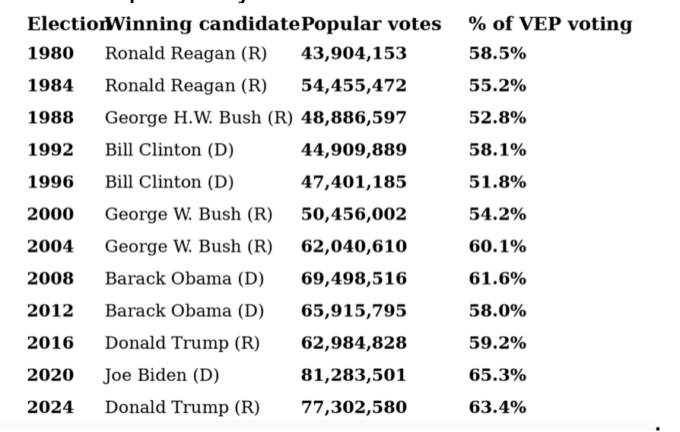
Apparently, Trump advisors didn’t show him these stats. So, Trump lives in a world where his beliefs become his reality and his compulsion to repeat America’s darkest moment. This November’s general election marks the first time since Reconstruction after the Civil War that the federal government has used tactics to discourage, rather than encourage, citizens from voting. During Reconstruction, all former black slaves became citizens, and then they were systematically, legally disenfranchised from voting through laws that suppressed their voting. Today, Trump’s voter suppression efforts do not break the law; he intends them to become the law.
Trump’s orders to dismantle Mail-In Voting will reduce turnout among seniors and rural voters – two of Republicans’ strongest bases.
Trump directed the U.S. Postal Service to block delivery of mail ballots to voters not on a list pre-submitted by state election officials, but the Supreme Court temporarily blocked the order until after the November 3 elections. If it had remained in force, it would have created the perception, if not the reality, of a burden and discouraged turnout among senior and rural voters in this November’s election.
Trump’s narcissism blinds him to the fact that banning or severely restricting mail-in voting will drive down voter turnout among these two Republican-leaning groups.
Senior Voting
Voters ages 65 and older were most likely to vote by mail. Mailed ballots accounted for almost 40% of votes cast by this group in 2024 and 44% in 2022. In 2020, exit polls showed that an overwhelming 56 percent of voters ages 50-64 voted for Trump, while 43 percent voted for Harris.
Among those 65 and older, the vote was split, but seniors still voted: 72% of registered seniors (65 and older) voted, compared with the national average of 62% across all age groups. This means that if seniors cannot mail in their votes, they may need motivation to make the extra effort to get to the voting booth.
However, Democrats are more motivated to vote than Republicans. The Pew Research Center found that Republican voters who are disaffected with their party are less motivated to vote than Democrats who feel that way about their party. The study found that only 36% of Trump voters with an unfavorable view of the GOP say the outcome this November really matters. By comparison, 65% of Harris voters with a negative view of the Democratic Party say it does.
Rural voters
Rural voters are another largely Republican constituency. The Pew Research Center reported that 69% of validated voters who described their communities as rural voted for Donald Trump in 2024, compared with 29% for Kamala Harris. This report was based on a survey-based estimate, not a calculation from county election returns. However, it is probably more accurate than measuring only rural county votes, because 18.6 million Americans live in rural counties, while 59.3 million live in rural tracts and face similar problems.
Given that Republicans have done better than Democrats in capturing a larger share of the white population, rural voters are also more likely to vote for them. In half of all rural counties, more than 92% of the population is white, less than 1% of the Citizen Voting Age Population (CVAP) is Black, and less than 2% of the CVAP is Hispanic.
When voting in person, rural voters generally must travel farther to cast their ballots. 50% of urban polling places serve areas of less than 2 square miles, whereas rural county polling places serve larger areas, up to 62 square miles in some rural counties. Consequently, eliminating or making mail-in voting harder to use would make rural voters less likely to vote.
That assumption is supported by the fact that turnout among voters in rural counties that did not require an excuse to vote by mail in 2020 was nearly 8 percent higher than in rural counties that required a qualifying reason to vote by mail.
Restrictions on Mail-In Voting could tilt tight Senate races to the Democrats.
By restricting mail-in voting in contested Senate races, Trump ironically lowers the chances of Republican victories. The percentages of senior and rural voters in the mail-in voting states with the tightest races are listed below.
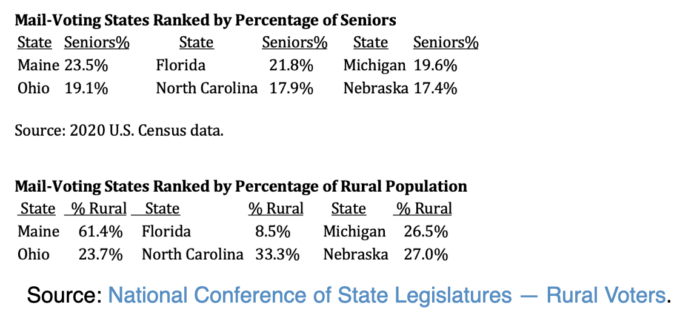
With low Republican turnout, a 10% drop in registered senior voters would align with the average turnout rate for all voters. That drop alone could secure a Democratic victory.
The same dynamic would apply to rural Republican voters in the listed states. Although a drop in Florida would be insignificant, Republican candidates in the other states depend more on rural than senior mail-in voting. That’s because, in each of these states, rural voters are more likely than seniors to vote by mail.
SCOTUS could kill mail-in voting after this November.
In a major win against unsubstantiated fears of fraudulent voting, the U.S. Supreme Court (SCOTUS) upheld an injunction that prevented the U.S. Postal Service (USPS) from significantly restricting mail voting. The majority wrote that the Trump administration was “unlikely to succeed on the merits of its challenge” to the lower court order that blocked Trump from enacting his March 2026 executive order.
Trump would have required states to provide the USPS with a list of voters who have submitted proof of citizenship and identity data to the Secretary of Homeland Security (SHS). SHS is the U.S. agency currently in charge of ICE. Without SHS approval, all citizens not approved would be ineligible to vote by mail or by absentee ballot transmitted via the USPS.
SCOTUS left a major opening for Trump and the Republican Party to pursue this effort. The Supreme Court’s order only delayed the plan’s application to the upcoming midterms. The lower court that initially stopped it can now continue to hear arguments, and appeals will proceed through the court system until they reach SCOTUS.
However, to date, lower courts have sided with two dozen states and the voting rights groups that oppose this plan. Nevertheless, three of the Supreme Court Justices already favor or lean toward supporting Trump’s plan.
Democrats can stop this threat if they become the majority in Congress.
Another way to halt this proposal is for Congress to pass legislation banning it. The current Senate and House races will determine whether Congress acts. If Democrats win a majority in both Houses, they could stop this political infringement on our Constitutionally designed nonpartisan voting process. If Republicans remain in control of Congress, this debate will be decided by the courts, where six ultra-conservative SCOTUS Justices will decide its fate.
Consequently, in tight Senate and House races, Democrats need to connect the dots between restricting mail-in voting and the loss of their state’s authority to manage elections, as guaranteed by the Constitution. If voters wish to preserve their current ease of voting, they should support candidates who will protect that right in Congress.